
All About The Monroe Doctrine: Historical Significance

Why The Monroe Doctrine Still Matters
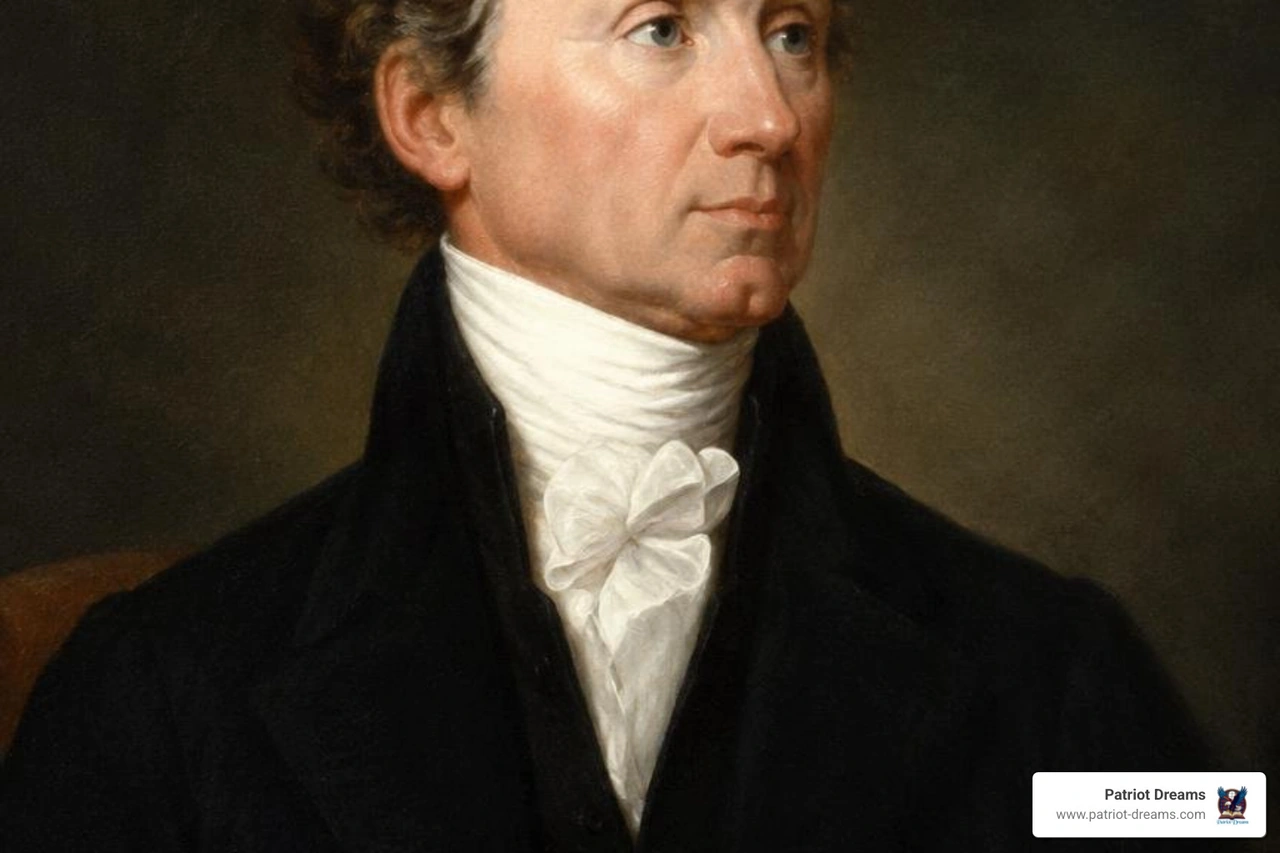
The Monroe Doctrine was an 1823 U.S. foreign-policy statement that warned European powers not to create new colonies or interfere with independent nations in the Americas. It set out three lasting ideas: the Americas and Europe should remain separate political spheres, Europe should not colonize further in the Western Hemisphere, and the United States would generally stay out of Europe's wars.
President James Monroe delivered the policy in his annual message to Congress on December 2, 1823. At the time, newly independent Latin American republics faced the risk of renewed European control, while Russia was expanding southward from Alaska. The United States lacked the power to enforce its warning alone, yet the declaration became a major marker in American diplomacy.
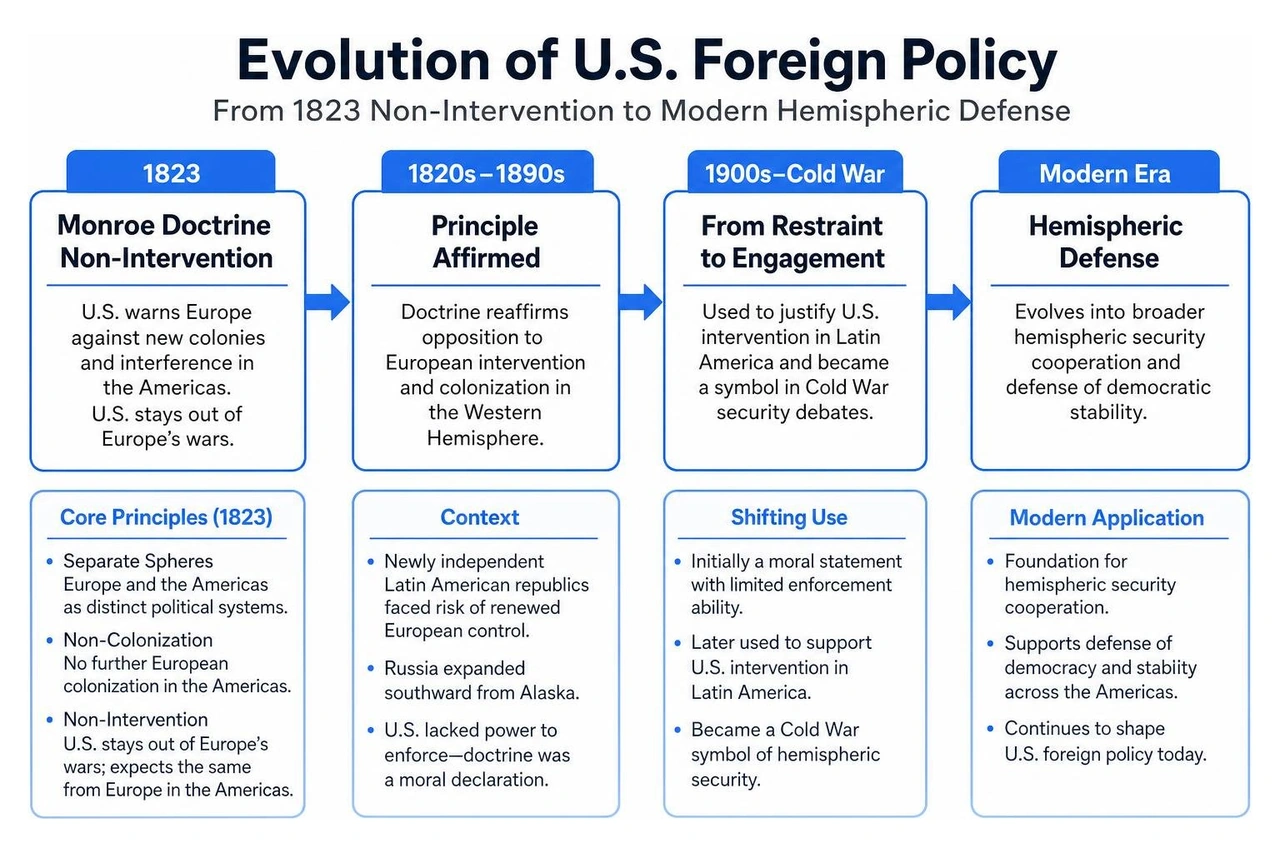
Over the next two centuries, its meaning changed dramatically. It was used to oppose European intervention, later to support U.S. intervention in Latin America, and eventually as a symbol in Cold War and modern security debates. That changing story helps explain both its influence and its controversy.
We are Kyle & Emily, and we invite you to explore how this short statement grew into one of America's most debated foreign-policy ideas.
Origins and Core Principles of The Monroe Doctrine
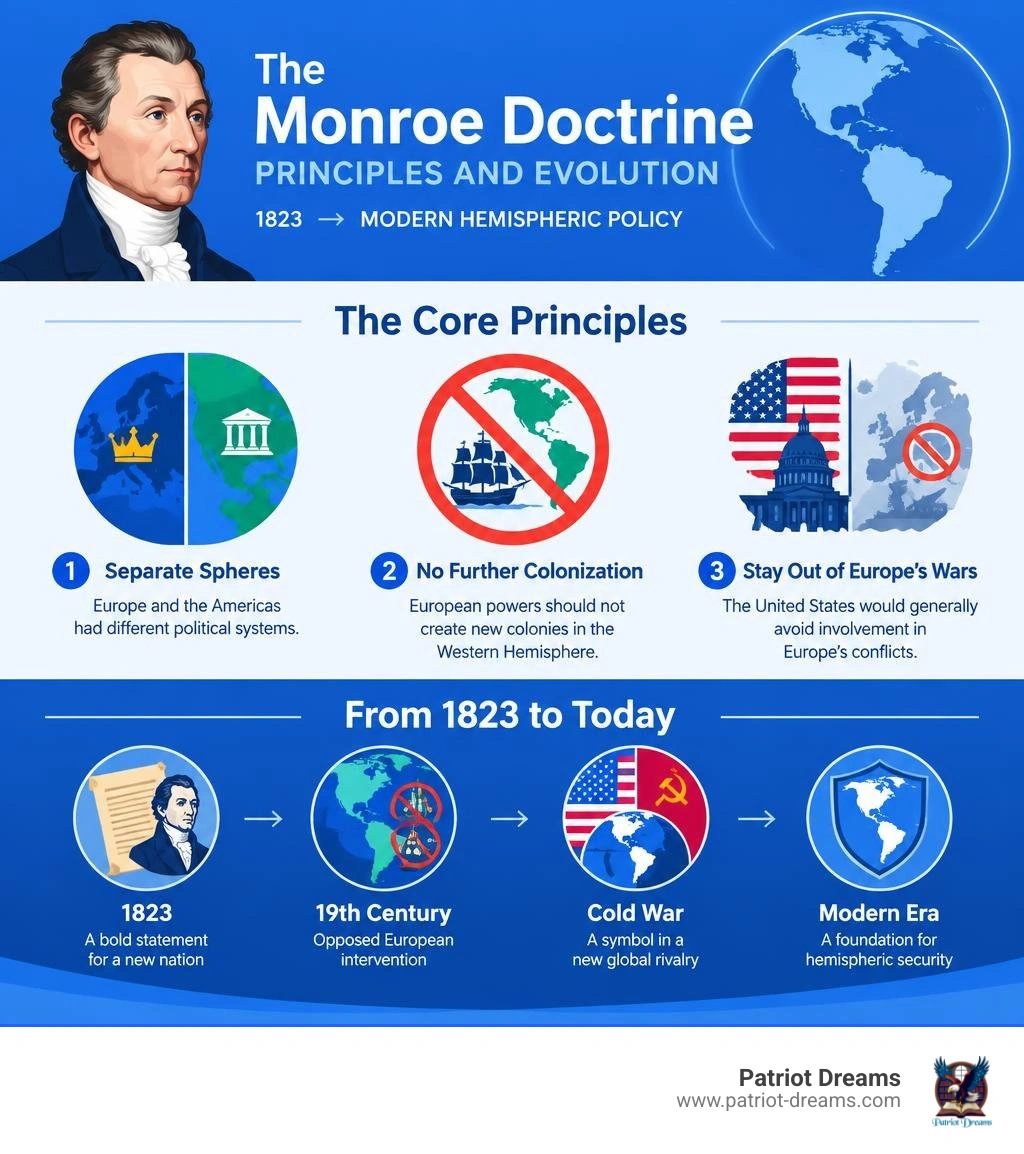
On December 2, 1823, President James Monroe delivered his seventh annual address to Congress. Tucked within pages of regular government reports on public finances and postal routes was a bold diplomatic philosophy. Understanding the definition of the Monroe Doctrine starts with the three foundational pillars crafted largely by Secretary of State John Quincy Adams:
- Separate Spheres: The political systems of Europe and the Americas were fundamentally distinct. The Old World was ruled by monarchies, while the New World was forging representative republics.
- Non-Colonization: The American continents were no longer open to future colonization by any European powers.
- Non-Intervention: The United States pledged not to meddle in the internal concerns or wars of European nations, expecting Europe to show the same respect toward sovereign nations across the Americas.
These principles emerged in response to urgent global developments. Following the Napoleonic Wars, the Holy Alliance in Europe sought to restore monarchical rule, raising concerns that European powers might assist Spain in reclaiming its newly independent colonies in South and Central America. Simultaneously, Czarist Russia issued an imperial decree in 1821 asserting exclusive rights along the Pacific Northwest coast down into Oregon Territory. In his 1823 Seventh Annual Message, Monroe declared that extending European political systems to any portion of our hemisphere was dangerous to our peace and safety.
Geopolitical Catalysts and British Diplomacy
The road to Monroe's message involved delicate transatlantic diplomacy. British Foreign Minister George Canning approached American minister Richard Rush with an intriguing offer: Great Britain and the United States should issue a joint declaration barring European intervention in Latin America. London wanted to protect its booming commercial trade routes with newly independent Latin American markets from French or Spanish meddling.
While elder statesmen like Thomas Jefferson and James Madison favored a joint stance with Britain, Secretary of State John Quincy Adams took a firm stand for independent diplomacy. Adams argued that the United States should not act as "a cockboat in the wake of the British man-of-war." He recognized that a joint declaration might bind American hands, limiting future westward growth. By acting unilaterally, the young republic established a clear voice in early American diplomatic milestones while establishing its own hemispheric identity.
Evolution Through Corollaries and Policy Shifts
The doctrine was not widely called "The Monroe Doctrine" until around 1850. In its first several decades, the statement stood more as a bold moral declaration than an enforceable policy because the United States lacked a large navy.
The doctrine gained practical enforcement power in 1865. When France installed Austrian Archduke Maximilian as emperor of Mexico during the American Civil War, Washington mobilized diplomatic pressure and stationed troops along the Rio Grande to support President Benito Juárez, helping Mexico restore its sovereign republic. Three decades later, in 1895, President Grover Cleveland and Secretary of State Richard Olney invoked the principle during a border dispute between Venezuela and British Guiana, asserting American authority to arbitrate hemispheric disputes.
Theodore Roosevelt and International Police Power
In 1904, President Theodore Roosevelt introduced a major reinterpretation known as the Roosevelt Corollary. Responding to European naval blockades against Venezuela over unpaid foreign debts, Roosevelt declared that the United States had a duty to exercise "international police power" in cases of chronic wrongdoing or financial instability in Latin America.
Under Roosevelt's "Big Stick" approach, the U.S. established customs receiverships in the Dominican Republic and intervened in regional affairs to preempt European military actions. This shifted the doctrine's original defensive spirit into an active justification for preventive intervention, as documented in official National Archives milestone documentation.
From Interventionism to Multilateral Cooperation
By the late 1920s, American leaders sought a more collaborative approach. The 1928 J. Reuben Clark Memorandum separated interventionist policies from Monroe's original defensive declaration. In the 1930s, President Franklin D. Roosevelt instituted the Good Neighbor Policy, emphasizing mutual respect and non-intervention.
As global conflict approached in 1940, public sentiment strongly supported collective hemispheric defense, with 81% of surveyed Americans favoring the protection of Canada and nearly 70% supporting the defense of South America. This cooperative spirit led to the 1947 Inter-American Treaty of Reciprocal Assistance (the Rio Pact) and the founding of the Organization of American States (OAS) in 1948, turning mutual protection into a shared hemispheric commitment.
| Era | Primary Focus | Key Policy or Milestone | Core Hemispheric Objective |
|---|---|---|---|
| Defensive Foundation (1823–1890s) | Anti-Colonization | Monroe's 1823 Message | Deter European monarchies from reclaiming former colonies |
| Interventionist Era (1904–1920s) | Police Power | Roosevelt Corollary (1904) | Preempt European debt collection through regional stabilization |
| Multilateral Partnership (1930s–Present) | Shared Security | Good Neighbor Policy & Rio Pact | Build regional cooperation and collective defense via the OAS |
Regional and Global Repercussions

Latin American leaders originally welcomed Monroe's declaration. Revolutionary leaders like Francisco de Paula Santander and Simón Bolívar appreciated early American recognition of their hard-won independence. However, as the 19th century progressed and unilateral interventions grew, regional sentiment turned cautious.
Jurists and diplomats across the Americas championed sovereign equality. Argentine diplomat Luis María Drago formulated the Drago Doctrine in 1902, arguing that foreign powers should never use armed force to collect public debts from sovereign nations. Over time, these dialogues encouraged modern partnerships grounded in neighborly respect and shared heritage.
British Naval Enforcement and The Monroe Doctrine
During much of the 19th century, the informal guarantor of Monroe's declaration was the British Royal Navy. Under the era of Pax Britannica, Great Britain maintained naval dominance across Atlantic sea lanes.
Because open Latin American markets benefited British commercial trade, Britain shared a practical interest in preventing continental European monarchies from re-establishing colonial monopolies. This balance of power provided a protective shield behind which American institutions and commerce grew throughout the 19th century.
Pacific and Global Adaptations
The core idea of establishing a protective sphere inspired similar concepts beyond the Atlantic. In the late 19th century, Australian colonies advocated for an "Australasian Monroe Doctrine," urging Britain to annex nearby Pacific territories—such as eastern New Guinea and the New Hebrides—to prevent French and German colonial encirclement.
Following the 1898 Treaty of Paris and the Philippine-American War, American thinkers debated how a policy rooted in the Western Hemisphere applied to overseas territories, prompting deeper reflections on national values and global responsibilities.
Modern Invocations and Enduring Significance
The doctrine took on new life during the Cold War. In October 1962, President John F. Kennedy invoked the principle of hemispheric defense during the Cuban Missile Crisis, ordering a naval quarantine to prevent Soviet nuclear missile deployments in Cuba.
For readers exploring our Monroe Doctrine 1823 complete guide, this moment showed how an 1823 declaration continued to influence strategic decisions in the modern nuclear era.
In 2013, Secretary of State John Kerry declared before the OAS that "the era of the Monroe Doctrine is over," highlighting an era of equal partnership among sovereign neighbors.
The Monroe Doctrine in Cold War and Modern Geopolitics
Today, discussions around hemispheric security remain active. Recent strategic debates have revisited these classic ideas in response to changing global trade networks, critical mineral supply chains, and foreign investments in regional ports. The 2025 National Security Strategy draft referenced the doctrine when discussing Western Hemisphere stability, sparking conversations about balancing sovereign partnerships with shared regional resilience.
Frequently Asked Questions About Hemispheric Defense
What were the three main principles established in 1823?
The original 1823 message established separate spheres of political influence for Europe and the Americas, prohibited future European colonization in the Western Hemisphere, and affirmed American neutrality in European domestic conflicts.
Why did John Quincy Adams oppose a joint declaration with Great Britain?
John Quincy Adams opposed a joint declaration to ensure the United States maintained an independent foreign policy, preserved its diplomatic credibility, and avoided limiting its future westward territorial growth.
How did the Roosevelt Corollary change the original policy?
The 1904 Roosevelt Corollary transformed a defensive warning against European colonization into an active assertion of U.S. "police power," justifying direct interventions in Latin American nations to stabilize finances and preempt European intervention.
Conclusion
The story of hemispheric diplomacy is a tale of a young country finding its footing in a wide, complex world. What began in 1823 as a quiet message to Congress grew into an enduring conversation about neighborhood, independence, and how sovereign nations can live together in peace. Discover more about this legacy through our interactive historical exploration of the James Monroe Doctrine, where our audio stories bring American history and family heritage to life. History is simply the shared story of our human family—learning, growing, and striving together to build a welcoming neighborhood for generations to come.

Join the Patriot Dreams Community
Download the app today and start your journey through American history and personal legacy.

Explore Our Latest Insights
Dive into stories that shape our American legacy.