Everything You Need to Know About Paul Revere's Midnight Ride

The Night That Changed America: Paul Revere's Midnight Ride, Explained
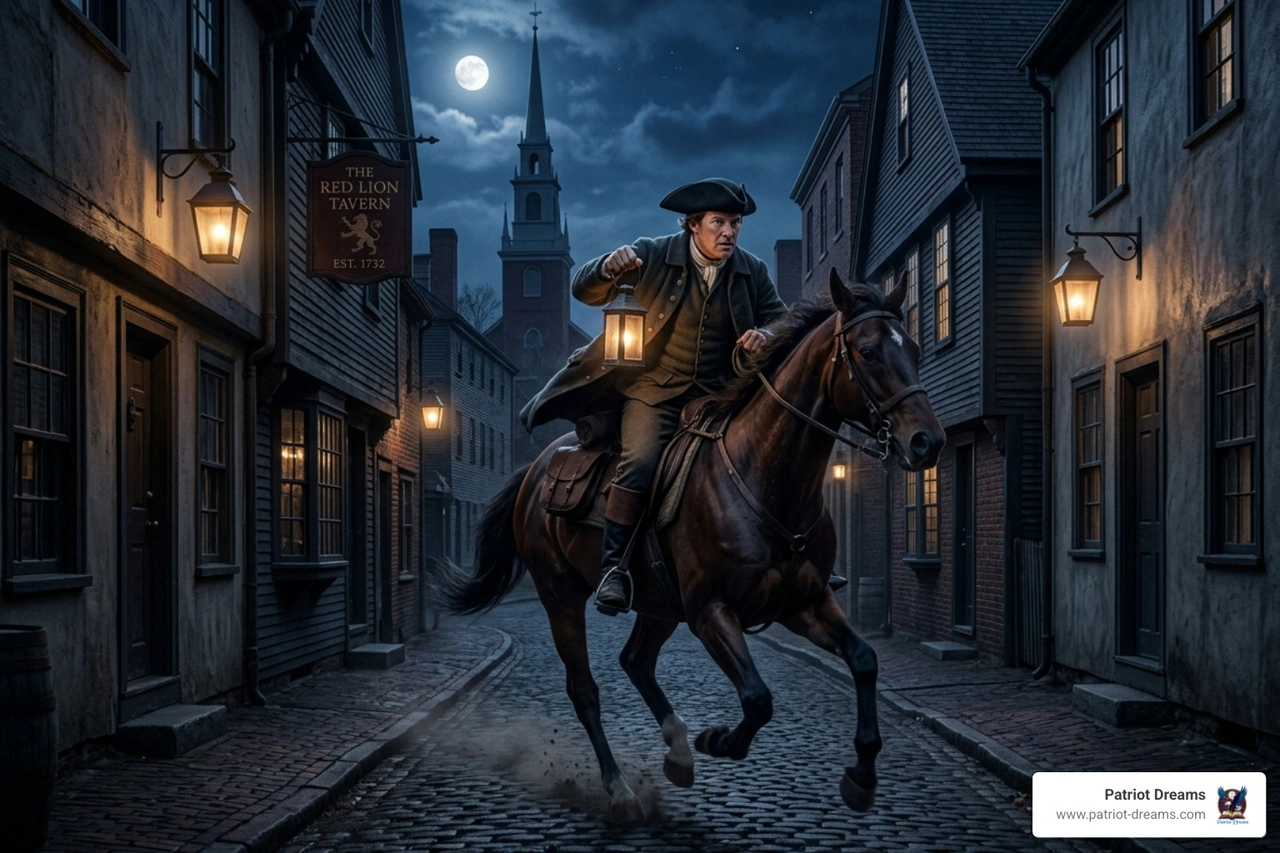
Paul Revere's midnight ride on April 18, 1775, was one of the most important moments in American history. Here is a quick summary:
- Who: Paul Revere, along with William Dawes and Samuel Prescott
- What: A secret mission to warn Patriot leaders and local militias that British troops were on the move
- When: The night of April 18, 1775, starting around 11 p.m.
- Where: From Boston through Somerville, Medford, Arlington, and toward Lexington and Concord
- Why: To protect Patriot leaders John Hancock and Samuel Adams, and alert communities to defend their military supplies in Concord
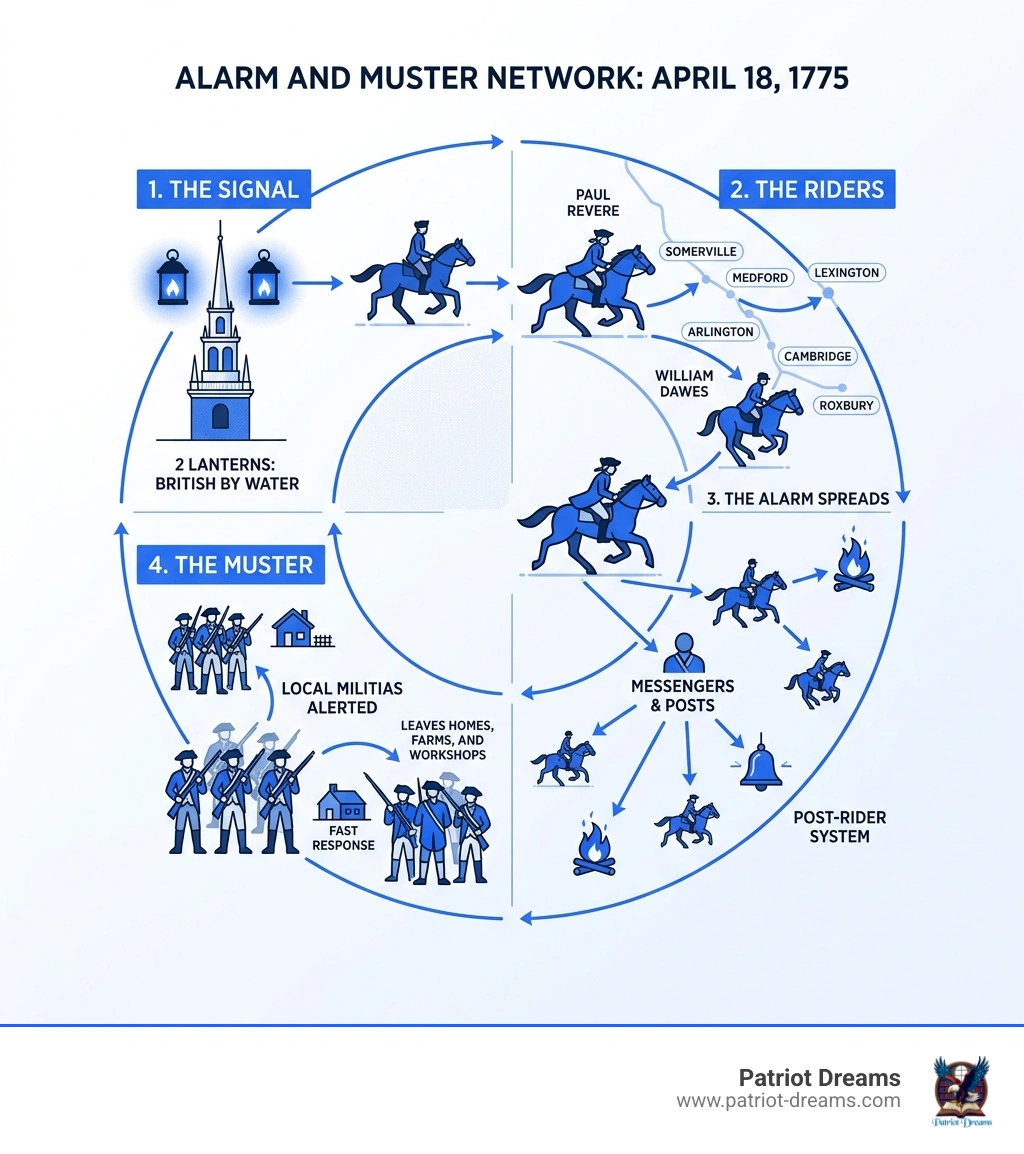
- Signal: Two lanterns hung in the steeple of the Old North Church — meaning the British were crossing by water
There is something deeply moving about a neighbor riding through the dark to protect his community. No armies had gathered yet. No battles had been fought. There was just one man on a borrowed horse, and a whole countryside of ordinary people ready to answer the call.
That is the true spirit of the ride.
Most of us grew up hearing Henry Wadsworth Longfellow's famous poem — "Listen, my children, and you shall hear / Of the midnight ride of Paul Revere..." It is a beautiful story. But the real history is even richer, and in many ways, even more inspiring.
Revere was not a lone hero galloping into legend. He was a silversmith, an engraver, an industrialist, and a trusted member of his community. He was one part of a carefully organized network of neighbors looking out for one another. And on the night of April 18, that network helped spark a revolution.
In this guide, we will walk through the full story together — the facts, the myths, the people, and the lasting meaning of that remarkable night.
The Heart of a Patriot: Who Was Paul Revere?
Before he was a legendary rider, Paul Revere was a man of his hands and his community. Born in Boston's North End, he was the son of a French Huguenot silversmith. When we think of the Founding Fathers, we often think of lawyers and plantation owners, but Revere represented the "mechanics"—the skilled artisans who were the heartbeat of colonial Boston.
Revere was a true family man, raising 16 children across two marriages. His silver shop wasn't just a place of business; it was a hub of social connection. In the 1700s, being a silversmith meant you knew everyone, from the wealthy merchants to the local laborers. This made him the perfect choice for the Who Are Founding Fathers Of Usa to trust with sensitive information.

Beyond his artistry, Paul Revere was an industrial pioneer. He was a man of constant curiosity. Did you know he practiced forensic dentistry? He actually identified the body of his friend, Dr. Joseph Warren, by a false tooth he had crafted for him. After the war, he became America’s first defense contractor, opening a foundry that produced cannons, bells, and the copper sheathing used for the hull of the USS Constitution. He was a man who believed in building things that lasted—whether it was a silver teapot or a new nation.
One if by Land, Two if by Sea: The Signal and the Start
As the tension in Boston reached a breaking point in April 1775, the Patriots knew the British Regulars were preparing to move. Dr. Joseph Warren, one of our greatest Revolutionary War Heroes, received intelligence that the British intended to march to Concord to seize military stores and potentially arrest Samuel Adams and John Hancock.
Revere had already helped set up a clever backup plan. He knew that if he were captured while trying to leave the city, the message still had to get out. He met with Robert Newman, the sexton of the Old North Church, and instructed him on the famous lantern signals.
- One lantern: The British were marching by land across the Boston Neck.
- Two lanterns: The British were crossing the Charles River by boat (the "water route").

On the night of April 18, the signal was clear: two lanterns. While the lights shone from the steeple, Revere was being rowed across the Charles River, silently slipping past the HMS Somerset, a massive British warship. He was heading for Charlestown to begin the Paul Revere midnight ride, carrying the weight of a nation’s future on his shoulders.
The Real Story of the Paul Revere Midnight Ride
When Revere reached the Charlestown shore, he borrowed a horse from John Larkin and set off into the night. It wasn't a quiet, lonely ride. As he galloped through Somerville, Medford, and Menotomy (now Arlington), he was triggering a sophisticated "alarm and muster" system. This wasn't a spontaneous act; it was a well-oiled machine. By the time he reached Lexington, his warnings had already sent dozens of other riders out in all directions.
This collaborative effort is a beautiful example of community protection. Our American Revolution Stories Ultimate Guide reminds us that history is made by neighbors helping neighbors. By the end of the night, nearly 40 riders were spreading the word across Middlesex County. This was the true strength of the Paul Revere’s Ride | American Revolution, Midnight Ride, Patriot | Britannica—not just one man, but a whole community waking up to defend their homes.
Even George Washington The General Who Became Americas First President would later marvel at how quickly the colonial militias could assemble when the alarm was raised.
The Paul Revere midnight ride route and companions
We often forget that Revere had partners on the road. While Revere took the "water route" through Charlestown, William Dawes was sent by Dr. Warren via the "land route" across the Boston Neck. The two met in Lexington around midnight.
After warning Adams and Hancock at the Hancock-Clarke House, they were joined by a young doctor named Samuel Prescott. Prescott had been on his way home from visiting a lady friend and, being a dedicated Patriot, offered to help them reach Concord. You can read more about the logistical details in The Real Story of Paul Revere's Ride. It is a story of teamwork—three men from different walks of life, united by a single purpose.
The capture during the Paul Revere midnight ride
History isn't always a smooth gallop. Shortly after leaving Lexington for Concord, the three riders were intercepted by a British patrol in Lincoln. Dr. Prescott managed to jump a stone wall and escaped—he was actually the only one of the three to successfully reach Concord that night. William Dawes also escaped but fell off his horse and had to walk back.
Revere, however, was captured. The British officers interrogated him at gunpoint, threatening to "blow his brains out" if he didn't tell the truth. Revere remained remarkably calm. He told them the countryside was already awake and that they would find "five hundred men" ready to meet them. When the sound of militia gunfire and clanging bells erupted in the distance, the British officers grew nervous. They confiscated Revere’s horse and released him, leaving him to walk back to Lexington on foot. You can find his own personal account of this harrowing moment in Paul Revere's True Account of the Midnight Ride.
Beyond the Gallop: Rescuing History and the Legacy of Industry
Revere’s work didn't end when he lost his horse. When he arrived back in Lexington, he found Samuel Adams Patriot and John Hancock preparing to leave. But there was a problem: a large, heavy trunk filled with Hancock’s private papers was still at a local tavern.
These weren't just personal letters; they were the "innermost secrets" of the rebellion. If the British captured that trunk, they would have had the evidence needed to execute the Patriot leaders for treason. Revere and a man named John Lowell lugged the heavy trunk across the Lexington Green just as the first shots of the war—the "shot heard round the world"—were being fired.
This act of document preservation was just as vital as the ride itself. Just as Thomas Jefferson And The Declaration Of Independence How A Nation Found Its Voice gave us our words, men like Revere protected the records that made our government legitimate. To understand why these documents matter, look at The Declaration Of Independence What It Really Says And Why It Still Matters.
Later in life, Revere’s industrial spirit continued to serve the country. He transitioned from a master artisan to a captain of industry.
| Revere the Artisan | Revere the Industrialist |
|---|---|
| Hand-crafted silver tea sets | First American to roll copper into sheets |
| Detailed political engravings | Cast over 900 church bells |
| Hand-made dental prosthetics | Manufactured cannons for the state |
| Managed a small family shop | Operated a large-scale foundry and mill |
Poetry vs. History: Why We Remember the Ride
If Revere wasn't the only rider, and he didn't even finish the trip to Concord, why is he the one we all remember? We can thank Henry Wadsworth Longfellow. In 1861, as the United States was facing the darkness of the Civil War, Longfellow wrote his famous poem to inspire a sense of national unity and courage.
He took some "poetic license," making Revere a lone hero and changing the timeline for dramatic effect. He also skipped over the capture in Lincoln. But Longfellow captured something the history books sometimes miss: the feeling of that night. The poem turned the Paul Revere midnight ride into a timeless symbol of American vigilance.
It’s also worth noting what Revere actually said. He never shouted "The British are coming!" In 1775, most colonists still considered themselves British. Shouting that would have been very confusing! Instead, eyewitnesses and Revere’s own notes say he warned people that "The Regulars are coming out." It was a specific, tactical warning for his neighbors. This spirit of clear, brave communication is reminiscent of the passion found in the Patrick Henry Speech.
Frequently Asked Questions about the Midnight Ride
Did Paul Revere actually shout "The British are coming!"?
No. Because the mission required secrecy to avoid British patrols, and because the colonists were technically British subjects at the time, Revere used the term "The Regulars" (referring to the British Army) to alert the townspeople.
Who was the only rider to successfully reach Concord?
Dr. Samuel Prescott was the only one of the three main riders to make it all the way to Concord. He joined Revere and Dawes in Lexington and used his knowledge of the local woods to evade the British patrol that captured Revere.
Why did the British release Paul Revere after capturing him?
The British officers were in a hurry to rejoin their main column. When they heard the town bells ringing and militia drums beating, they realized the countryside was already alerted. They took Revere's horse to replace one of their own tired mounts and let him go so they could move faster.
Conclusion
The story of the Paul Revere midnight ride is more than just a tale of a man on a horse. It is a story about the power of a connected community. It reminds us that when we look out for our neighbors and stand up for our shared values, we can change the course of history. Revere was a silversmith who became a messenger, an industrialist who became a patriot, and a neighbor who became a legend.
At Patriot Dreams, we believe these stories are the threads that weave our national family together. We are dedicated to preserving this shared heritage, ensuring that the courage of people like Paul Revere continues to inspire us today. As we look toward America 250 Years in the Making, let’s remember that the "fate of a nation" doesn't just rest with the famous names in history books—it rests with all of us, working together.
Thank you for spending some time with us today in the quiet streets of 1775. We hope you feel a little more connected to the neighbors who came before us.
Join the Patriot Dreams Community
Download the app today and start your journey through American history and personal legacy.

Explore Our Latest Insights
Dive into stories that shape our American legacy.