A Guide to Patrick Henry
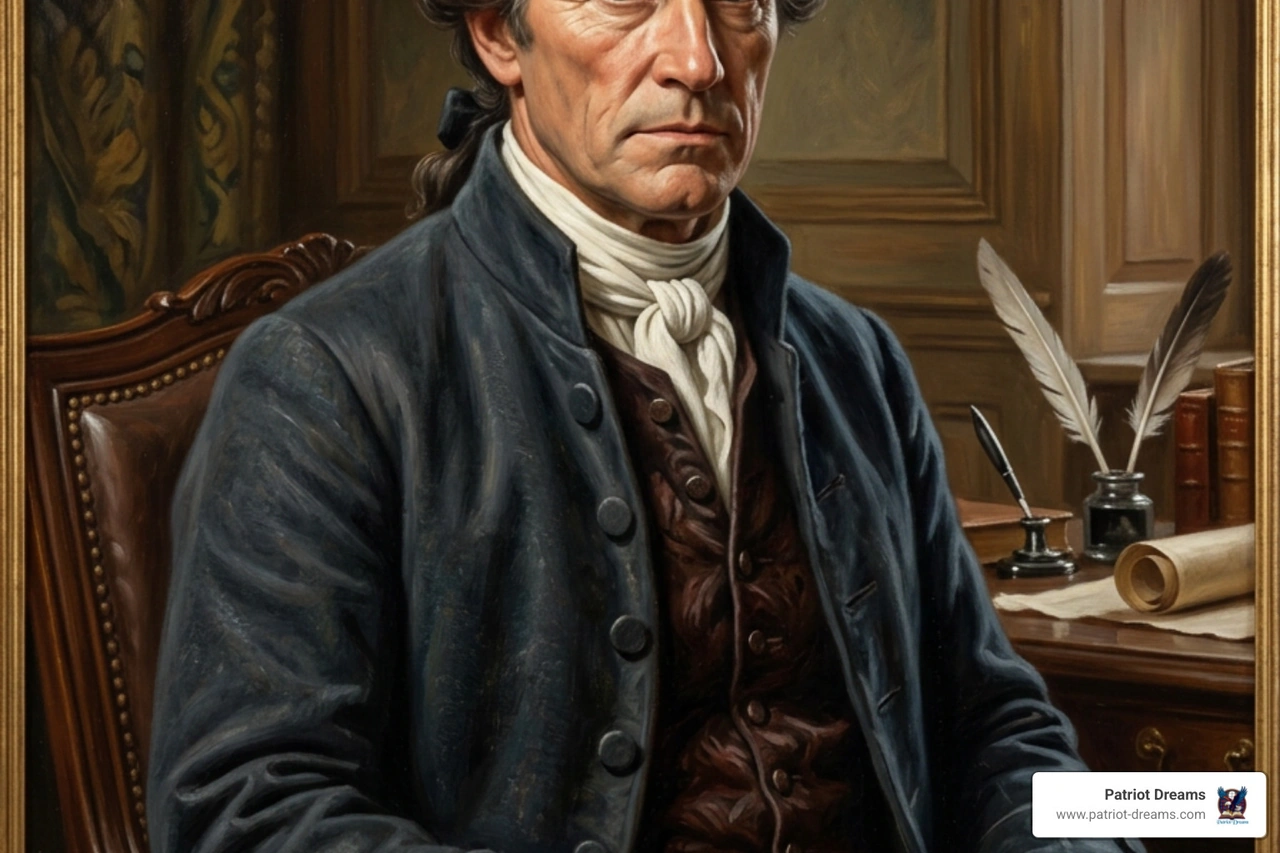

The American Patriot Who Gave Liberty Its Voice
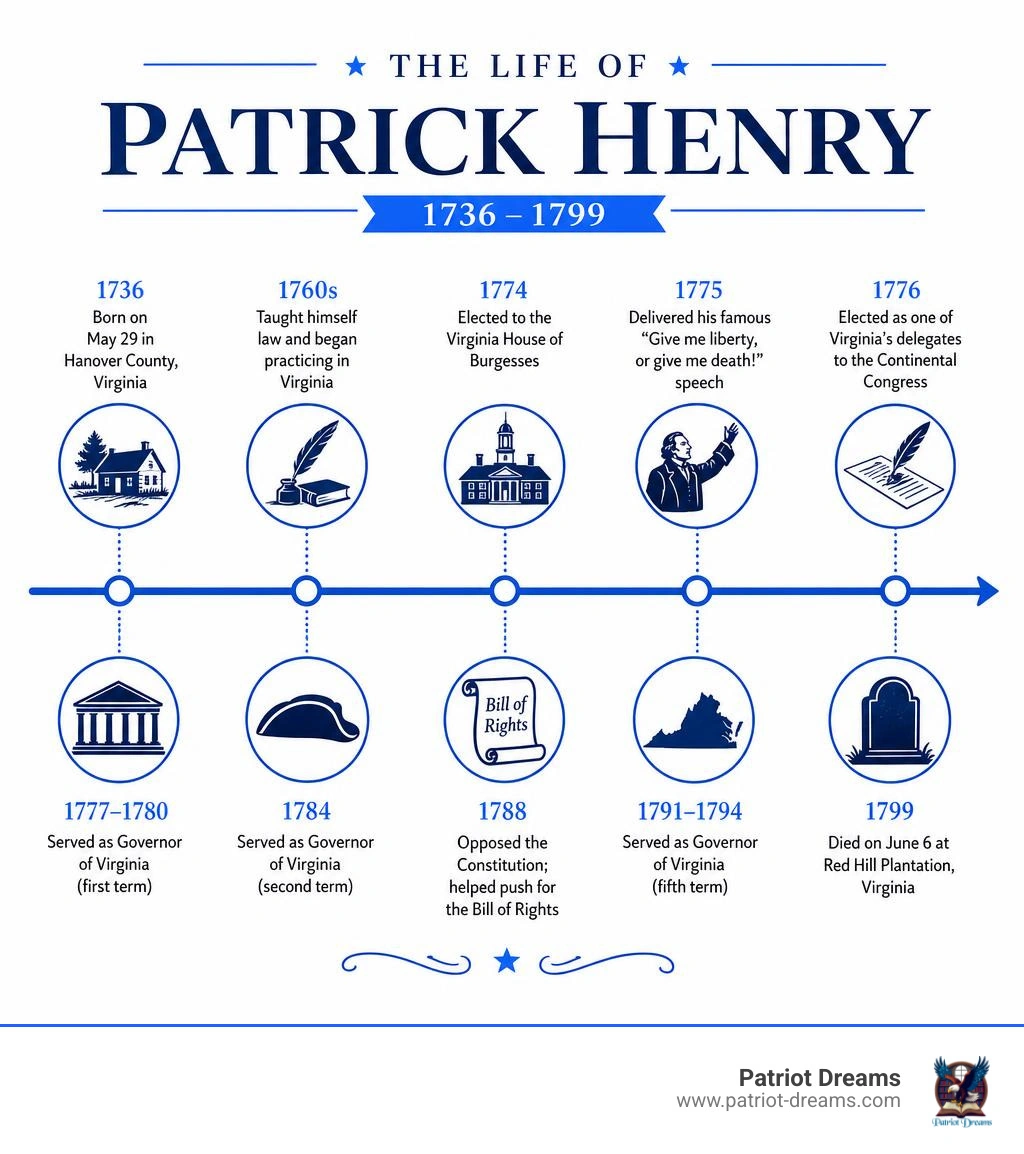
Patrick Henry (May 29, 1736 – June 6, 1799) was one of America's most passionate Founding Fathers — a self-taught lawyer, five-time Virginia governor, and the voice that helped light the fire of revolution.
Here are the key facts about him at a glance:
FactDetailBornMay 29, 1736, Hanover County, VirginiaDiedJune 6, 1799, Red Hill Plantation, VirginiaKnown for"Give me liberty, or give me death!" speech (1775)Political officesFirst and sixth Governor of Virginia (five total terms)Key contributionOpposed the Constitution; helped push for the Bill of RightsFamilyMarried twice; fathered 17 children
Some names from history feel distant and dusty. Patrick Henry is not one of them.
He was loud. He was bold. And he spoke the way people felt in their hearts — not in the polished language of scholars, but in plain, urgent words that made ordinary people feel like their freedom was worth fighting for.
Before he was a statesman, he was a struggling young man in Virginia — running a tavern, tending tobacco fields, and teaching himself law from books in just a matter of weeks. His story is one of perseverance, passion, and an unshakable belief that every person deserves a say in how they are governed.
Whether you're a lifelong history lover or just beginning to explore America's founding story, Patrick Henry's life has something to teach all of us about courage and conviction.
Know your Patrick Henry terms:
- Founding Fathers
- Revolutionary War heroes
- The Declaration of Independence: What It Really Says and Why It Still Matters
The Early Life and Legal Rise of Patrick Henry
Long before Patrick Henry was celebrated as a master orator of the American Revolution, he was a young boy growing up in the rolling hills of Hanover County, Virginia. Born to a Scottish immigrant father, John Henry, and a warm-hearted Virginian mother, Sarah Winston Syme, young Patrick was not your typical studious academic. While he learned Latin and classics under his father’s careful tutoring, he much preferred the outdoors. He loved wandering through the woods, fishing along quiet creek banks, and listening to the rhythmic, passionate sermons of evangelical Presbyterian ministers during the First Great Awakening. These early experiences deeply shaped his worldview, teaching him that the most powerful messages are those that speak directly to the human heart.
But finding his true calling took time. As a young man, Patrick tried his hand at various careers and met with failure at almost every turn. He opened a small country store with his brother, only to watch it go under. He tried farming tobacco, but a devastating fire destroyed his home and left him with little choice but to pivot.
At the age of 18, he married his first love, 16-year-old Sarah Shelton. Together, they moved to Hanover Tavern, which was owned by Sarah's family. There, Patrick served as the tavern’s de facto manager. He was known to welcome guests with a warm smile, serve up hearty drinks, and entertain weary travelers by playing lively tunes on his fiddle. It was during these tavern years that a 17-year-old student named Thomas Jefferson stayed at the tavern and became well acquainted with Patrick, later recalling how easily the young tavern-keeper could win over a room.
Realizing that retail and farming were not his path, Patrick decided to study the law. Remarkably, he did not attend a prestigious university. Instead, he embarked on a period of intense self-study that lasted only about six weeks. In the spring of 1760, he traveled to Williamsburg, passed his bar exam before some of the colony's most prominent legal minds, and was admitted to the Virginia bar. His natural empathy and deep understanding of ordinary folk made him an instant fit for the courtroom. To explore how his journey fits into the broader story of early America, check out our American Historical Figures Complete Guide.
To learn more about his early steps and family history, you can also view the comprehensive biography on Patrick Henry - Wikipedia.
The Parsons' Cause and the Spark of Advocacy
In 1763, a local legal dispute known as the "Parsons' Cause" thrust the young attorney into the colonial spotlight. At its heart, the case was about how Anglican ministers in Virginia were paid. Traditionally, clergy salaries were paid in tobacco. However, when a severe drought caused tobacco prices to skyrocket, the Virginia House of Burgesses passed the Two Penny Act, which allowed colonists to pay their taxes and clergy salaries in paper currency at a fixed rate of two pence per pound of tobacco.
The local ministers were furious, believing they were being cheated out of their fair share. They appealed to King George III, who vetoed the colonial law. An Anglican minister named James Maury subsequently sued the taxpayers of Hanover County for back wages.
When Patrick took the case to defend the taxpayers, the court had already ruled that the minister was legally owed damages; Patrick's job was simply to argue before a jury of local farmers how much those damages should be.
Instead of focusing on dry legal technicalities, Patrick delivered a fiery, emotional speech that shocked everyone in the courtroom. He argued that the Two Penny Act was a good and necessary law passed by local representatives to protect the community. By vetoing it, Patrick declared, King George III had "degenerated into a Tyrant" and forfeited all rights to his subjects' obedience on local matters.
The opposing counsel cried, "Treason!" but the jury was utterly transfixed. After brief deliberation, they awarded Reverend Maury damages of exactly one penny. It was a stunning symbolic victory for self-governance.
Almost overnight, Patrick became a folk hero. His bold defense of local rights resonated deeply with ordinary citizens who felt increasingly disconnected from a distant crown. The victory also transformed his career: Patrick Henry added 164 new clients in the single year following the Parsons' Cause victory. This pivotal moment is widely remembered today as one of the earliest sparks of the American independence movement. For more stories on the brave individuals who stood up for their communities, read about our Revolutionary War Heroes.
The Voice of Revolution: From the Stamp Act to "Liberty or Death"
By 1765, the British Parliament was looking for ways to pay off the massive debts incurred during the French and Indian War. Their solution was the Stamp Act, which placed a direct tax on virtually all printed paper goods in the colonies, from legal documents to playing cards. For the colonists, this was a dangerous precedent: taxation without representation.
Newly elected to the Virginia House of Burgesses, Patrick Henry wasted no time in mounting a defense. He introduced the Virginia Stamp Act Resolves, a series of bold resolutions asserting that only local colonial assemblies had the right to tax Virginians.
During the heated debate on the floor, Patrick’s passion boiled over. He famously declared that Julius Caesar had his Brutus, Charles I his Oliver Cromwell, and he hoped that George III might profit from their examples. When cries of "Treason!" echoed through the chamber, Patrick reportedly stood tall and replied with trademark defiance: "If this be treason, make the most of it!"
The Resolves were published throughout the colonies, giving the rest of America the impression that Virginia was leading a radical charge toward resistance. This bold political maneuvering cemented his reputation as the voice of the emerging patriot cause. You can read more about how these early acts of defiance paved the way for the birth of a new nation in our article, Thomas Jefferson and the Declaration of Independence: How a Nation Found Its Voice.
For additional historical context on his legislative battles, visit Patrick Henry | George Washington's Mount Vernon.
The Historical Context of the "Liberty or Death" Speech
By the spring of 1775, tensions between the colonies and Great Britain had reached a boiling point. In March, the Second Virginia Convention met at St. John's Episcopal Church in Richmond to discuss the growing crisis. The atmosphere inside the church was heavy with anxiety. Many delegates still hoped for a peaceful reconciliation with the mother country and favored a cautious, wait-and-see approach.
Patrick Henry believed there was no more time for waiting. On March 23, 1775, he rose to address the crowd, urging Virginia to immediately arm its militia and prepare for armed conflict.
He spoke with an intensity that moved everyone in the room. He urged his fellow delegates not to shut their eyes to the painful truth, declaring that the British military buildup in the colonies was meant for subjection, not peace. He ended his legendary call to action with a dramatic flourish: plunging an ivory paper cutter toward his chest to symbolize the ultimate sacrifice for freedom, uttering the words that would echo through the centuries:
"I know not what course others may take; but as for me, give me liberty or give me death!"
While there are no direct transcriptions from that day—the speech was reconstructed years later by biographer William Wirt—the impact of his words was undeniable. It galvanized the delegates, united the colony, and set Virginia firmly on the path toward armed resistance. You can explore the enduring power of his words in our dedicated piece, the Patrick Henry Speech.
To explore more primary materials and historical analysis of this period, visit The American Revolution.
The Gunpowder Incident and Virginia's Path to Independence
Just a few weeks after the speech at St. John's Church, Patrick's warnings became a reality. On the night of April 20, 1775, Virginia's royal governor, Lord Dunmore, ordered British marines to secretly remove 15 barrels of gunpowder from the public magazine in Williamsburg and load them onto a royal warship.
When the colonists woke up and discovered the gunpowder was gone, they were outraged. It felt like a direct attempt to disarm them and leave them defenseless. While some moderate leaders urged patience, Patrick Henry took action. He organized the Hanover county militia and led a march toward Williamsburg, determined to demand the return of the powder or secure fair financial compensation for it.
As his force grew, Lord Dunmore grew nervous. Rather than risk an open battle, the governor arranged for a wealthy colonial merchant to pay for the seized powder. Satisfied that justice had been served, Patrick and his men turned back without shedding a single drop of blood.
Dunmore was furious and declared Patrick an outlaw for disturbing the peace, but the public hailed him as a protector of their liberties. This high-stakes standoff showed that the colonists were willing to back up their words with action, pulling Virginia further along the road to independent statehood. For more inspiring tales of colonial courage, check out our American Revolution Stories Ultimate Guide.
Shaping a New Nation: Governorship and the Constitutional Debate
Following the declaration of independence, the newly formed state of Virginia needed a leader to guide it through the dark, uncertain days of the Revolutionary War. In 1776, Patrick Henry was chosen as the first post-colonial Governor of Virginia. He would go on to serve five one-year terms in total (serving as the first and sixth governor), demonstrating remarkable executive leadership during a time of immense trial.
As governor, he worked tirelessly to recruit soldiers, secure supplies for the Continental Army, and protect Virginia's western frontiers. He maintained a close working relationship with General George Washington, sending vital resources north to support the war effort. To understand how these leaders worked hand-in-hand to secure our freedom, read George Washington: The General Who Became America's First President.
For more details on his public career and legislative history, you can reference the records at the Delegate Patrick Henry of Virginia | US House of Representatives.
Once independence was won, however, a new debate emerged: how should the new nation be governed? This question divided American leaders into two main camps:
FederalistsAnti-FederalistsFavored a strong central governmentFavored strong state governments and local autonomyBelieved a unified nation was necessary for defense and commerceFeared a distant central government would become tyrannicalIncluded figures like Alexander Hamilton and James MadisonIncluded figures like Patrick Henry and Samuel AdamsArgued that a Bill of Rights was unnecessaryDemanded a Bill of Rights to protect individual liberties
Why Did Patrick Henry Oppose the U.S. Constitution?
When the Constitutional Convention met in Philadelphia in 1787 to draft a new framework for the United States, Patrick Henry was invited to attend. However, he flatly refused the invitation, later explaining his absence with the famous words: "I smelt a rat."
He was deeply suspicious of the secret proceedings in Philadelphia. When the proposed U.S. Constitution was finally revealed, his worst fears were confirmed. He believed the document went too far in stripping power from the states and consolidating it in a massive, centralized federal government.
During the Virginia Ratifying Convention in 1788, Patrick led the opposition. He spoke passionately and frequently—his speeches filled nearly one-quarter of the convention's entire recorded debates. He warned his fellow Virginians that a strong federal executive could easily slide into a monarchy, and that a distant federal congress would lose touch with the everyday needs of ordinary citizens. He argued that the Constitution lacked the essential checks needed to protect individual rights and state sovereignty. Though Virginia ultimately ratified the Constitution by a close vote of 89 to 79, his powerful arguments left a lasting mark on the nation's founding. You can read more about this crucial period in our Constitutional Convention History.
For a deeper look into his arguments during this historic debate, see Patrick Henry (1736–1799) - Encyclopedia Virginia.
How Did Patrick Henry Influence the Bill of Rights?
Though Patrick Henry lost the battle to block the ratification of the Constitution, his fierce opposition achieved a monumental victory. His relentless demands for explicit protections of personal freedom forced the Federalists to make a crucial promise: if the states ratified the Constitution, the new government would immediately adopt a series of amendments to protect individual liberties.
James Madison, a leading Federalist, kept that promise. He drafted the first ten amendments to the Constitution, which we know today as the Bill of Rights.
These amendments—protecting freedom of speech, freedom of religion, the right to a fair trial, and reserving un-delegated powers to the states—exist largely because Patrick and his fellow Anti-Federalists refused to stay silent. His insistence on safeguarding our everyday freedoms shaped the very character of American liberty. To explore these foundational rights in simple, clear terms, read The US Constitution & Bill of Rights Explained Simply and learn about Madison's role in James Madison Constitution.
The Complex Legacy and Later Years of a Patriot
In his later years, Patrick Henry retired from the bustling world of politics to find peace in the quiet countryside of southern Virginia. After the passing of his first wife, Sarah Shelton, who had suffered from severe mental illness and was tenderly cared for at home rather than institutionalized, Patrick married Dorothea Dandridge in 1777. Across his two marriages, Patrick fathered a total of 17 children (six with Sarah and eleven with Dorothea), creating a home filled with laughter, music, and the joyful chaos of a large family.
As the years went by, his political views began to evolve. Seeing the rise of radical movements abroad, such as the French Revolution, Patrick began to worry about the stability of the young United States. He grew to appreciate the need for national unity and aligned himself more closely with the Federalist Party later in life.
Despite his growing national reputation, he turned down numerous prestigious federal appointments, including offers from George Washington to serve as Secretary of State, Minister to Spain, and Chief Justice of the Supreme Court. He preferred to stay close to his family and his beloved Virginia land. Discover more about his fellow patriots and their final years in our guide to US Historical Figures.
To read a detailed summary of his military and political leadership, visit the Patrick Henry | American Battlefield Trust.
Reconciling Liberty and the Contradictions of Slavery
Like many of his fellow Virginia founders, Patrick Henry lived a life marked by a profound and painful moral contradiction. While he spoke passionately about the beauty of human liberty, he owned 67 enslaved people at the time of his death in 1799.
Patrick did not try to hide or justify this contradiction. In a heartfelt 1773 letter to a friend, he wrote candidly about the evils of slavery, calling it a practice "totally repugnant to the first impressions of right and wrong." He admitted that he kept his slaves out of personal convenience and the practical challenges of finding an alternative in the society of his day.
While he expressed a sincere hope that the institution of slavery would eventually be abolished, he offered no concrete plan to end it beyond supporting efforts to ban the importation of new slaves. This tension between his high ideals and the reality of his life remains a vital, complex chapter of his legacy that helps us understand the full, human story of our nation's founding. To learn more about the diverse group of people who shaped the birth of our country, read Who Are Founding Fathers of USA.
Preserving the Legacy at Red Hill and Beyond
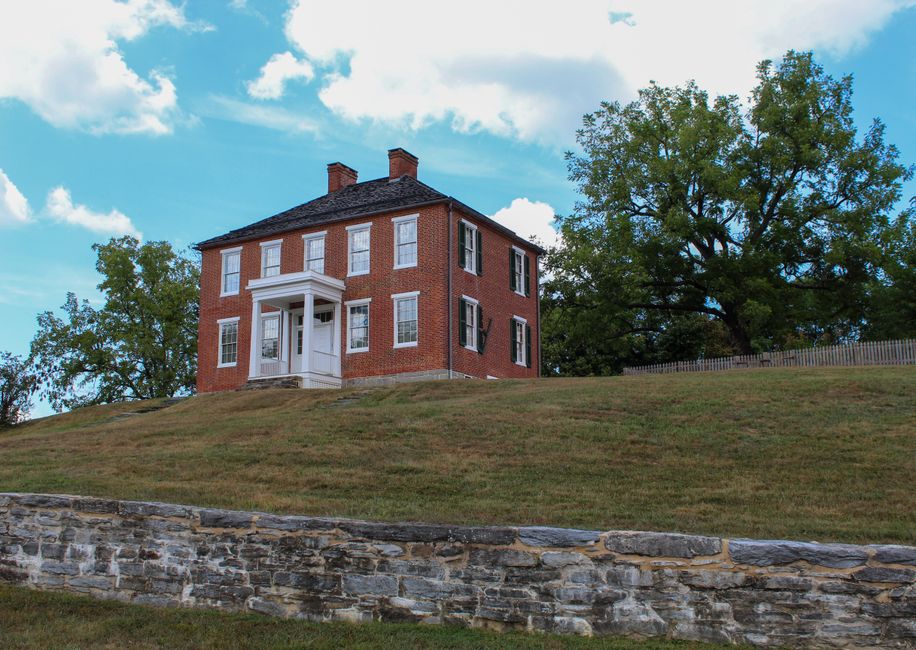
Today, the final chapter of Patrick's life is preserved at Red Hill, his beautiful plantation home located near Brookneal, Virginia. It was here, surrounded by rolling fields and the quiet beauty of nature, that the great orator drew his last breath on June 6, 1799, at the age of 63.
Since 1944, the Patrick Henry Memorial Foundation has worked to safeguard nearly 1,000 acres of this historic land, preserving more than 3,000 artifacts that tell the stories of all who lived there—including the Henry family, the local Indigenous peoples, and the enslaved African Americans who worked the fields. Red Hill stands as a peaceful place of reflection, reminding us of the enduring values of family, community, and the ongoing journey of American freedom.
To access educational resources and primary documents about his life and legacy, explore the Patrick Henry - Online Classroom.
Frequently Asked Questions about the Great Orator
What is the Patriot's most famous quote?
His most famous quote is, "Give me liberty, or give me death!" He delivered this line on March 23, 1775, during a speech at St. John's Episcopal Church in Richmond, Virginia, urging the colony to arm its militia in defense of their rights.
Why did he refuse to attend the Constitutional Convention?
He refused to attend because he "smelt a rat." He feared that the convention would create a highly centralized federal government that would strip power from the states and eventually threaten the individual liberties of ordinary citizens.
How many terms did he serve as Governor of Virginia?
He served a total of five one-year terms. He was elected as Virginia’s very first post-colonial governor in 1776, serving three consecutive terms, and was later elected to two more terms in the 1780s.
Conclusion
At Patriot Dreams, we believe that history is not just a collection of dates and names on a page. It is a rich tapestry of human stories—filled with courage, struggle, family, and hope. Patrick Henry was a man of deep convictions who spoke from the heart and reminded us that our everyday freedoms are precious gifts worth protecting.
Our interactive map and unique audio storytelling platform are designed to bring these powerful stories to life, helping you and your family explore the incredible heritage of America while preserving your own family's legacy for generations to come.
Listen to history come alive on Patriot Dreams and start your journey of discovery with us today.

Join the Patriot Dreams Community
Download the app today and start your journey through American history and personal legacy.

Explore Our Latest Insights
Dive into stories that shape our American legacy.