Everything You Need to Know About Shays Rebellion

Why Shays Rebellion Facts Still Matter Today
One of the most important Shays Rebellion facts to know is this: in 1786 and 1787, ordinary American farmers — many of them Revolutionary War veterans — rose up against their own government, and what happened next changed the United States forever.
Here are the key facts at a glance:
- What it was: An armed uprising by farmers in western Massachusetts
- When it happened: August 1786 – February 1787
- Who led it: Daniel Shays, a former Continental Army captain
- Main cause: Crushing debt, high taxes, and farm foreclosures after the Revolutionary War
- Key event: 1,200 rebels marched on the Springfield Armory on January 25, 1787
- How it ended: General Benjamin Lincoln suppressed the rebellion with 4,400 troops; most rebels were eventually pardoned
- Why it mattered: It exposed fatal weaknesses in the Articles of Confederation and helped bring about the U.S. Constitution
These were not angry strangers. They were neighbors, fathers, and war heroes who had fought for freedom — and then came home to find their farms being seized over unpaid debts. Their story is one of struggle, resilience, and a nation learning what it truly means to govern itself.

Similar topics to Shays Rebellion facts:
The Heart of the Crisis: What Caused the Uprising?

To truly understand Shays' Rebellion, we have to look past the battlefield and step onto the quiet, snow-covered family farms of western Massachusetts in the 1780s.
After winning the Revolutionary War, the young United States fell into a severe postwar economic depression. The new nation had no unified currency, and paper money was virtually worthless. European merchants who had lent money to Boston merchants began demanding payment in "specie"—which meant cold, hard gold and silver.
Because Boston merchants had to pay their debts in gold, they passed that demand down the line. They began demanding hard currency from the rural shopkeepers, who in turn had to demand it from local farmers. But rural farmers lived in a barter-based economy. They traded rye for firewood, and labor for blacksmithing. They simply did not have gold or silver.
At the same time, the Massachusetts state government, heavily influenced by wealthy coastal merchants, raised taxes to pay off its own war bonds. Between 1783 and 1786, land taxes in Massachusetts increased by over 60 percent. By 1786, new taxes amounted to more than 30 percent of an average citizen's income.
The consequences for local families were devastating:
- Court Cases: In Hampshire County, debt cases prosecuted in court jumped from a historical average of about 1,100 to 2,977 between 1784 and 1786—a staggering 262% increase. Worcester County saw debt cases skyrocket to 4,789.
- Debtors' Prison: Farmers who could not pay their debts had their livestock and land seized. Many were thrown into crowded, freezing debtors' prisons. In Hampshire and Worcester counties alone, over 200 people were jailed for debt during this brief window.
- Unpaid Veterans: To make matters more painful, many of these farmers were veterans of the Continental Army. They had spent years away from their families fighting for independence, only to be paid in near-worthless government certificates. They returned home to find their properties on the auction block.
This created a profound sense of betrayal. These families had risked everything for liberty, and now they felt they were being crushed by a new elite class. To explore more about the everyday courage of these early citizens, you can read our American Revolution Stories Ultimate Guide. It was during this fragile era that our early leaders, whom we often remember as the Founding Fathers, realized just how difficult building a stable, fair republic would be.
Essential Shays Rebellion Facts: The Spark and the Struggle

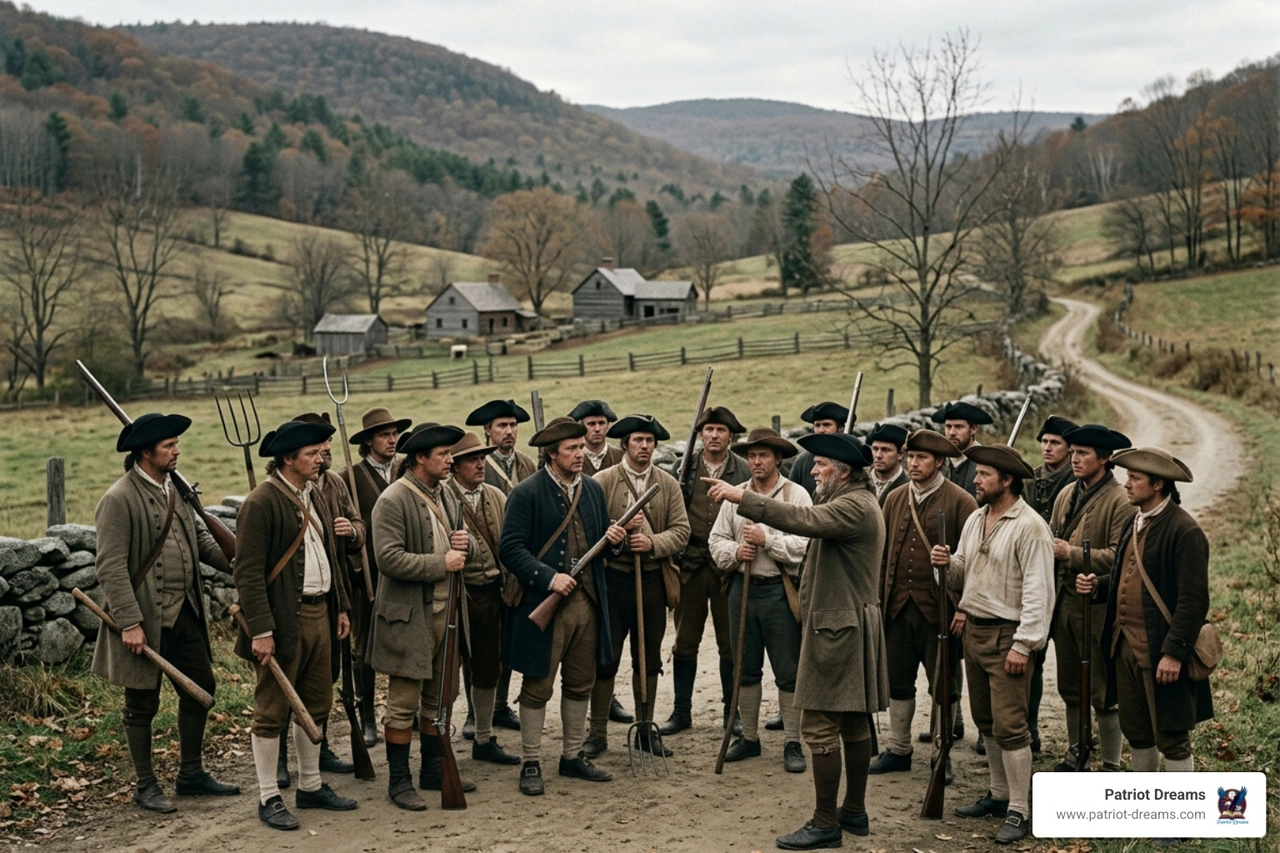
When petitions to the state legislature for relief, paper currency, and lower taxes went unanswered, the farmers decided to take matters into their own hands. Calling themselves "Regulators"—a term borrowed from pre-Revolutionary community protection movements—they organized peaceful blockades of local courthouses. Their goal was simple: if the courts could not sit, the judges could not order any more foreclosures or send any more neighbors to debtors' prison.
The unrest escalated dramatically through the fall of 1786. In places like Northampton, Worcester, and Great Barrington, hundreds of armed citizens stood outside the courthouse doors, preventing judges from entering.
The situation reached a boiling point on January 25, 1787, at the federal Springfield Armory. The armory was a vital military storehouse containing roughly 7,000 muskets, bayonets, and 1,300 barrels of gunpowder. A force of about 1,200 Regulators, organized in three separate columns, marched toward the armory hoping to seize weapons to defend themselves against the state's forces.
However, the armory was defended by 1,200 state militia under General William Shepard. When the rebels approached, Shepard ordered his men to fire warning shots over their heads, followed by rounds of grapeshot directly into the advancing crowd.
The confrontation was brief but tragic:
- 4 rebels were killed and 20 were wounded.
- The rebel lines shattered, and the men retreated in confusion into the winter snow.
The state's response was fueled by deep anxiety. Interestingly, some former patriots took an incredibly harsh stance against the farmers. For instance, Samuel Adams Patriot leader who had once champion-headed protests against the British crown, now argued that rebellion against a republic was treason and should be punished by death.
To explore the official correspondence and the deep concern this event caused across the states, you can read more through resources like Shays' Rebellion | George Washington's Mount Vernon . You can also find comprehensive breakdowns on Shays' Rebellion | American Battlefield Trust and Shays's Rebellion - Reference.org .
Key Shays Rebellion Facts About Daniel Shays
Though history bears his name, Daniel Shays was actually a reluctant leader. Born to poor Irish immigrants, Shays was a respected family man with six children who lived in Pelham, Massachusetts.
He was a true patriot. He enlisted at the start of the Revolutionary War, fighting bravely at Bunker Hill, Saratoga, and Stony Point. He rose to the rank of captain, and was so highly regarded that General George Washington personally selected him to help oversee the guard for British Major John André before his execution. The Marquis de Lafayette even presented Shays with a beautiful, ornamental sword as a token of appreciation.
Yet, when Shays returned home, he faced the same grim reality as his neighbors. Unpaid for his military service, he was sued for outstanding debts and was forced to sell his prized Lafayette sword just to keep his family afloat.
When local farmers began organizing, Shays initially refused to lead them, urging everyone to seek a peaceful resolution. Eventually, seeing no other way to protect his community, he stepped into the role. After the rebellion was put down, Shays escaped to Vermont and New Hampshire. He was eventually pardoned in 1788, received a small pension for his military service in his final years, and lived out his life quietly in upstate New York, where he passed away in 1825. To learn about other remarkable figures from this era, check out our American Historical Figures Complete Guide and our guide to US Historical Figures.
Surprising Shays Rebellion Facts About the Aftermath
Because the federal government was broke and powerless to help, Massachusetts Governor James Bowdoin had to rely on private funding. A group of 125 wealthy Boston merchants personally raised over £6,000 to hire a private state militia of 4,400 troops, commanded by Revolutionary War General Benjamin Lincoln.
In February 1787, General Lincoln led his troops on a grueling, overnight march through a blinding winter storm to surprise the remaining rebel forces camped at Petersham. The surprise was complete: Lincoln’s men captured 150 Regulators without firing a single shot, effectively ending the organized rebellion.
In the aftermath, the state government initially took a hard line, passing the Disqualification Act of 1787, which banned former rebels from voting, holding public office, serving on juries, or working as schoolteachers for three years. Eighteen men were sentenced to death for treason.
However, the people of Massachusetts favored mercy. In the next gubernatorial election, they voted Governor Bowdoin out of office and elected the legendary John Hancock. Hancock, known for his generous spirit, pardoned almost all of the participants, including Daniel Shays. Only two men—John Bly and Charles Rose—were executed, and that was for local looting and burglary committed during the chaos, rather than for the act of rebellion itself.
| Force / Group | Size / Troop Count | Casualties / Captured |
|---|---|---|
| Rebel forces (Regulators) | ~4,000 total participants | ~34 killed, dozens wounded, 150 captured at Petersham |
| Government Militia (Gen. Lincoln) | 4,400 troops | 3 killed, dozens wounded |
| Springfield Armory Defenders (Gen. Shepard) | 1,200 troops | 0 killed |
How a Rural Protest Shaped the U.S. Constitution
Though the rebellion was put down, the shockwaves it sent through the young nation were profound. Under the Articles of Confederation, the national government had no standing army, no power to levy taxes, and no way to assist a state in crisis.
From his home in Mount Vernon, George Washington watched the events with deep anxiety. He famously wrote to Henry Lee, "Influence is no government," warning that without a stronger central structure, the nation they had fought so hard to build might slide into anarchy.
This sense of urgency directly paved the way for the Philadelphia Convention in May 1787. Leaders like James Madison and Alexander Hamilton used the crisis in Massachusetts as the ultimate proof that the Articles of Confederation had to be completely replaced.
When delegates gathered to draft the new U.S. Constitution, the memory of Shays' Rebellion was fresh in their minds. It directly influenced:
- The establishment of a strong executive branch (the Presidency).
- Federal authority to raise a standing army and suppress domestic insurrections.
- Unified federal taxation and economic controls to manage interstate debt.
The debate over the new Constitution was fierce, especially in Massachusetts. During the state's ratifying convention, 97 towns that had supported the Shaysite regulators sent delegates. Only 7 of those delegates voted in favor of the new Constitution. However, after intense debate and promises to add a Bill of Rights to protect individual liberties, Massachusetts ratified the Constitution by a narrow vote of 187 to 168.
For a deeper dive into how this dramatic period unfolded, you can read our detailed articles on Constitutional Convention History and James Madison Constitution. You can also explore the academic and historical records on Shays's Rebellion , Shays's Rebellion - Wikipedia , Shays' Rebellion - Definition, Date & Significance | HISTORY , and Shays' Rebellion | Encyclopedia.com . For a visual journey through this turning point, we highly recommend watching Shays' Rebellion: Revolt Against the Revolution - YouTube .
Frequently Asked Questions About Shays' Rebellion
What was the main cause of Shays' Rebellion?
The main cause was a severe post-Revolutionary War economic crisis. Struggling rural farmers, many of whom were unpaid war veterans, faced high state taxes and aggressive debt collection. Lacking paper currency or gold, they stood by helplessly as their farms were foreclosed and they were sent to debtors' prisons.
How did Shays' Rebellion end?
The active rebellion ended in February 1787 when General Benjamin Lincoln led a state-funded militia of 4,400 men on a surprise winter march to Petersham, Massachusetts, capturing the remaining rebel forces. Political reconciliation followed when Governor John Hancock took office and pardoned almost all of the participants.
Why was Shays' Rebellion significant for the Constitution?
The rebellion exposed the fatal weaknesses of the Articles of Confederation, showing that the federal government could not raise funds or field an army to help a state in crisis. This alarmed national leaders like George Washington and directly motivated the states to gather in 1787 to draft the U.S. Constitution.
Conclusion
At its heart, the story of Shays' Rebellion is not a story of enemies, but of neighbors. It is a story about a young family of states trying to find its footing, learning how to balance law and order with compassion, mercy, and representation. The farmers of western Massachusetts and the leaders in Boston eventually found a path toward healing and reconciliation, showing the true resilience of the American spirit.
Here at Patriot Dreams, we believe that every town, every valley, and every family has a story that connects us to this incredible shared heritage. Our digital storytelling platform brings these human moments to life through an interactive map and unique listening modes, helping you preserve your own family’s legacy alongside the grand tapestry of American history.
We invite you to share your family's stories, explore our heritage, and connect with your roots by visiting our Patriot Dreams Creator Hub. Let's keep our shared history alive, together.

Join the Patriot Dreams Community
Download the app today and start your journey through American history and personal legacy.

Explore Our Latest Insights
Dive into stories that shape our American legacy.