A Comprehensive Guide to Harriet Tubman

The Remarkable Story of Harriet Tubman, America's "Moses"
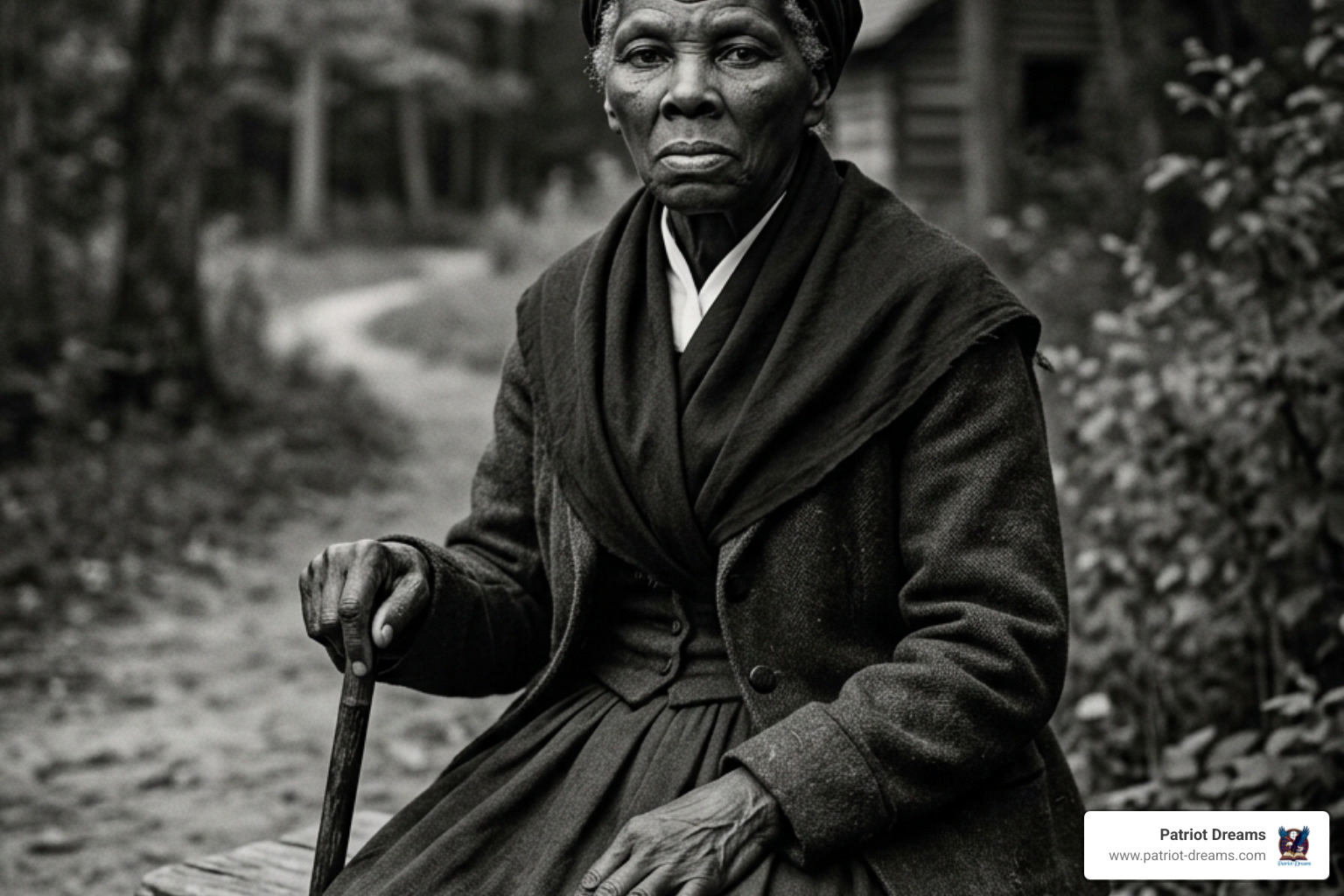
Harriet Tubman was an American abolitionist, Civil War spy, and freedom fighter who escaped slavery in 1849 and went on to liberate dozens of others — becoming one of the most courageous figures in American history.
Here's a quick look at who she was:
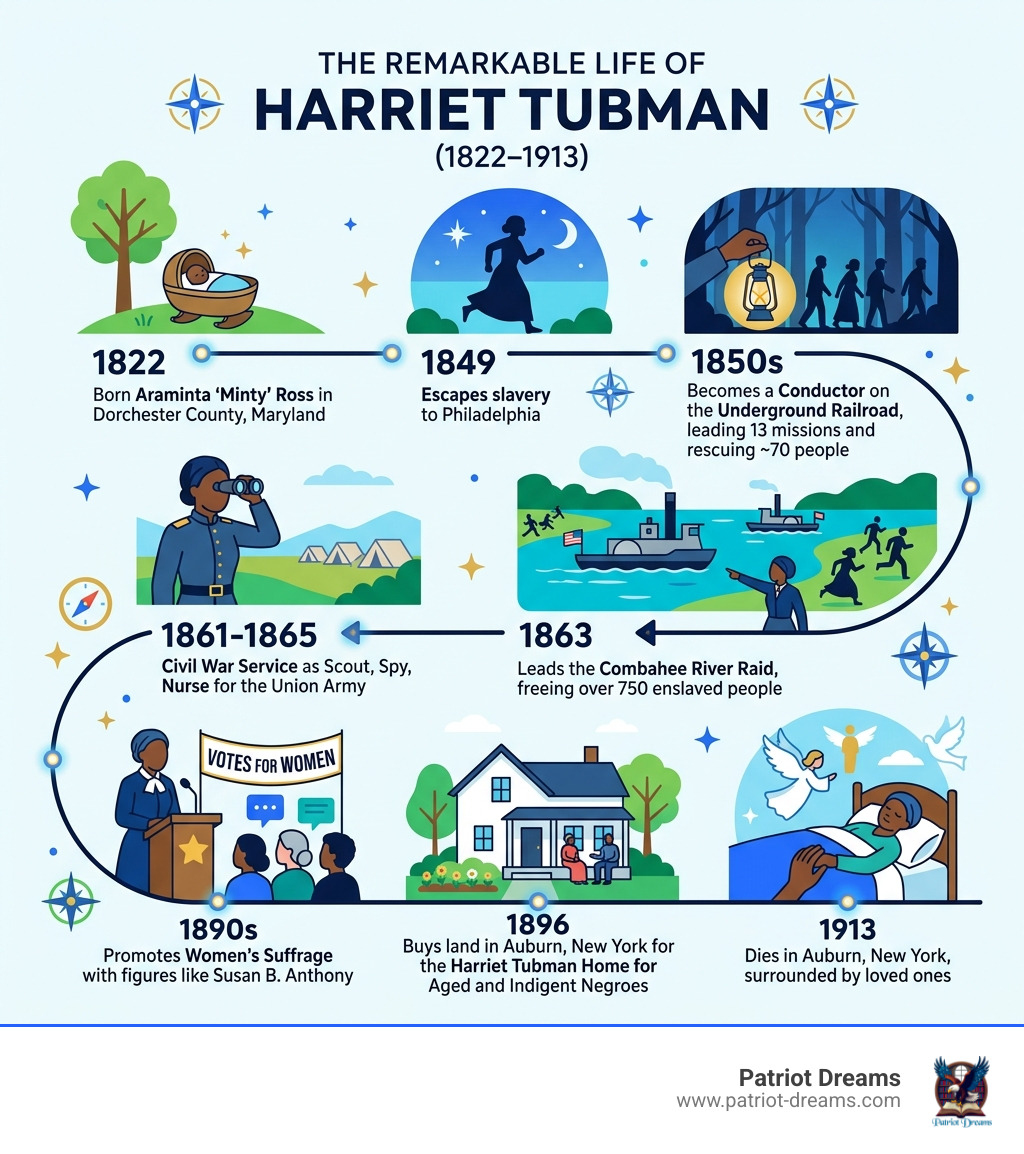
- Born: Araminta "Minty" Ross, circa March 1822, in Dorchester County, Maryland
- Died: March 10, 1913, in Auburn, New York, aged 90–91
- Known for: Conducting 13 missions on the Underground Railroad, rescuing approximately 70 people
- Civil War role: Scout, spy, nurse, and leader of the Combahee River Raid, which freed more than 750 enslaved people
- Nickname: "Moses" — because she led her people to freedom
- Legacy: First woman in U.S. history to lead an armed military raid; posthumously awarded the rank of Brigadier General in 2024
There's a famous quote often attributed to Tubman that captures everything about who she was:
"I was conductor of the Underground Railroad for eight years, and I can say what most conductors can't say — I never ran my train off the track and I never lost a passenger."
Think about that for a moment.
A woman born into slavery, with no formal education, suffering from a painful head injury her entire life — and yet she never lost a single person in her care. Not once.
Her story isn't just a history lesson. It's a reminder of what one person's courage, faith, and determination can do. It's the kind of story that stays with you.
At Patriot Dreams, we believe stories like Harriet's deserve to be told with warmth, care, and the deep respect they've earned. Whether you're a lifelong history lover or just beginning to explore America's past with your family, Tubman's life has something to teach all of us about resilience, compassion, and the quiet power of doing what's right.
Let's walk through her extraordinary life together.
Harriet Tubman terms to remember:
The Early Life and Resilience of Araminta Ross
Long before she was a household name, she was a little girl named Araminta Ross, affectionately called "Minty" by her family. Born into the harsh reality of slavery on Maryland’s Eastern Shore in Dorchester County, her early years were marked by the kind of hardships that would break most spirits.

Minty was born to Ben and Rit Ross, a couple who did their best to keep their family together despite the constant threat of separation. Life for a young enslaved child was grueling; by age five or six, she was already being "hired out" to work for other families. She served as a nursemaid, where she was whipped if the baby cried, and later worked as a field hand and woodcutter.
Working alongside her father in the timber fields wasn't just labor; it was an education. She learned the layout of the land, how to navigate the woods, and how to communicate with Black sailors who traveled the waterways. These skills, as noted by the Harriet Tubman (U.S. National Park Service), would later become the tools of her trade as a conductor.
The Injury That Shaped Harriet Tubman’s Faith
When Minty was about 13 years old, a traumatic event changed her life forever. While at a dry goods store, an overseer threw a two-pound metal weight at a runaway enslaved person. The weight missed its target and struck Minty squarely in the head, fracturing her skull.
The injury was severe. For the rest of her life, she suffered from what we now recognize as temporal lobe epilepsy or narcolepsy. She would fall into deep "sleeping spells" without warning, even in the middle of a conversation. However, Minty didn't view this as a disability. During these spells, she experienced vivid religious visions and dreams that she believed were direct communications from God. This deep spiritual connection gave her a sense of divine protection and a fearlessness that defined her character, a detail beautifully explored in Harriet Tubman | Biography, Facts, & Underground Railroad | Britannica.
A Name Change and a Journey to Freedom
In 1844, Minty married a free Black man named John Tubman. It was around this time that she adopted her mother’s name, becoming Harriet Tubman. Despite her marriage, the threat of being sold further south loomed. In 1849, following the death of her enslaver, Harriet decided she would no longer live in chains.
Her first attempt at escape with her brothers failed when they turned back out of fear. But Harriet was undeterred. She set out alone, traveling nearly 90 miles from Maryland to Philadelphia. Using the North Star as her guide and the skills she’d learned in the woods, she crossed into Pennsylvania, a free state.
She later recalled the feeling: "When I found I had crossed that line, I looked at my hands to see if I was the same person. There was such a glory over everything; the sun came like gold through the trees, and over the fields, and I felt like I was in Heaven." This spirit of liberation is shared by many Famous Black Men throughout our history.
Conductor of the Underground Railroad: Leading the Way Home
Harriet was free, but she couldn't enjoy that freedom while her family remained in bondage. Over the next decade, she became the most famous "conductor" of the Underground Railroad. This wasn't a real railroad with tracks, but a secret network of safe houses and brave individuals who helped people flee to the North and Canada.

Between 1850 and 1860, Harriet made approximately 13 dangerous missions back into Maryland. She personally rescued about 70 family members and friends. Additionally, she provided specific instructions to another 50 to 60 people who escaped on their own. Her work was so impactful that she earned the nickname "Moses."
The Fugitive Slave Act of 1850 made her work even more dangerous. It required that escaped persons be returned to their enslavers, even if they were found in "free" Northern states. In response, Harriet began leading her "passengers" all the way to St. Catharines, Ontario, in Canada. As a Harriet Tubman (circa 1822-1913) National Historic Person, she is celebrated in Canada for her role in the abolitionist movement there.
How Harriet Tubman Never Lost a Passenger
Harriet was a master of strategy. She often scheduled her escapes for Saturday nights because runaway notices wouldn't appear in the newspapers until Monday morning, giving her a two-day head start. She used disguises—like carrying live chickens to look like a simple farmhand—and communicated using coded spirituals like "Swing Low, Sweet Chariot."
She also maintained an "iron discipline." To protect the group and the secret routes, she carried a revolver. If someone grew too frightened and wanted to turn back, she would tell them, "Go on or die." She knew that if one person returned and was tortured, the entire network could be destroyed. Her commitment to the safety of others is a cornerstone of the Civil Rights Movement legacy.
Strategic Alliances and the Raid on Harpers Ferry
Harriet’s reputation grew among the leading abolitionists of the day. She was close friends with Frederick Douglass and worked alongside the radical abolitionist John Brown. Brown had such high respect for her tactical mind that he called her "General Tubman."
She helped Brown plan his famous 1859 raid on Harpers Ferry, though she was unable to participate herself due to illness. Her ability to organize and inspire was legendary, much like the power found in a Sojourner Truth speech.
General Tubman: A Heroine of the Civil War
When the Civil War broke out, Harriet didn't sit on the sidelines. She traveled to South Carolina to serve the Union Army. She wore many hats: nurse, cook, laundress, and most importantly, scout and spy.
She used her knowledge of the terrain and her ability to blend in to gather intelligence behind Confederate lines. Much like the story of Stealing Freedom How Robert Smalls Commandeered A Confederate Warship, Harriet’s contributions were vital to the Union’s success in the South. You can find more about these military efforts through the Harriet Tubman | American Battlefield Trust.
The Combahee River Raid and the Gift of Liberty
On June 1, 1863, Harriet Tubman made history. Working with Colonel James Montgomery, she became the first woman to lead an armed military operation in the United States. She led three Union gunboats up the Combahee River, bypassing Confederate "torpedoes" (mines) she had located through her spy network.
The raid was a massive success. They destroyed Confederate supply lines and liberated more than 750 enslaved people from rice plantations. As the boats pulled away, hundreds of people ran toward the water, seeking the freedom Harriet represented. This heroic act is a shining example of the bravery seen in Rising From The Shadows How Cathay Williams And African American Soldiers Inspired New Hope During The Civil War.
A Soldier’s Struggle for Recognition
Despite her incredible service, Harriet faced a long battle for the recognition and compensation she deserved. For over three years of service, she was paid a total of only $200. It wasn't until the 1890s that she began receiving a small pension, and even then, it was primarily because of her second husband, Nelson Davis, who was a Civil War veteran.
In 1898, she filed an affidavit in Cayuga County, New York, supported by high-ranking officials, to claim her own military pension. She signed the document with an "X," a humble mark from a woman who had changed the course of history.
A Legacy of Care: Post-War Activism and the Auburn Years
After the war, Harriet settled in Auburn, New York, on land she had purchased from William Seward, Lincoln’s Secretary of State. Her home became a sanctuary once again, this time for her elderly parents and other formerly enslaved people who had nowhere else to go.
She also became a passionate advocate for women's suffrage. She worked alongside leaders like Susan B. Anthony, attending conventions and speaking about her experiences. As the Harriet Tubman - National Women's History Museum notes, she believed that the right to vote was essential for the true freedom of all people.
Perseverance Through Personal Hardship
Harriet’s later years were not easy. She struggled financially and continued to suffer from the effects of her childhood head injury. In the late 1890s, she underwent brain surgery at Massachusetts General Hospital to alleviate the pressure. In a display of the same "iron discipline" she showed on the Underground Railroad, she refused anesthesia, choosing instead to bite a bullet just as she had seen soldiers do during the war.
Harriet passed away on March 10, 1913, surrounded by friends and family. She was buried with full military honors at Fort Hill Cemetery in Auburn. Her life of service paved the way for future leaders, a journey reflected in the Rosa Parks story.
Honoring the Lasting Impact of Harriet Tubman
Today, Harriet Tubman is recognized as a true American hero. Her legacy is preserved in National Historical Parks in both Maryland and New York. In 2024, she was posthumously awarded the rank of one-star Brigadier General in the Maryland National Guard, finally receiving the formal military recognition she earned on the battlefields of South Carolina.
| Historical Role | Modern Honor / Recognition |
|---|---|
| Underground Railroad Conductor | Two National Historical Parks dedicated to her |
| Civil War Scout and Spy | Posthumous rank of Brigadier General (2024) |
| Humanitarian and Activist | Image selected for the U.S. $20 bill |
| Leader of the Combahee Raid | First woman to lead a U.S. military operation |
Lesser-Known Facts About a True American Hero
To truly understand Harriet, it helps to look at the smaller details of her life:
- Environmental Literacy: She was an expert at navigating by the stars and identifying native plants for food and medicine.
- Networker: She used her time working in timber fields to build a secret network of informants among Black sailors.
- The Chicken Disguise: To avoid a former enslaver on the street, she once released a pair of live chickens and chased them, using the commotion to hide her face.
- Illiteracy as a Tool: She once sat on a train and pretended to read a newspaper to divert suspicion, as it was well-known "Minty" couldn't read.
- Total Journeys: While she made 13 missions to Maryland, some records suggest her total number of rescue-related trips reached 19.
Frequently Asked Questions about Harriet Tubman
How many people did Harriet Tubman actually rescue?
While legends sometimes suggest hundreds, modern research confirms she personally led about 70 people to freedom over 13 missions. However, her impact was much larger: she gave instructions to 50–60 others and led a raid that liberated over 750 people during the Civil War.
What was Harriet Tubman's birth name?
She was born Araminta Ross and was called "Minty" as a child. She changed her name to Harriet (after her mother, Rit) around the time of her marriage to John Tubman.
Did Harriet Tubman ever lose a passenger?
No. She famously stated that she "never ran my train off the track and never lost a passenger." Her meticulous planning and strict discipline ensured that every person who stayed with her reached safety.
Conclusion
Harriet Tubman’s life is a testament to the fact that you don't need a title or a formal education to change the world. You just need a heart full of courage and a spirit that refuses to be broken. She was a woman of deep faith, a brilliant strategist, and a tireless caretaker of her community.
At Patriot Dreams, we are honored to help you explore these stories of everyday heroism. Our audio storytelling platform and interactive maps are designed to bring history to life, making the legacy of figures like Harriet Tubman personal and accessible for your family.
We hope you feel inspired by Harriet’s journey. Her story reminds us that even in the darkest times, there is always a North Star to guide us home.

Join the Patriot Dreams Community
Download the app today and start your journey through American history and personal legacy.

Explore Our Latest Insights
Dive into stories that shape our American legacy.