Sacred Earth and Star Spirits in Native American Creation Legends

Why Native American Creation Legends Matter
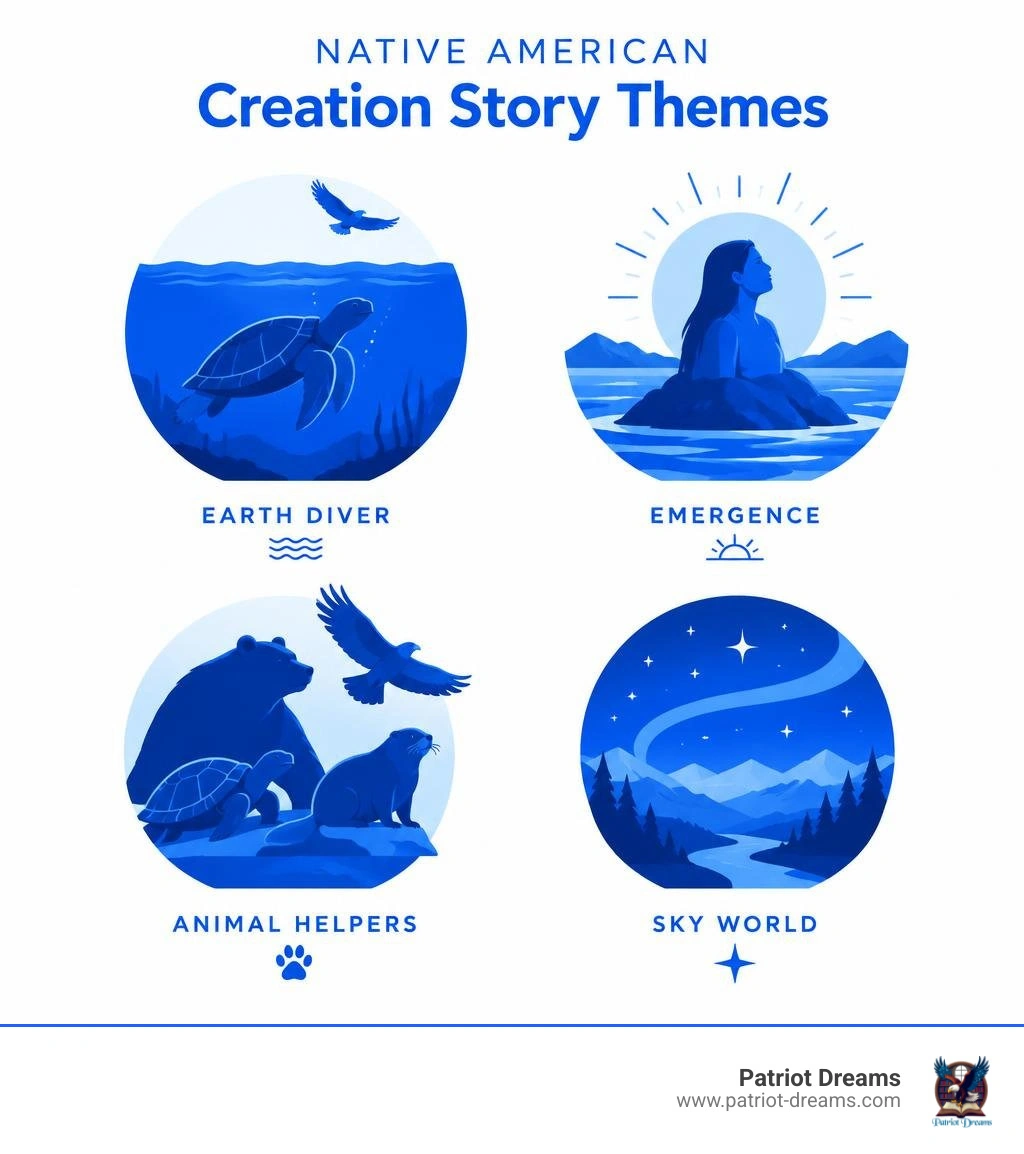
Native American creation legends are many distinct Indigenous origin stories, not one shared mythology. They explain how land, people, animals, stars, and sacred responsibilities came to be. Across regions, stories may describe animals bringing earth from deep water, ancestors emerging from earlier worlds, or sky beings shaping life. Their most enduring lesson is simple: humans belong within nature, with duties to other living beings.
These traditions are tied to specific peoples and homelands. Haudenosaunee stories tell of Sky Woman and Turtle Island. Cherokee accounts describe a water beetle raising mud to form land. Diné teachings follow a journey through successive worlds, while Lakota emergence accounts connect ancestral beginnings to sacred places such as Wind Cave.
Read them with care. Versions can differ by community, family, season, and storyteller, because these are living oral traditions rather than one fixed text. In this guide, we will explore the shared patterns while honoring the important differences.
We are Kyle & Emily, and we invite you to explore these sacred stories as pathways into the enduring heritage of America's first peoples.
Essential native american creation legends terms:
- american indian myths and legends by richard erdoes
- Lewis and Clark expedition
- The Legacy of Fred Rogers
Core Motifs Across Indigenous Origin Traditions
When we take time to sit quietly and listen to the ancient accounts of this continent, we notice deep patterns woven through different landscapes. Indigenous cosmologies do not separate spirituality from the soil underfoot; rather, sacred geography, animal kinship, and moral duties are bound together in every spoken word.
Across hundreds of distinct nations, oral traditions often organize cosmic history around specific narrative frameworks. These structural patterns help explain humanity's humble beginnings, our responsibilities to fellow creatures, and the delicate balance required to live in harmony with the cosmos.
| Creation Motif | Geographic Regions | Core Themes | Key Figures / Elements |
|---|---|---|---|
| Earth-Diver | Northeast Woodlands, Great Lakes, Plains, Southeast | Primordial waters, humble sacrifice, animal collaboration | Muskrat, Beaver, Water Beetle, Great Turtle, Sky Woman |
| Emergence | American Southwest, Great Basin, Northern Plains | Ascending through layered worlds, spiritual transformation | Wind Cave, Holy People, Spider Grandmother, Tokahe |
| Cosmic Dualism | Eastern Woodlands, Iroquoian Nations | Balance between competing energies, complementary nature | Twin Brothers (Right-Handed and Left-Handed), Creator Beings |
| Trickster Catalyst | Great Plains, Great Basin, Pacific Northwest, California | Disruption, humor, mortal lessons, origin of boundaries | Coyote, Iktomi (Spider), Raven, Sinawav |
Earth-Diver Motifs in Native American Creation Legends
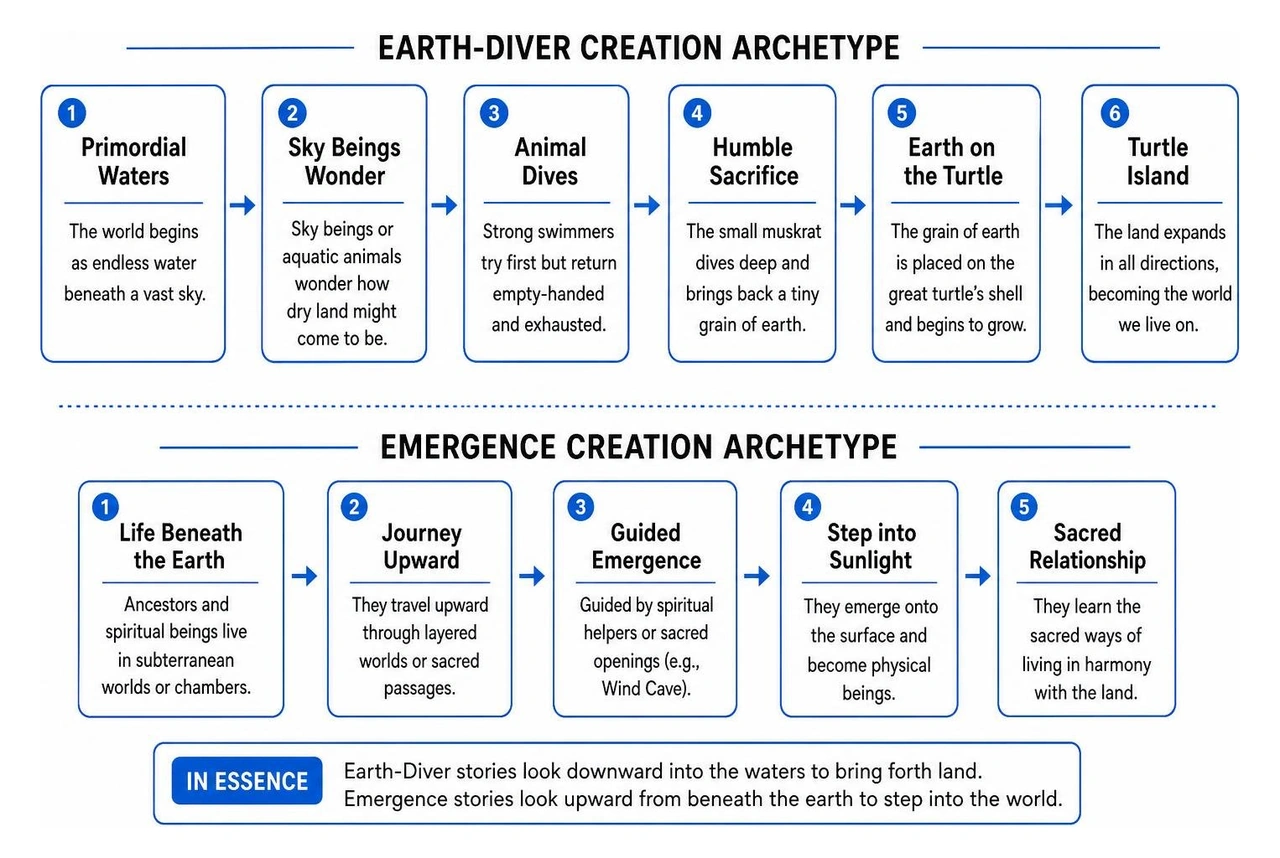
One of the most widespread and heartfelt patterns in North American lore is the Earth-Diver motif. In these narratives, the world begins as an endless expanse of primordial water beneath a vast sky. Sky beings look down upon the waters, or aquatic animals swim across the surface, wondering how dry land might come to be.
To create the world, animals take turns diving deep into the dark waters to retrieve a tiny grain of mud or soil. In many traditions, powerful and swift swimmers—such as the beaver, the otter, or the loon—attempt the dive first but return exhausted and empty-handed. Finally, the smallest or most humble creature, often the little muskrat, volunteers. With quiet courage, the muskrat descends into the crushing depths, sacrificing its very breath to bring back a small speck of earth clenched tightly in its paw.
When this tiny grain of soil is placed upon the sturdy shell of a giant turtle, it begins to expand in all directions, growing into what many Indigenous peoples refer to as Turtle Island. As shared in The Creation Story – Meherrin Indian Nation, the creation of dry land was never the act of a single, all-powerful ruler acting in isolation. It was an act of communal love, perseverance, and profound cooperation between sky beings and humble water creatures.
Emergence Narratives in Native American Creation Legends
While Earth-Diver accounts look downward into the ocean depths, emergence narratives look upward from beneath the soil. Common across the American Southwest and the Great Plains, emergence stories describe ancestors, animal peoples, and spiritual beings journeying upward through subterranean chambers or layered worlds before arriving on the earth’s surface.
These journeys are rarely easy. They represent spiritual maturation, moral growth, and perseverance. In the Northern Plains, The Lakota Emergence Story - Wind Cave National Park (U.S. National Park Service) recounts how ancestral beings lived in subterranean spirit lodges beneath the Black Hills. Guided through a sacred breathing opening known as Oniya Oshoka (today known as Wind Cave), they stepped forth into the sunlight to learn the sacred ways of living as physical beings, forming an eternal relationship with the sacred landscape.
Cosmic Dualism and Moral Equilibrium
Creation is rarely presented as static or flawless in Indigenous oral histories. Instead, it is an ongoing dance of balance. Many traditions feature twin creators or complementary cosmic forces that shape the environment to reflect both light and shadow, ease and challenge.
Rather than framing existence as an absolute battle between pure good and pure evil where one side must utterly destroy the other, Indigenous dualism emphasizes dynamic equilibrium. If one twin creates sweet berries, clean springs, and gentle breezes, the other introduces thorns, swift river rapids, and winter storms. This balance reminds us that life requires both comfort and struggle to foster strength, wisdom, and resilience. Understanding these foundational balances provides crucial insight into the wider tapestry of Native American history, where ethics and nature are intertwined.
Regional Traditions and Tribal Cosmologies

Every Indigenous origin story is deeply anchored to a specific homeland. The granite peaks, rushing rivers, pine forests, and desert canyons are not mere backdrops; they are the living characters and sacred monuments born directly from the moments of creation.
Haudenosaunee and Northeast Woodland Traditions
Among the Haudenosaunee (Iroquois) nations, origin traditions begin in the celestial Sky World. At the center of this realm stood a radiant Celestial Tree whose blossoms filled the sky with fragrant light. When the tree was uprooted, a pregnant woman known as Sky Woman peered into the open chasm below. As she slipped through the opening, she tumbled down toward an infinite expanse of dark water.
Seeing her fall, a flock of waterbirds flew upward, joining their wings together to create a soft, living cushion that gently lowered her downward. A great turtle offered its shell as a resting place, and after the humble muskrat brought up earth from the ocean floor, Sky Woman danced in circles upon the turtle's back, moving in the direction of the sun. As her feet touched the earth, the mud expanded into a vast continent.
Sky Woman gave birth to a daughter, who later gave birth to twin boys: the Right-Handed Twin (often associated with daylight, smooth waters, and nourishing plants) and the Left-Handed Twin (associated with night, jagged mountains, and fierce creatures). From the mother’s resting place grew the sacred sustenance of life: corn, beans, and squash—affectionately known as the Three Sisters. These foundational events are explored further in our look at Iroquois Confederacy origin stories.
Cherokee and Southeastern Earth Formation
In the traditional homelands of the Southeast, Cherokee elders teach that the earth is a great island floating peacefully in a sea of water, suspended at each of the four cardinal directions by cords hanging down from a solid rock sky vault.
When the animals lived crowded in the sky world (Gälûñ'lätï), they wondered what lay beneath the waters. The brave little Water Beetle, Dayuni'si ("Beaver's Grandchild"), volunteered to dive down into the darkness. Searching the ocean floor, the beetle brought up a bit of soft mud, which quickly spread outward to form the earth.
At first, the land was flat, soft, and wet. The Great Buzzard flew down to inspect it, gliding close over the damp ground. As the buzzard grew tired, its heavy wings struck the soft mud; where the wings touched down, deep valleys formed, and where they lifted, towering mountains rose, creating the majestic Blue Ridge and Great Smoky Mountains. As documented in archival Native American creation stories, the Cherokee ancestors also adjusted the placement of the sun seven handbreadths high so that every plant and creature could enjoy gentle warmth without burning.
Diné (Navajo) Four Worlds Journey
The epic creation narrative of the Diné people, known as Diné Bahaneʼ, chronicles an upward pilgrimage through four distinct layered worlds, each associated with a sacred color and cardinal direction:
- The First World (The Dark World - Niʼ Hodiłhił): A misty realm where insect beings and spiritual entities first lived by the glow of sacred cardinal lights.
- The Second World (The Blue World - Niʼ Hodootłʼizh): Inhabited by blue-feathered birds and mammals, where beings sought greater harmony and learned essential lessons of peaceful coexistence.
- The Third World (The Yellow World - Niʼ Hałtsooí): A rich land of rivers where First Man and First Woman cultivated sacred plants, learned the art of weaving from Spider Woman, and survived a great flood.
- The Fourth World (The White World - Niʼ Hodisxǫs): The glittering present world, bounded by four sacred mountains, where the Holy People shaped the sun, moon, constellations, and the sacred Diné way of life (Hózhǫ́).
To delve into the complete sacred journey of the Holy People and the restoration of universal beauty, explore the detailed translation of the Navajo Diné Bahaneʼ – College of Western Idaho.
Lakota and Plains Emergence Accounts
For the Lakota people of the Great Plains, life is rooted in the boundless mystery of Wakan Tanka (the Great Mystery). In their emergence traditions, humanity originally dwelled in spirit lodges deep beneath the earth. A spiritual ancestor named Tokahe was the first to be led to the surface through the breathing opening of Wind Cave (Oniya Oshoka) in the sacred Black Hills (Paha Sapa).
Those early humans who emerged learned humility through their trials in the sunlit world. Traditional narratives recount how spiritual lessons reshaped the relationship between humans and the magnificent bison herds, establishing the buffalo as an elder relative who provides shelter, clothing, and food. The Lakota were given the Sacred Pipe and ceremonial ways to maintain absolute kinship with all things—encapsulated in the sacred prayer Mitákuye Oyásʼiŋ ("All My Relations").
Southwest and Great Basin Origin Traditions
Across the Great Basin and the Colorado Plateau, tribes such as the Southern Ute and Hopi maintain distinct traditions of their permanent geographic bonds:
- The Ute Tradition: The Utes hold that they have always lived in their ancestral mountain home. According to tribal accounts, the Creator Sinawav fashioned the people from willow twigs and placed them into a leather bag. Entrusted to deliver the bag, the curious trickster Coyote opened it prematurely, allowing diverse peoples to scatter across the valleys. Sinawav placed the remaining people—the resilient Utes—firmly in the shelter of the rugged Rocky Mountains.
- The Hopi Origin Tradition: Hopi ancestors emerged from the earth and met Màasaw, the humble caretaker of the land. He invited them to live simply, directing them to migrate to the four corners of the continent before gathering at their sacred Center Place on the high desert mesas, honoring Mother Earth through prayer, farming, and seasonal dances.
Universal Themes in Native American Creation Legends
While the details and geographic settings vary widely between tribes, several profound spiritual and philosophical themes unite these timeless stories.
Role of Animal Helpers and Sacred Beings
In almost every Indigenous creation narrative, animals are not inferior beings placed on earth to be dominated; they are our elders, teachers, and compassionate benefactors. Animals existed before humans and generously used their unique gifts—sharp vision, endurance, swimming ability, and wisdom—to make the world safe and habitable for human life.
From the loyal eagle who soars high to carry prayers to the sky world, to the industrious beaver and patient turtle who support our physical footing, animals are treated as sovereign relatives. To learn more about how legendary animals and spiritual guardians are remembered across different traditions, you can explore the ultimate American folklore creatures guide.
Tricksters as Catalysts of Transformation
No exploration of Indigenous lore would be complete without meeting the trickster figures. Whether taking the form of Coyote across the West, Iktomi the Spider among the Lakota, or Raven along the Pacific coast, the trickster is an essential cosmic catalyst.
Tricksters are neither purely benevolent nor purely wicked; they are delightfully complex, curious, impulsive, and deeply fallible—much like humans ourselves! Through their blunders and mischievous schemes, tricksters often introduce necessary realities into creation:
- The Origin of Mortality: When Coyote insists that a rock thrown into water must sink, he introduces death into the world so the earth does not become overcrowded.
- The Placement of the Stars: Impatient with the careful arrangement of constellations, Coyote flings a bag of mica dust into the heavens, scattering the Milky Way across the night sky.
- Humility and Caution: Trickster mishaps serve as entertaining cautionary tales, teaching children and adults alike the value of patience, honesty, and respect.
Worldview Comparisons and Global Parallels
When we compare Native American origin stories with the sacred texts of world cultures, fascinating parallels and meaningful distinctions emerge:
- The Primordial Waters: The concept of a vast, watery void before land appears is shared between Indigenous Earth-Diver stories, the opening of Genesis, and ancient Mesopotamian epics.
- The Great Flood: The renewal of the world following a cleansing flood appears in Diné, Lakota, and Ojibwe traditions, echoing Mesopotamian and Mediterranean accounts.
- Ecosystem Partnership vs. Human Mastery: While some Western traditions have historically emphasized human dominion over nature, Native American cosmologies place humans as humble partners within an interconnected web of life. Humans are often created last, serving not as rulers, but as the younger siblings of the plant and animal kingdoms.
Preservation and Modern Resonance of Indigenous Oral Traditions
For thousands of years, these sacred accounts were preserved not on printed paper, but through the living breath of oral storytelling. Knowledge was passed down from elders to youth around winter lodge fires, woven into ceremonial songs, painted onto sacred pottery, and carved into stone.
During the late nineteenth and early twentieth centuries, ethnologists and cultural anthologists began transcribing these spoken words into English texts. Classic collections like American Indian myths and legends by Richard Erdoes helped bring these remarkable narratives to broader reading audiences while honoring the voices of the elders who shared them.
Historical Recording and Oral Stewardship
While written anthologies helped preserve many stories during difficult eras of federal assimilation and boarding schools, Indigenous nations have always maintained that true oral tradition is alive. Storytelling involves tone of voice, cadence, facial expression, and seasonal timing—many stories, for instance, are sacred and may only be spoken during the quiet winter months when the earth sleeps.
Today, tribal historic preservation offices, Indigenous language revitalization programs, and community elders are using modern digital recording tools to capture their ancestors' native dialects. By preserving the original languages, they preserve the subtle humor, spiritual nuances, and philosophical depth embedded in every word.
Living Heritage and Cultural Continuity
These origin stories are far from dusty artifacts of the distant past; they remain vibrant, guiding lights that inform contemporary Indigenous identity, legal land rights, and environmental ethics. When modern tribal nations protect clean waters, sacred mountains, and native forests, they are actively honoring the original instructions given to their ancestors at the dawn of creation.
Exploring these sacred places and their historical roots helps all of us develop a deeper, more thoughtful appreciation for the soil beneath our shoes. You can take your own journey across these storied ancestral landscapes through our American history interactive map, connecting geographic landmarks with the cultural legacies that define them.
Frequently Asked Questions about Native American Origin Stories
What is the most common motif found in Native American creation stories?
The Earth-Diver motif is among the most widespread archetypes across North America, particularly throughout the Northeast, Great Lakes, Plains, and Southeast regions. It centers on water animals diving into primordial waters to retrieve mud, which is placed on a turtle's back to expand into the continent known as Turtle Island. In the Southwest and Plains, emergence motifs—where beings ascend from subterranean worlds—are equally prominent.
How do Native American creation legends view the relationship between humans and nature?
Indigenous creation traditions view humans not as masters of the natural world, but as equal and responsible participants within it. Animals, plants, rivers, and mountains are considered living relatives with their own spirits and purposes. Because animals and plants were created before humanity, they are regarded as elder teachers whom humans must treat with humility, gratitude, and reciprocity.
Why are trickster characters like Coyote so prominent in creation myths?
Tricksters such as Coyote, Iktomi, and Raven serve as essential cultural teachers. Through their humorous mistakes, selfish desires, and clever discoveries, tricksters explain how natural phenomena came to be (such as the arrangement of stars or the cycle of life and death). They provide entertaining, memorable moral lessons that teach community members the consequences of pride, greed, and disobedience.
Conclusion
When we listen closely to the ancient creation stories of this land, we are gently reminded of something deeply reassuring: we are all part of a larger, beautiful story. The earth beneath our feet, the winding rivers that quench our thirst, the towering mountains on the horizon, and the stars that twinkle above our neighborhoods are not silent, inanimate objects. In the eyes of America's first storytellers, they are living kin, inviting us every day to live with kindness, wonder, and care for one another.
Every family and community carries sacred memories and lessons passed down across generations. Just as Indigenous elders have faithfully kept the wisdom of their ancestors burning like a warm hearth fire, our mission at Patriot Dreams is to help every family preserve, celebrate, and listen to the diverse voices that make up our nation's story. Through our interactive audio maps and legacy listening experiences, we welcome you to pull up a comfortable chair, listen with an open heart, and explore America's 250-year heritage and timeless ancestral stories. May we walk gently upon this sacred earth, always grateful for the stories that connect us all.

Join the Patriot Dreams Community
Download the app today and start your journey through American history and personal legacy.

Explore Our Latest Insights
Dive into stories that shape our American legacy.