Thomas Jefferson Facts That Will Make You Re-Read Your History Books

The Thomas Jefferson Facts That Still Surprise Us Today
Thomas Jefferson facts are some of the most fascinating, surprising, and deeply human stories in all of American history.
Here are the key facts at a glance:
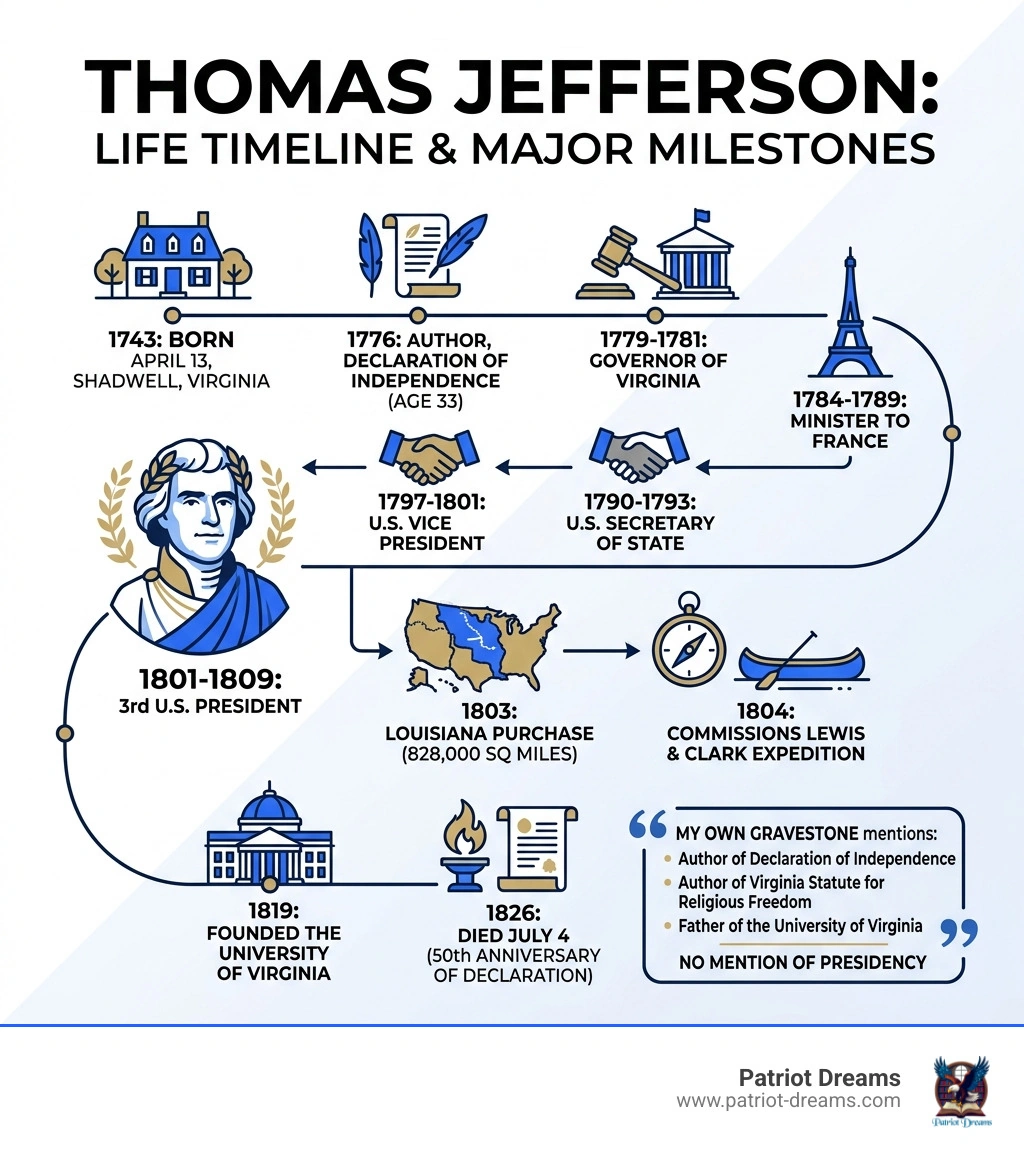
- Born: April 13, 1743, in Shadwell, Virginia
- Died: July 4, 1826 — the exact 50th anniversary of the Declaration of Independence
- Best known for: Writing the Declaration of Independence at age 33
- President: 3rd President of the United States (1801–1809)
- Biggest presidential achievement: The Louisiana Purchase — 828,000 square miles for $15 million
- Owned: More than 600 enslaved people during his lifetime
- Other roles: Governor of Virginia, Secretary of State, Vice President, Minister to France
- Personal talents: Architect, inventor, scientist, linguist (6 languages), and passionate book collector
- Legacy highlight: Founded the University of Virginia and authored the Virginia Statute for Religious Freedom
- His own gravestone: Made no mention of his presidency — only his writings and the university
There is something quietly remarkable about a man who could write the words "all men are created equal" and also spend his entire life wrestling with the world he was born into. Jefferson was brilliant and complicated, visionary and flawed — in other words, deeply human.
He studied 15 hours a day in college. He wrote over 19,000 letters in his lifetime. He designed his own home, Monticello, over 40 years and never quite considered it finished. And when he died, his last wish was to be remembered not as a president, but as a teacher and a writer.
His story is one of America's most honest mirrors — showing us both how far we've come and how much those early ideals still matter.
Thomas Jefferson facts word roundup:
- Founding Fathers
- The Declaration of Independence: What It Really Says and Why It Still Matters
- who are founding fathers of usa
The Early Years of a Curious Mind
Imagine a young boy roaming the thick woods of the Virginia Piedmont, his pockets likely filled with interesting stones or a well-worn book. Born on April 13, 1743, at Shadwell Plantation, Thomas Jefferson was the son of Peter Jefferson, a successful planter and surveyor, and Jane Randolph, who came from one of Virginia’s most prominent families.
When we look at Thomas Jefferson facts, his early education reveals a man who was almost obsessed with understanding the world. After his father passed away when Thomas was just 14, he inherited about 3,000 acres of land and 30 enslaved individuals. This early responsibility didn't slow his academic drive; if anything, it seemed to fuel it.
He eventually made his way to the College of William & Mary in Williamsburg. During his second year, he was known to study for 15 hours a day, leaving only three hours for his violin practice and a few precious hours for eating and sleeping. It was here that he met George Wythe, a renowned legal mind who became his mentor. Wythe didn't just teach him the law; he taught him how to think about justice and the "natural rights" of man.

Jefferson once recalled that as a student, he was often invited to dinners with his mentors where he heard "more common good sense" than in the rest of his life. These conversations shaped the young man who would eventually use his pen to change the course of history. You can learn more about his formative influences in this Thomas Jefferson | Biography, Political Career, Slavery, & Facts | Britannica overview.
Thomas Jefferson Facts: The Architect of American Liberty
In June 1776, a 33-year-old Jefferson sat in a rented room in Philadelphia, tasked with a job that would weigh heavily on anyone’s shoulders. He was part of the "Committee of Five," but the others—including Benjamin Franklin and John Adams—insisted that Jefferson do the actual writing because of his "peculiar felicity of expression."
For 17 days, he worked in relative isolation, drafting the Declaration of Independence. He wasn't trying to say something brand new; he was trying to find the right words for what everyone was feeling. He drew on the idea of "natural rights"—the belief that every person is born with certain rights that no king can take away.
When we talk about Thomas Jefferson And The Declaration Of Independence How A Nation Found Its Voice, we are talking about a moment where a young nation finally found the courage to speak its truth. It’s a document that still challenges us today to live up to its promise. For a deeper look at the text itself, check out The Declaration Of Independence What It Really Says And Why It Still Matters.
Thomas Jefferson facts about the power of the written word
Jefferson’s belief in liberty wasn’t just about breaking away from England. He was deeply committed to the idea that a person’s mind should be free. One of the Thomas Jefferson facts he was most proud of was his authorship of the Virginia Statute for Religious Freedom.
Before this statute, people in Virginia could be forced to pay taxes to a church they didn't attend or be barred from public office because of their beliefs. Jefferson believed that "Almighty God hath created the mind free." This document laid the crucial groundwork for the First Amendment and the separation of church and state we value so much today. You can see how these ideas influenced our founding documents in The Us Constitution Bill Of Rights Explained Simply.
His political career before the presidency was a whirlwind of service: he served as the Governor of Virginia, the U.S. Minister to France (where he developed a love for French culture and food), and the nation’s first Secretary of State under George Washington. You can read more about these early roles at the Thomas Jefferson - White House Historical Association site.
Thomas Jefferson facts regarding a complex and human legacy
It is impossible to tell the story of Thomas Jefferson without talking about the great contradiction of his life. The man who wrote that "all men are created equal" owned more than 600 enslaved people over the course of his lifetime. This is one of the most difficult Thomas Jefferson facts to reconcile, but it is an essential part of our history.
At Monticello, the enslaved community was the backbone of his daily life. We know today, through both historical records and DNA evidence, that Jefferson fathered at least six children with Sally Hemings, an enslaved woman at Monticello. Four of those children survived to adulthood and were eventually freed.
This part of his legacy reminds us that even our greatest heroes were deeply flawed people living in a complicated time. When we explore the Founding Fathers, we see men who were capable of visionary brilliance and profound human failure. Understanding Who Are Founding Fathers Of Usa means looking at the whole picture—the triumphs and the shadows alike.
A President Who Dreamed of a Growing Nation
When Jefferson became the third president in 1801, he wanted to move the country in a new direction. He preferred a smaller government and a nation of independent farmers. But his most famous act as president was actually a massive expansion of government power: the Louisiana Purchase.
In 1803, Jefferson sent James Monroe and Robert Livingston to France with a modest goal: buy New Orleans so American farmers could ship their goods down the Mississippi River. To their surprise, Napoleon Bonaparte offered to sell the entire Louisiana Territory for $15 million.
This deal nearly doubled the size of the United States, adding 828,000 square miles of land. It was a bargain—about three cents an acre! To explore this new "Empire of Liberty," Jefferson tapped his personal secretary, Meriwether Lewis, and William Clark to lead an expedition to the Pacific Ocean. Their journey, aided by Sacagawea, remains one of the greatest adventure stories in our history. For more on his time in office, the Thomas Jefferson: Life in Brief | Miller Center provides an excellent summary.
The Renaissance Man of Monticello
If you were to visit Jefferson at his home, Monticello, you might find him in his library, or perhaps in his garden experimenting with a new type of pea. He was a true "Renaissance Man" who believed that "architecture is my delight."
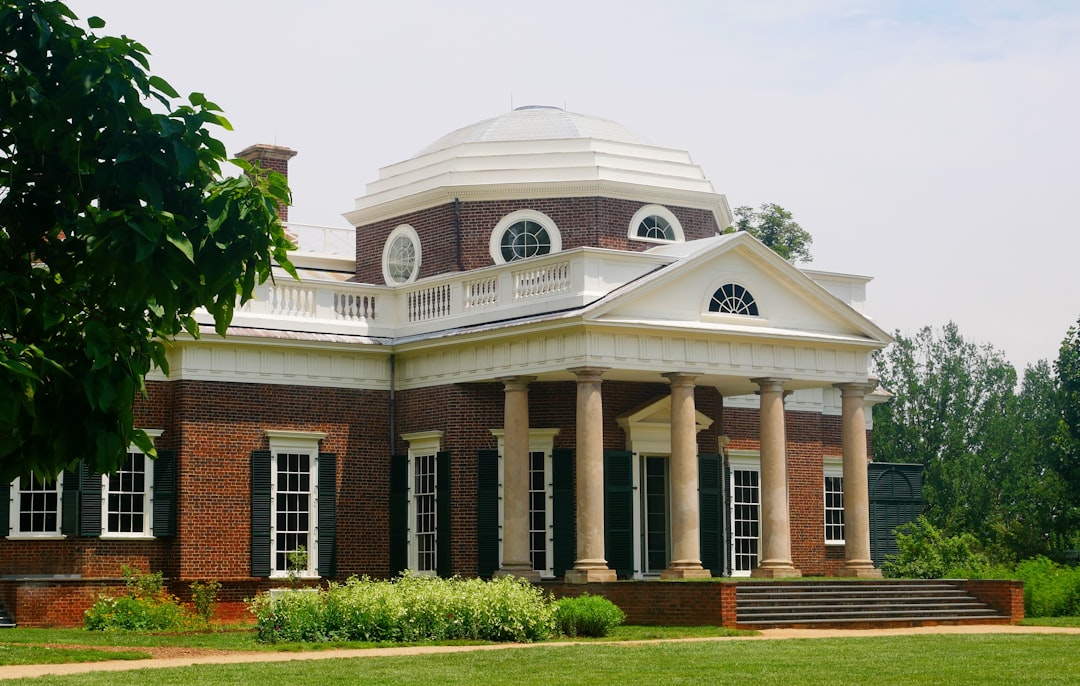
He designed Monticello in a Neoclassical, Palladian style, topped with an iconic dome that was the first of its kind on an American home. But his creativity didn't stop with buildings. He was a restless inventor who created:
- An iron moldboard for a plow that helped farmers dig deeper furrows.
- A "polygraph" machine (not a lie detector, but a device that made a copy of a letter as he wrote it).
- A revolving bookstand that could hold five books at once.
Jefferson was also a "founding foodie." He is credited with popularizing macaroni and cheese, ice cream, and French fries in America. He even had a pasta machine brought over from Europe! His curiosity was endless, and his personal library grew so large (nearly 6,500 volumes) that he sold it to Congress to jumpstart the Library of Congress after the British burned the original collection in 1814.
He was truly one of the most unique Historical American Figures to ever hold office. You can find him on our list of Us Historical Figures who shaped the American spirit through both politics and personal passion.
A Legacy of Connection and Reflection
In his later years, Jefferson didn't slow down. He founded the University of Virginia, designing the buildings (including the beautiful Rotunda) and even helping to choose the books for the library. He wanted it to be a place where "the boundless field of public law" could be studied without the influence of religious dogma.
One of the most touching Thomas Jefferson facts is his renewed friendship with John Adams. The two men had been close friends, then bitter political rivals, and finally, in their old age, they became constant pen pals. They wrote to each other about everything—history, philosophy, and their hopes for the country they helped build.
On July 4, 1826—exactly 50 years to the day after the Declaration of Independence was adopted—Thomas Jefferson passed away at the age of 83. In an almost unbelievable coincidence, John Adams died just a few hours later. Adams’ final words were reportedly, "Thomas Jefferson survives," unaware that his friend had passed earlier that morning.
Jefferson’s life is a central chapter in any American Historical Figures Complete Guide. He remains one of the most Famous Figures In American History because he represents the very essence of the American experiment: a constant search for truth, a deep love for liberty, and a lifelong commitment to learning.
Frequently Asked Questions about Thomas Jefferson facts
Where was Thomas Jefferson born?
Thomas Jefferson was born on April 13, 1743, at Shadwell Plantation in Albemarle County, Virginia. At the time, this was considered the "west," near the Blue Ridge Mountains.
What was Thomas Jefferson's greatest achievement as president?
Most historians agree that the Louisiana Purchase of 1803 was his greatest achievement. It doubled the size of the country for $15 million and paved the way for the Lewis and Clark Expedition and westward expansion.
When did Thomas Jefferson die?
He died on July 4, 1826. Remarkably, this was the 50th anniversary of the signing of the Declaration of Independence. He died on the same day as his friend and fellow Founding Father, John Adams.
Conclusion
At Patriot Dreams, we believe that history isn't just a collection of dates and names; it’s a tapestry of human stories. Thomas Jefferson’s life—with all its brilliant sunshine and its deep shadows—is a story that belongs to all of us. It’s a story of a man who dreamed of a nation where every person could pursue happiness, even as he struggled with the complexities of his own time.
Through our audio storytelling and interactive maps, we aim to bring these stories to life, helping you connect with the heritage that shaped our world. Whether it's the scratch of a pen in a Philadelphia room or the sound of a violin at Monticello, these moments are the heartbeat of our history.
We invite you to keep exploring, keep asking questions, and keep discovering the threads that connect your family’s legacy to the broader American journey. Explore more stories of our nation's journey at Patriot Dreams and let’s keep the conversation going.

Join the Patriot Dreams Community
Download the app today and start your journey through American history and personal legacy.

Explore Our Latest Insights
Dive into stories that shape our American legacy.