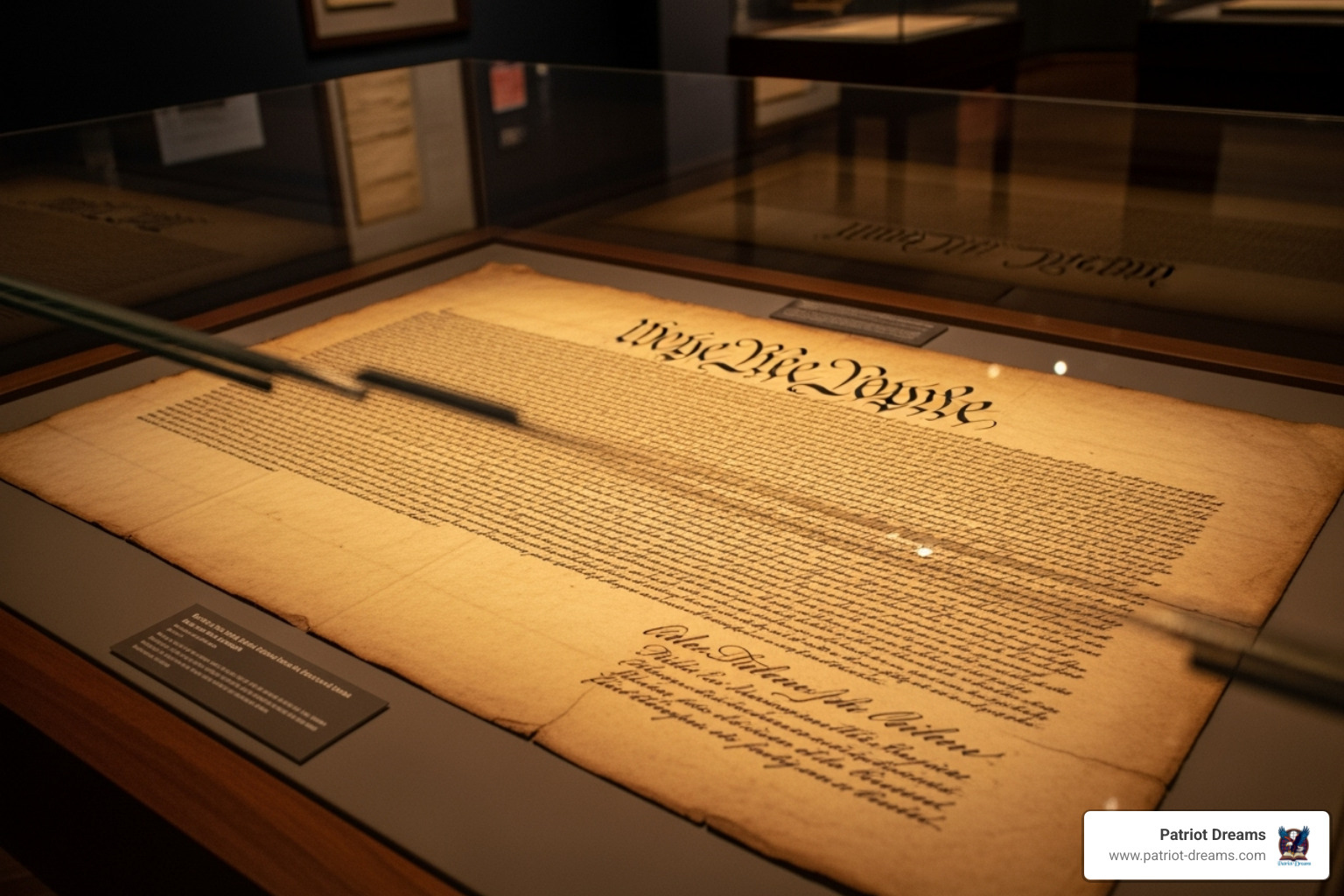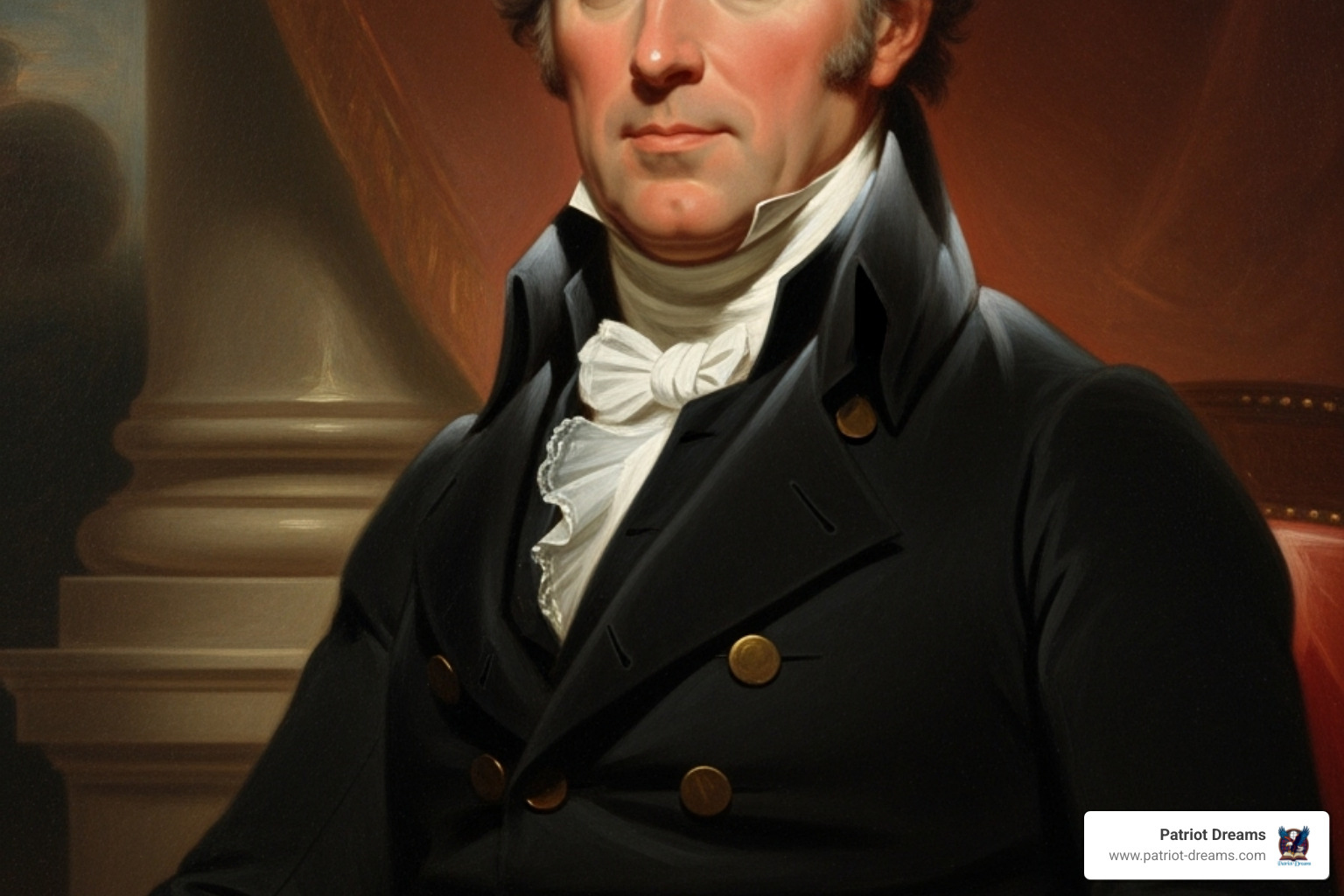
Samuel Adams: More Than Just a Name on a Beer Bottle
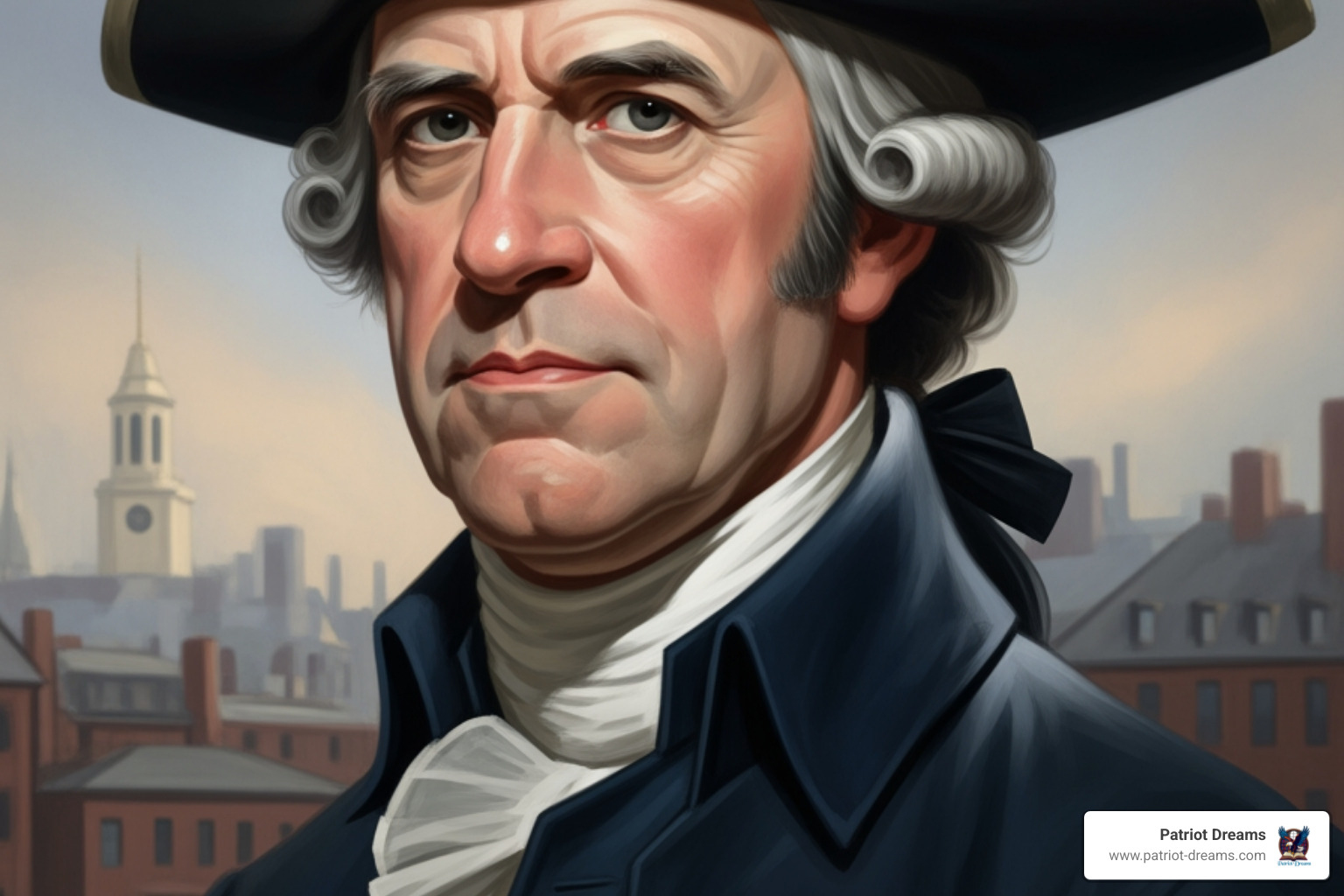

The Man Behind the Name: Who Was Samuel Adams, Patriot?
Samuel Adams patriot, Founding Father, and one of the earliest voices for American independence — here's a quick look at who he was and why he matters:
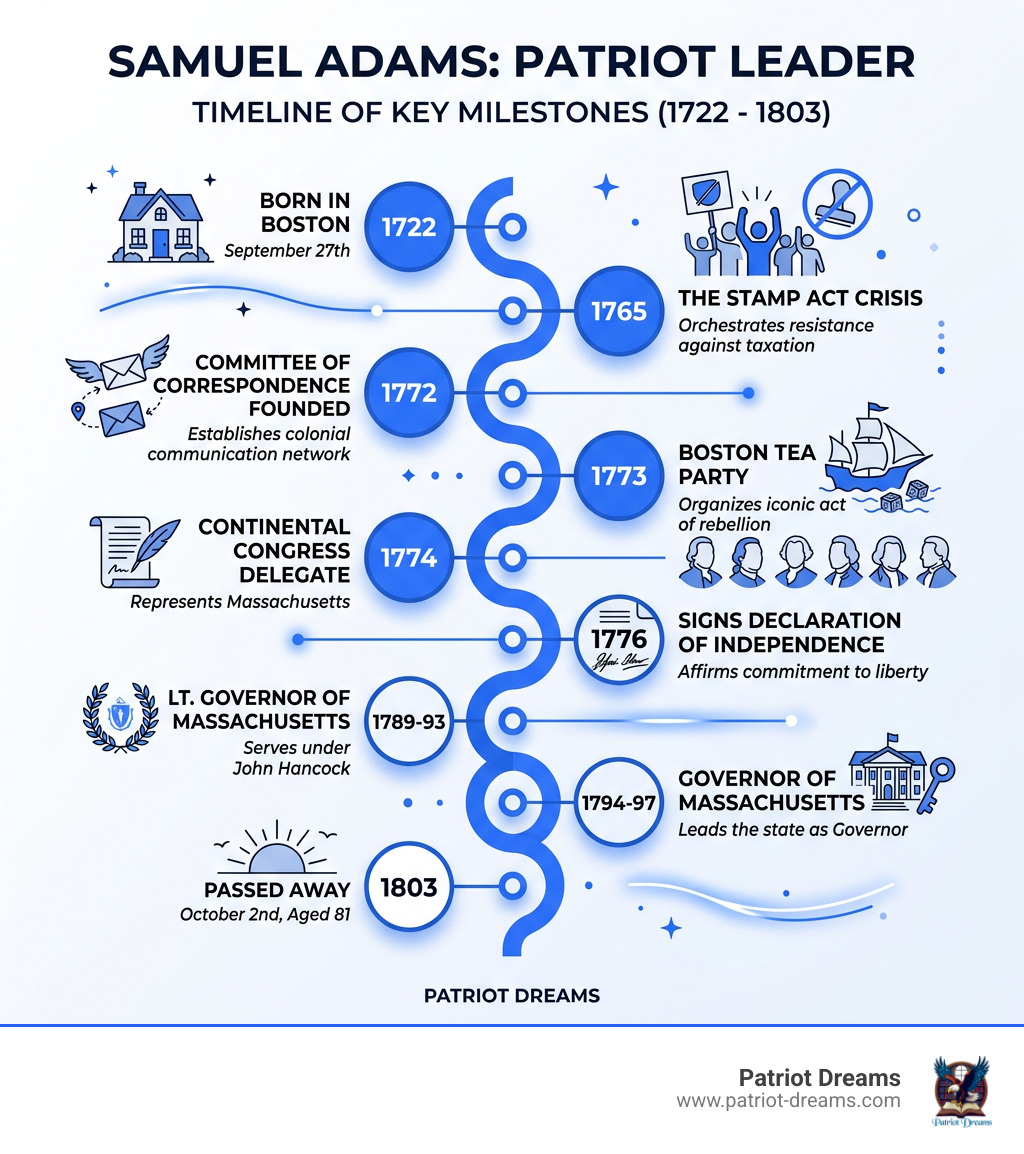
- Born: September 27, 1722, in Boston, Massachusetts
- Died: October 2, 1803 (aged 81)
- Key role: Political organizer, propagandist, and radical leader of the American Revolution
- Major contributions: Founded the first Committee of Correspondence (1772), helped organize the Boston Tea Party, signed the Declaration of Independence
- Later career: Lieutenant Governor (1789–93) and Governor (1794–97) of Massachusetts
- Known as: Thomas Jefferson called him "the patriarch of liberty"
When most people hear the name Samuel Adams today, they think of a beer bottle. And that's a little funny — because the real Samuel Adams was one of the most passionate, tireless champions of freedom this country has ever known.
He wasn't a general. He wasn't a wealthy statesman. He was a Boston neighbor — someone who failed at business, struggled to keep his accounts as a tax collector, and still found a way to help light the spark of a revolution.
Thomas Jefferson once called him "truly the Man of the Revolution." His own cousin, John Adams, described him as plain, modest, and deeply virtuous. And Royal Governor Thomas Hutchinson — no fan of Adams — called him "the chief incendiary" of passions in Boston.
All three were right.
Samuel Adams believed, with his whole heart, that people have the right to live free. And he spent his life quietly, persistently, and brilliantly working to make that belief a reality for his neighbors, his city, and eventually, his country.
This is his story.
Samuel Adams patriot vocab explained:
- Patrick Henry speech
- James Madison Constitution
- Teddy Roosevelt: The Fearless Leader Every Young American Should Know
Read Time: 10 mins read
The Early Life of a Humble Bostonian
Samuel Adams was born into a world of strong faith and community. His father, Samuel "Deacon" Adams, was a prominent figure in Boston’s Old South Church and a local politician. Growing up in a household steeped in Puritan values, young Samuel learned early on that a person's character was defined by their service to others and their commitment to virtue.
He attended Harvard College, graduating in 1740, and earned his Master’s degree in 1743. Even then, his mind was focused on the relationship between the people and their government. His Master’s thesis famously argued that it was lawful to resist the supreme magistrate if the commonwealth could not otherwise be preserved. It was a bold idea for a young man in a British colony, but it showed the heart of the Samuel Adams patriot that was already beating within him.
One of the most defining moments of his early life was the Land Bank crisis. His father had helped start a bank that issued paper money backed by land to help local farmers and shopkeepers. When the British government stepped in and shut it down, it ruined the Adams family financially. Seeing his father’s hard work destroyed by a distant power left a lasting impression on Samuel. He saw how arbitrary authority could hurt everyday families, and it sparked a lifelong distrust of concentrated power.
Samuel spent much of his early adulthood working at the family malthouse. While he wasn't particularly successful in commerce — often preferring a deep conversation about politics over a ledger of accounts — he remained a fixture of his community. He was a man of the people, more comfortable in a town meeting than a counting house.

As we explore the lives of our Founding Fathers, we see that they weren't always perfect businessmen or wealthy elites. Often, they were neighbors who simply cared deeply about their homes.
A Samuel Adams patriot in the Making
It’s okay to admit that Samuel Adams wasn't very good with money. After Harvard, he tried his hand at various businesses and failed. He even served as a tax collector for the town of Boston, but his heart was too soft for the job. He often failed to collect taxes from neighbors who were struggling, and by 1765, his accounts were more than £8,000 in arrears.
While his critics called this negligence, his friends saw a man who cared more about people than pennies. This "failure" in business actually made him the perfect leader for the coming struggle. He understood the struggles of the average Bostonian. Instead of focusing on his own wealth, he threw himself into community service, becoming a fixture at town meetings and writing essays that spoke directly to the hopes and fears of his fellow citizens. This grassroots connection is what truly makes someone a Who Are Founding Fathers of USA candidate — the ability to lead from the heart of the community.
The Voice of the People: Opposing British Taxation
The 1760s brought a series of challenges that would test the resolve of the colonies. Following the Seven Years' War, the British Parliament began passing acts to raise money from the American colonies. The Sugar Act of 1764 and the Stamp Act of 1765 were seen by many as a violation of their rights as British subjects.
Samuel Adams was among the first to argue that "taxation without representation" was a form of slavery. He didn't just complain; he organized. He helped form the Sons of Liberty, a group of patriots dedicated to protecting colonial rights. He used his pen to unite the people, writing fiery but reasoned protests that were shared across the colonies.
Adams was a master of using the media of his day. He wrote for the Boston Gazette under more than 30 different pseudonyms, making it seem like a whole chorus of voices was calling for justice. He knew that to change the world, you first had to change the conversation. His efforts helped turn local frustrations into a unified movement, earning him a place among our most cherished Revolutionary War Heroes.
Organizing the Samuel Adams patriot Cause through Correspondence
One of Samuel's greatest inventions was the Committee of Correspondence. In 1772, he realized that if the colonies were going to stand together, they needed to talk to each other. He created the first committee in Boston, which allowed patriots across Massachusetts and eventually all thirteen colonies to share news and coordinate their resistance.
This wasn't about spreading rumors; it was about building a network of truth and unity. By keeping the lines of communication open, Adams ensured that a farmer in Virginia knew exactly what was happening to a merchant in Boston. This sense of colonial unity was the bedrock upon which a new nation would be built. As noted by the National Park Service - Samuel Adams: Boston's Radical Revolutionary, his ability to organize was his greatest gift to the cause of liberty.
From the Boston Massacre to the Tea Party
Tensions reached a breaking point on March 5, 1770, with the tragedy known as the Boston Massacre. Five colonists were killed by British soldiers, and the city was on the verge of an explosion. Samuel Adams acted quickly, using the event to demand the removal of British troops from Boston.
However, Samuel also showed his commitment to justice. When the British soldiers went to trial, it was his cousin, John Adams, who defended them. Samuel supported this because he believed that for the Patriot cause to be legitimate, it had to be based on the rule of law, not mob rule. He wanted a revolution of principles, not just a revolution of anger.
But when Parliament passed the Tea Act in 1773, giving the East India Company a monopoly, Samuel knew words alone wouldn't be enough. He led mass meetings at the Old South Meeting House, where thousands gathered to protest the arrival of tea ships at Griffin’s Wharf.
The Boston Tea Party broadside encouraged the people to stand firm. On the night of December 16, 1773, after a final attempt to negotiate with Governor Hutchinson failed, Adams reportedly told the crowd, "This meeting can do nothing more to save the country." This was the signal. A group of men, some disguised as Mohawk Indians, headed to the wharf and dumped 342 chests of tea into the harbor. It was a moment of quiet, disciplined defiance that changed history forever. For more stories like this, check out our American Revolution Stories Ultimate Guide.
The Strategic Mind of a Samuel Adams patriot
The logistics of the Boston Tea Party were carefully managed. Samuel Adams wasn't interested in chaos; he was interested in a clear, unmistakable message. The three ships involved — the Dartmouth, the Eleanor, and the Beaver — were the center of a high-stakes game of chicken between the colonists and the Crown.
| Ship Name | Arrival Date | Amount of Tea |
|---|---|---|
| Dartmouth | November 28, 1773 | 114 chests |
| Eleanor | December 2, 1773 | 114 chests |
| Beaver | December 15, 1773 | 114 chests |
Adams ensured that the non-tea cargo was unloaded from the Eleanor to prevent the customs officials from seizing the entire ship, showing his meticulous attention to detail even in the heat of a crisis.
A Legacy of Liberty and Public Service
As the conflict turned into the Revolutionary War, Samuel Adams continued to serve. He was a delegate to the First and Second Continental Congresses, where he was a tireless advocate for independence. He and John Hancock narrowly escaped arrest by British troops during the march to Concord in 1775 — a journey made famous by Paul Revere’s midnight ride.
In 1776, he achieved his lifelong dream when he signed the Declaration of Independence. He didn't seek the spotlight during the war; instead, he worked behind the scenes to ensure the colonies stayed unified and focused on their shared goal. To understand the weight of that moment, you can read more about The Declaration of Independence What It Really Says and Why It Still Matters.
After independence was won, Samuel returned to Massachusetts to help build the new state government. He helped frame the Massachusetts Constitution of 1780 and served as Lieutenant Governor under his old friend John Hancock before eventually becoming Governor himself in 1794.
The Patriarch of Liberty
Samuel Adams was a man of firm convictions. After the war, he was initially an Anti-Federalist, fearing that the new U.S. Constitution might give the federal government too much power and threaten the rights of individual citizens. However, he eventually supported its ratification after being promised that a Bill of Rights would be added to protect the people.
He remained a champion of "republican virtue." He believed that for a free country to survive, its citizens had to be honest, hardworking, and committed to the common good. He even supported the suppression of Shays' Rebellion, arguing that while it was right to rebel against a king, it was wrong to rebel against a government chosen by the people. He was always consistent: the law and the will of the people were his guiding lights.
His peers held him in the highest regard. Thomas Jefferson called him the "patriarch of liberty," recognizing that without Samuel’s early agitation, the Revolution might never have begun. Even as George Washington the General Who Became Americas First President led the armies, Samuel was the one who had prepared the hearts of the people for the struggle.
The Enduring Legacy of a Samuel Adams patriot
Today, Samuel Adams is sometimes a controversial figure among historians. Some see him as a master propagandist who manipulated public opinion, while others see him as a principled leader who used the only tools he had — words and organization — to fight for justice.
But if we look at the man himself, we see someone who lived a very modest life. He didn't seek wealth or fame. He often wore simple clothes and lived in a house that was sometimes in disrepair. He was a man who truly believed in the "virtue" he preached. He didn't even keep copies of his own letters because he didn't want to bring trouble to his friends if the British ever found them. He was a man who put his community and his country above his own legacy.
His influence is woven into the very fabric of our government. From the James Madison Constitution to the local town meetings that still happen across New England, Samuel Adams' belief in the power of the people lives on.
Frequently Asked Questions about Samuel Adams
Was Samuel Adams actually a brewer?
Not exactly. He was a maltster, which means he produced the malt needed to make beer. His family owned a malthouse, and while they provided the ingredients for many of Boston’s brewers, Samuel himself was more focused on politics than brewing. The modern beer brand uses his name as a tribute to his Boston roots and his spirit of independence, but the real Sam was more likely to be found at a town meeting than a brewery.
Why is he called the "Father of the American Revolution"?
He earned this title because he was one of the very first people to suggest that the colonies should be independent. Long before others were ready to break away from Britain, Adams was organizing protests, writing essays, and building the networks (like the Committees of Correspondence) that made the Revolution possible. He was the "spark" that lit the fire.
Did Samuel Adams sign the Declaration of Independence?
Yes! He was a proud signer of the Declaration in 1776. He represented Massachusetts at the Continental Congress and remained a dedicated member of that body until 1781, helping to steer the new nation through the most difficult years of the war.
Conclusion: Remembering the Heart of a Patriot
Samuel Adams reminds us that you don't need to be a great general or a wealthy business owner to change the world. You just need to care about your neighbors and be willing to stand up for what is right. His life was defined by perseverance, a deep sense of unity, and an unwavering belief in the goodness of the American people.
At Patriot Dreams, we believe that every family has stories of resilience and community just like Samuel’s. Our mission is to help you preserve those personal legacies while exploring the great history of our nation. Samuel Adams didn't leave behind a memoir, but he left behind a free country.
Core Values of Samuel Adams:
- Virtue: Putting the community's needs before your own.
- Unity: Working together across different backgrounds for a common goal.
- Persistence: Never giving up, even when things look dark.
- Communication: Sharing the truth and keeping neighbors connected.
Let's carry those values forward in our own lives and families. For more info about historical American figures, we invite you to keep exploring the stories that make our heritage so special. Like Samuel, may we all find ways to be "patriarchs of liberty" in our own small way.

Join the Patriot Dreams Community
Download the app today and start your journey through American history and personal legacy.

Explore Our Latest Insights
Dive into stories that shape our American legacy.