In-Depth Guide to the Battle of Bunker Hill

The Battle of Bunker Hill: A Turning Point in American History
The Battle of Bunker Hill was fought on June 17, 1775, during the Siege of Boston — and it changed the course of the American Revolution forever.
Quick Facts:
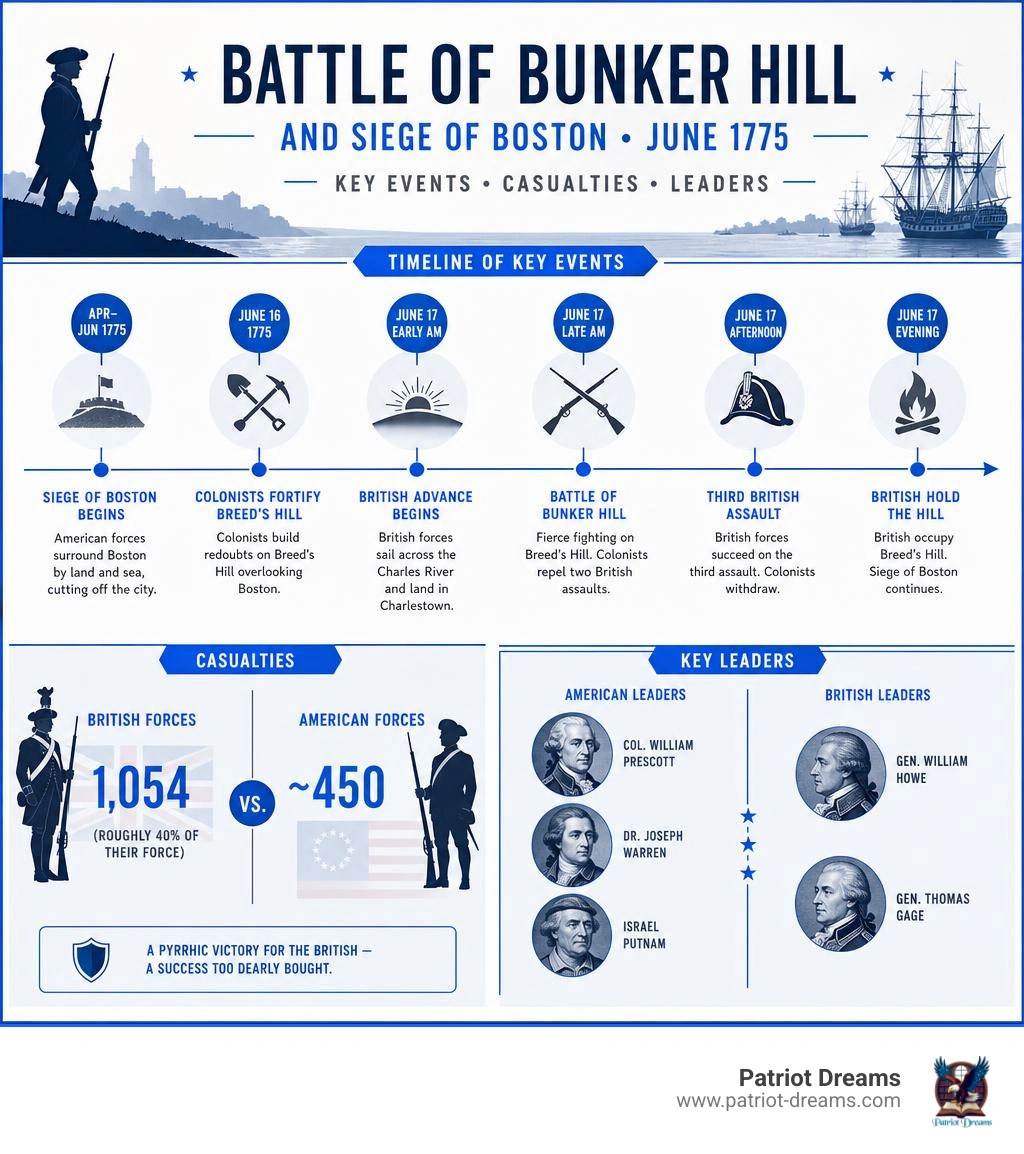
DetailInformationDateJune 17, 1775LocationBreed's Hill, Charlestown, MassachusettsOutcomeBritish victory (Pyrrhic)British Casualties1,054 (roughly 40% of their force)American Casualties~450Key American LeadersCol. William Prescott, Dr. Joseph Warren, Israel PutnamKey British LeadersGen. William Howe, Gen. Thomas Gage
It was technically a British win. But it didn't feel like one.
British General William Howe reportedly called it "a success too dearly bought." His forces suffered over 1,000 casualties in a single afternoon — the highest losses of any single engagement in the entire Revolutionary War.
And the colonists? Farmers, tradesmen, and everyday citizens held off the most powerful military on earth — twice — before finally being pushed back.
There's something deeply moving about that. Ordinary people, standing on a hillside at dawn, choosing to be brave. Not because they were professional soldiers, but because they believed something was worth fighting for.
This guide walks you through everything: the causes, the battles, the heroes on both sides, the myths, and why this moment still matters — 250 years later.
Basic Battle of Bunker Hill glossary:
- General Jonathan Wainwright: The Hero of Bataan’s Defiance
- The Courage of Mitchell Red Cloud Jr.: A Native American Hero of the Korean War
- The Four Chaplains, George Fox, Alexander Goode, Clark Poling, John Washington
Prelude and Strategy: The Road to Breed's Hill
To understand why this battle happened, we have to travel back to the spring of 1775. The air in Massachusetts was thick with tension. Only two months prior, the quiet towns of Lexington and Concord had echoed with the first shots of the Revolutionary War.
Following those fateful encounters, thousands of local militiamen left their farms, families, and workshops to march toward Boston. They surrounded the city, trapping the British army inside in what became known as the Siege of Boston. It was a remarkable display of unity—ordinary citizens from all walks of life standing shoulder-to-shoulder.
This was a time of rapid awakening. Only a short while before, the legendary Paul Revere Midnight Ride had spread the alarm through the countryside, and the passionate words of the Patrick Henry Speech were still ringing in the hearts of colonists who yearned for self-determination.
The Prelude: Why the Battle of Bunker Hill Was Fought
By June 1775, British General Thomas Gage found himself in a difficult strategic position. His troops were bottled up on the Boston Peninsula, surrounded by roughly 20,000 provincial militiamen. To break the deadlock, the British high command formulated a plan to seize and fortify the unoccupied hills surrounding the city, including Dorchester Heights to the south and the Charlestown Peninsula to the north.
According to historical records preserved by The Battle of Bunker Hill (U.S. National Park Service) , the colonial Committee of Safety caught wind of this British design. Recognizing that whoever controlled those hills controlled Boston, the colonists decided they had to act first. On the night of June 16, a detachment of colonial soldiers quietly marched onto the Charlestown Peninsula to set up defenses.
Fortifying Breed's Hill: A Provocative Decision
The original orders given to Colonel William Prescott were to fortify Bunker Hill, the tallest and most easily defendable hill on the Charlestown Peninsula. However, after arriving under the cover of darkness, Prescott and his engineers made a bold, last-minute tactical choice. They decided to construct their main defensive earthen redoubt on Breed's Hill instead.
Breed's Hill was lower—standing at about 75 feet compared to Bunker Hill's 110 feet—but it was positioned much closer to Boston and the waters of Boston Harbor. This made it an incredibly provocative location. When the sun rose on the morning of June 17, British sailors aboard warships like the HMS Lively looked up to see a massive, newly constructed earthen fort, 160 feet long and 30 feet high, staring down at them. The message was clear: the colonists were not backing down.
The Battle of Bunker Hill: A Step-by-Step Account of the Conflict
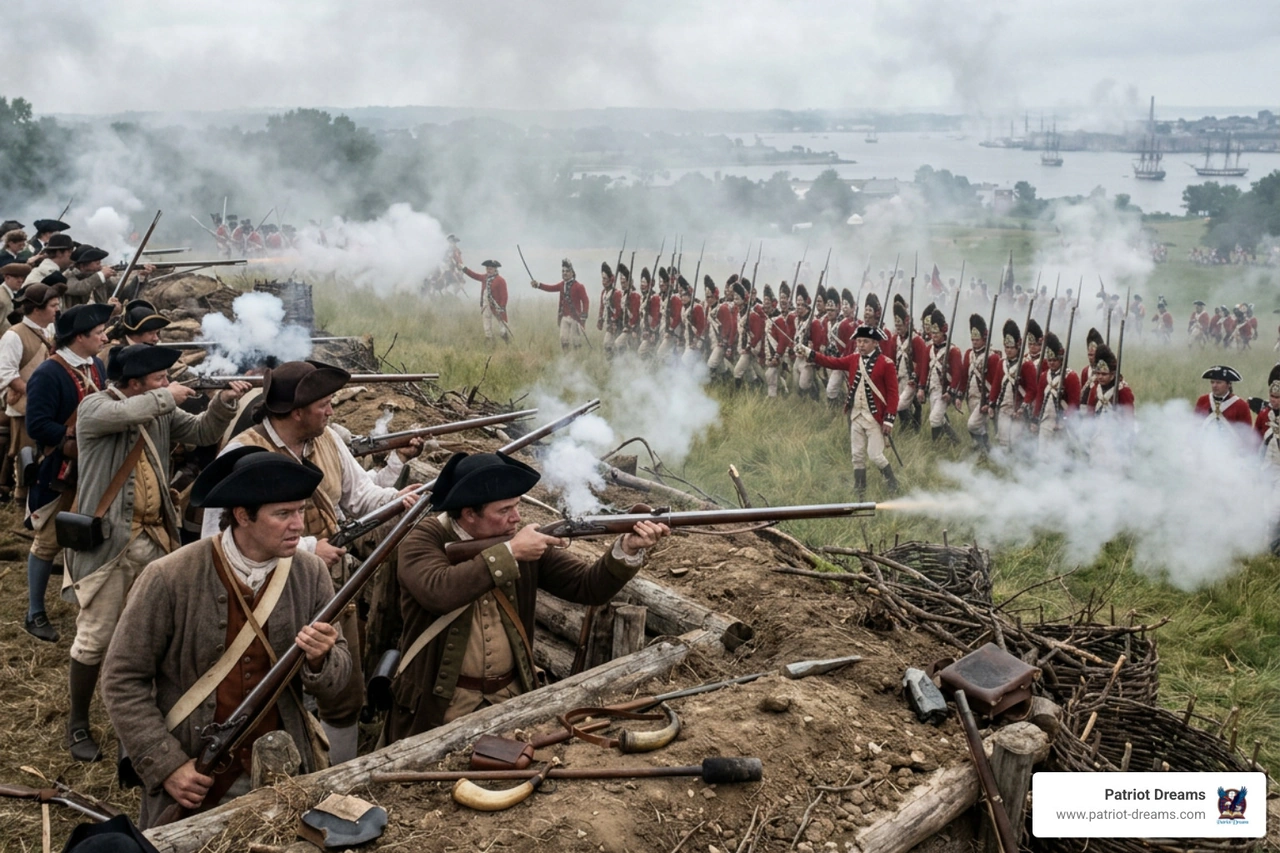
The sight of the colonial redoubt sent shockwaves through the British command. General Gage and his newly arrived officers—Generals William Howe, Henry Clinton, and John Burgoyne—knew they had to clear the hill immediately. What followed was a intense, two-hour struggle that would test the resolve of both armies.
For a deeper look at the broader context of these early campaigns, you can explore our American Revolution Stories Ultimate Guide.
The First and Second British Assaults
Around mid-afternoon, British barges landed approximately 2,400 regular troops near Moulton's Hill. General William Howe, leading the attack, planned a classic flanking maneuver. He sent a column of light infantry along the narrow beach of the Mystic River to slip behind the colonial lines, while Brigadier General Robert Pigot led a frontal assault against the redoubt.
But the colonists were prepared. Colonel John Stark and his New Hampshire militia quickly fortified a nearby rail fence, stuffing it with grass and stones to create a defensive barrier stretching down to the water.
As the British regulars marched up the hill in perfect formation—carrying heavy packs under the scorching summer sun and tripping over waist-high grass and hidden fences—the colonists held their ground. Facing an acute ammunition shortage, the patriots waited until the British were incredibly close before unleashing a devastating volley. The effect was immediate. The disciplined fire shattered the British lines, forcing them to retreat down the hill.
Undeterred, General Howe rallied his men for a second assault. Once again, the colonial militia exhibited incredible tactical discipline, waiting until the redcoats were within 50 yards before firing. Again, the British ranks were decimated, and they were forced to retreat a second time.
The Final Charge and the Fall of the Redoubt
By the time of the third assault, the situation inside the colonial redoubt had grown critical. The patriots were almost entirely out of gunpowder.
To make matters worse, British naval gunners began using heated cannonballs, setting the nearby town of Charlestown ablaze. Thick, black smoke filled the air, adding to the chaos of the battlefield.
General Howe ordered his men to shed their heavy packs and mount a direct bayonet charge against the redoubt. This time, when the British breached the earthen walls, the colonists had no choice but to engage in brutal hand-to-hand combat, using their muskets as clubs and throwing stones.
Realizing that holding the fort was no longer possible, Colonel Prescott ordered a disciplined tactical retreat. Although they lost the hill, the colonists managed to escape across the Charlestown Neck, thanks in large part to the brave rear-guard actions of men like General Israel Putnam and John Stark.
Hearts of Courage: Key Leaders and Everyday Heroes
The stories of the individuals who stood on Breed's Hill remind us of the deeply personal nature of history. It wasn't just armies fighting; it was neighbors, fathers, and friends.
To learn more about the remarkable individuals of this era, read about our Revolutionary War Heroes, and discover the stories of the Founding Fathers and Who Are Founding Fathers of USA.
Dr. Joseph Warren: The Martyr of the Cause
One of the most beloved figures of the early movement was Dr. Joseph Warren. A highly respected Boston physician and president of the provincial congress, Warren had just been commissioned as a major general in the militia.
Yet, when he arrived at Breed's Hill, he refused to take command. Instead, he asked to fight as a private soldier in the dirt of the redoubt, saying, "I am come to learn war under a soldier of experience."
Warren fought bravely but was tragically killed during the final retreat. His death was a devastating blow to the colonies; British General Gage remarked that Warren's loss was equal to the death of 500 men.
In a touching twist of history, Warren's body was buried in a mass grave and could only be identified months later by his close friend, Paul Revere. Revere recognized the dental work—a false tooth crafted from ivory—that he had performed for Warren just weeks prior, marking one of the earliest recorded uses of forensic dentistry in America. You can read more about his life in The True Story of the Battle of Bunker Hill .
Peter Salem and Salem Poor: Unsung Heroes of the Day
The Battle of Bunker Hill also highlighted the incredible courage of African American soldiers who fought alongside their white neighbors.
Peter Salem, a freed slave from Framingham, Massachusetts, became a legendary figure of the battle. He is widely credited with firing the shot that mortally wounded British Major John Pitcairn during the critical final moments of the assault on the redoubt.
Another extraordinary soldier was Salem Poor, who displayed such outstanding bravery that fourteen colonial officers later signed a formal petition to the General Court, declaring that he behaved "like an experienced officer, as well as an excellent soldier."
To explore their incredible contributions, read At Bunker Hill and Beyond: Peter Salem's Revolutionary War Legacy.
A Costly Victory: Casualties, Myths, and Legacy
While the British successfully captured the Charlestown Peninsula, the cost of their victory was staggering. It made them realize that the American colonists were not a disorganized mob, but a determined and capable force.
The Numbers Behind the Sacrifice
To put the scale of the battle into perspective, let's look at the numbers:
ForceTotal EngagedKilledWoundedCaptured / MissingTotal CasualtiesBritish Forces~3,00022682801,054Colonial Forces~2,20011530530450
The British suffered a staggering 40% casualty rate, the highest they would experience in any single battle of the entire war. Particularly devastating was the loss of their officer corps: 19 officers were killed and 62 were wounded.
This high toll led General Nathanael Greene to famously remark, "I wish we could sell them another hill at the same price." Even British General Henry Clinton conceded in his diary that another such victory would have ruined the British army.
For a detailed breakdown of these statistics, visit the Bunker Hill Battle Facts and Summary | American Battlefield Trust .
"Don't Fire Until You See the Whites of Their Eyes"
Perhaps no quote is more famously associated with the Battle of Bunker Hill than the command: "Don't fire until you see the whites of their eyes!"
While popular history often attributes this line to Colonel William Prescott or General Israel Putnam, its historical accuracy is debated. The phrase was actually a standard tactical instruction in 18th-century European warfare, used to prevent soldiers from wasting precious ammunition at long ranges.
Whether the exact words were spoken or not, they perfectly capture the tactical reality of the battle: a small, resource-strapped force using patience, courage, and discipline to make every single shot count.
The Legacy: Commemorating the Battle of Bunker Hill Today
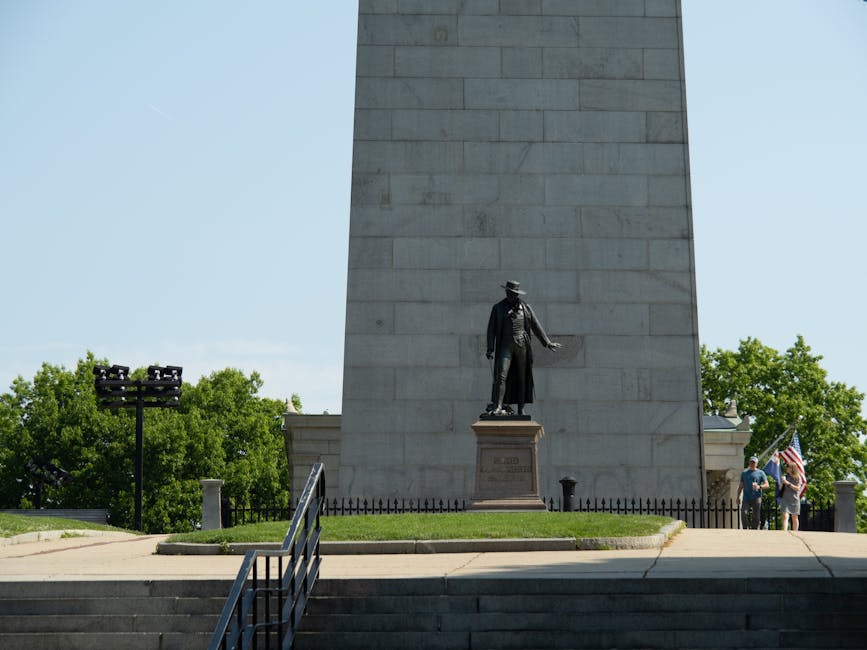
Today, the battle is commemorated by the Bunker Hill Monument, a grand 221-foot granite obelisk that stands tall on Breed's Hill in Charlestown.
Building the monument was a true community effort. The cornerstone was laid in 1825 by the Marquis de Lafayette, with Daniel Webster delivering a legendary address. However, funding ran dry, and construction halted for years.
It was rescued in the 1840s by Sarah Josepha Hale, the influential editor of Godey's Lady's Book, who organized a massive "Ladies' Fair" that raised the final $30,000 needed to complete the structure. Dedicated in 1843, the monument remains a beautiful symbol of American resilience, unity, and community spirit.
Frequently Asked Questions about the Battle of Bunker Hill
Why is it called the Battle of Bunker Hill if it was fought on Breed's Hill?
The confusion stems from a mix of last-minute tactical decisions and early mapmaker errors. Colonel Prescott was originally ordered to fortify Bunker Hill, but chose Breed's Hill because of its strategic proximity to Boston. In the aftermath of the battle, early British military maps accidentally reversed the names of the two hills, and the name "Bunker Hill" stuck in the public consciousness.
Who won the Battle of Bunker Hill?
Technically, the British won the battle because they successfully captured the Charlestown Peninsula and forced the colonial militia to retreat. However, it was a "Pyrrhic victory"—a win achieved at such a devastating cost that it felt like a defeat. The high British casualties severely limited their military options in the months that followed.
How did the battle influence the path to American independence?
The battle had profound political consequences. When news of the high casualties reached London, King George III rejected the colonists' peaceful "Olive Branch Petition" and officially declared the colonies to be in open rebellion. It convinced British leadership to hire Hessian mercenaries and hardened hearts on both sides, paving the way toward the signing of the Declaration of Independence.
To see how this moment connects to the birth of our nation's founding documents, read The Declaration of Independence: What It Really Says and Why It Still Matters and The US Constitution & Bill of Rights Explained Simply.
Conclusion
The Battle of Bunker Hill was far more than a clash of arms on a dusty Massachusetts hillside. It was the moment a fledgling nation found its voice, its confidence, and its shared resolve. It proved that when ordinary citizens stand together for a common cause, they can achieve extraordinary things.
Here at Patriot Dreams, we believe that these stories of courage, unity, and everyday heroism are the threads that bind us together. Our interactive audio storytelling platform is dedicated to bringing America's rich heritage to life, preservation-style, so that the legacies of those who came before us are never forgotten.
As we look forward to celebrating our nation's vibrant history, we invite you to explore the sights, sounds, and stories of our past. Discover how we are keeping these memories alive by visiting America 250 Years in the Making.

Join the Patriot Dreams Community
Download the app today and start your journey through American history and personal legacy.

Explore Our Latest Insights
Dive into stories that shape our American legacy.