Revolutionary War Perspectives 101


Why Revolutionary War Perspectives Still Matter Today
Understanding the full picture of the American Revolution means more than knowing who won. It means listening to everyone who lived through it.
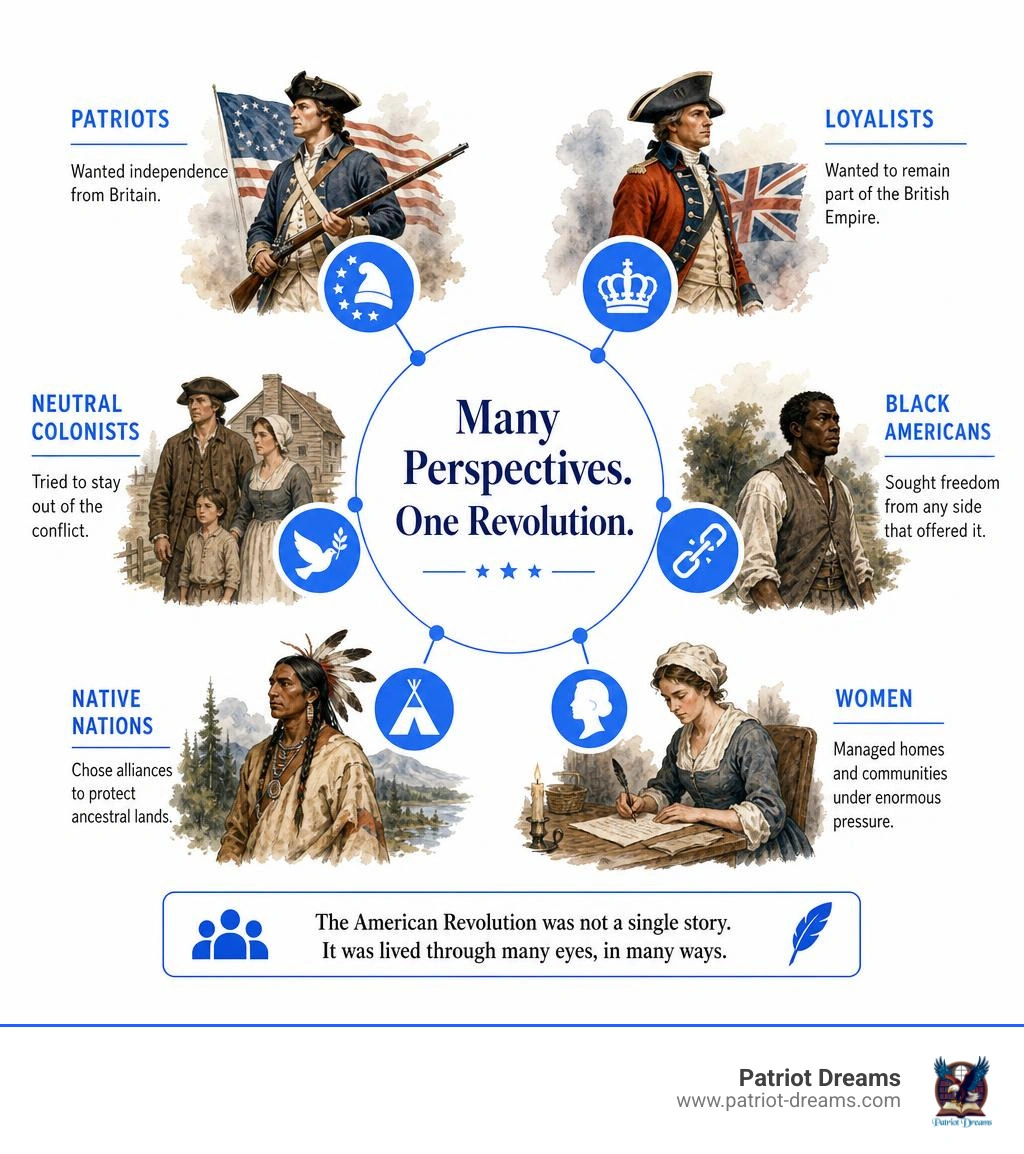
Here is a quick look at the main perspectives from the Revolutionary era:
GroupBasic ViewpointKey MotivationPatriotsWanted independence from BritainSelf-governance and representationLoyalistsWanted to remain part of the British EmpireStability, order, and existing tiesNeutral colonistsTried to stay out of the conflictFamily safety, pacifist beliefs, or uncertaintyEnslaved AmericansSought freedom from any side that offered itLiberty and survivalNative nationsChose alliances to protect ancestral landsTribal sovereignty and survivalWomenManaged homes and communities under enormous pressureFamily protection and, for many, quiet resistance
The American Revolution was not a single story. Historians estimate that roughly 40-45% of white colonists actively supported the Patriot cause, while 15-20% remained loyal to Britain, and many others tried simply to keep their families safe.
Think of it like a neighborhood where everyone is suddenly asked to pick a side — neighbors, friends, and even family members sometimes ended up on opposite sides of a very dangerous divide.
These were real people, with real fears and real hopes. Farmers, merchants, mothers, ministers, and freedom-seekers — each one saw the same events through a very different window. And when we take the time to hear all of those voices, the story of America becomes richer, warmer, and far more human.
That is exactly what this guide is here to explore.
Essential Revolutionary War perspectives terms:
Understanding Diverse Revolutionary War Perspectives
When we look back at the birth of the United States, it is easy to imagine a unified country rising up as one. But if we could step into a time machine and walk down a cobblestone street in 1776, we would find a community deeply divided. The choice to support the rebellion, remain loyal to the King, or stay completely out of the fight was one of the most agonizing decisions our ancestors ever had to make.
Choosing a side was not just a political debate over dinner; it was a decision that could cost a family their home, their safety, and their lives. Neighbors looked at neighbors with suspicion. Local committees demanded signed oaths of allegiance, and those who refused could find themselves facing public shunning, property seizure, or worse. The struggle to win the "hearts and minds" of the people was a quiet, intense war fought in every town square and church pew.
By exploring these varied Revolutionary War perspectives, we begin to see that the era was less like a simple march toward freedom and more like a complex, deeply personal civil war. To understand how these choices shaped the early American landscape, we can explore The American Story Values Beliefs and Myths Unveiled, which helps us unpack how these historical narratives took root. For a deeper dive into how everyday people navigated these pressures, the Season of Independence Big Idea 6: The People and Perspectives ... offers an illuminating look at those caught in the middle.
The Patriot Dream of Self-Governance
For those who chose the Patriot path, the driving force was a beautiful, radical dream of self-governance. Many of these colonists had lived for generations with a growing sense of local identity. They had built their own towns, run their own local assemblies, and created lives thousands of miles away from London. When the British Parliament began passing taxes without giving the colonists a voice in those decisions, it felt like a direct threat to their hard-earned way of life.
This perspective was championed by passionate community leaders like Samuel Adams, whose organizing work in Boston helped bind local citizens together in defense of their rights. You can read more about his tireless efforts in our profile of Samuel Adams Patriot. It was this same fiery devotion to liberty that echoed through the colony of Virginia when Patrick Henry gave his famous Patrick Henry Speech, declaring that life without liberty was simply not worth living.
This collective dream of self-determination was put into writing in Philadelphia. To understand the core ideals that motivated these early Americans, we can look closely at The Declaration of Independence: What It Really Says and Why It Still Matters. It was a bold statement that power should come from the consent of the governed—a concept that still inspires us today.
The Loyalist Desire for Peace and Stability
On the other side of the village green stood the Loyalists. It is important to remember that these men and women were not cartoon villains; they were ordinary colonists who deeply valued peace, law, and order. To them, Great Britain was the most free and prosperous empire on Earth. Breaking away from the mother country seemed like a reckless leap into chaos, likely to result in mob rule or a crushing military defeat.
The cost of holding these beliefs was incredibly high. Approximately 15-20% of the white colonial population remained loyal to the Crown, and their loyalty made them targets. Neighbors who had known each other for decades suddenly became bitter enemies. Many Loyalists had their property confiscated, their businesses ruined, and their families threatened.
Consider the story of Matthias Aspden, a wealthy Philadelphia merchant. He loved his home city but could not bring himself to support a violent rebellion against his government. In 1776, he made the painful decision to leave for England. While he was away, Pennsylvania officials declared him a traitor in his absence and seized his entire fortune. Even after the war ended, the legal system barred him from reclaiming his property or his citizenship.
Aspden’s story is just one of many. An estimated 100,000 Loyalists eventually fled the colonies, seeking refuge in England, Canada, Bermuda, and Jamaica. To learn more about this overlooked side of history, you can read The American Revolution’s triumphant story of democracy and freedom overlooks loyalists who paid a steep price for allegiance to Britain , which sheds light on the devastating losses experienced by those who chose to stay true to the Crown.
The Quiet Courage of the Undecided and Neutral
Then there were those who chose a third path: neutrality. For many colonists, the conflict was a storm they simply hoped to weather. Some lived on isolated frontiers far from the political debates of coastal cities, while others were deeply torn, seeing valid arguments on both sides.
For groups like the Quakers, neutrality was a matter of deep religious conviction. Pacifists like Elizabeth Drinker and her husband Henry rejected the violence of both sides. They believed that war was fundamentally incompatible with Christian love. Yet, trying to remain neutral in a highly polarized community was almost impossible. Both Patriots and Loyalists viewed neutral citizens with intense distrust, often accusing them of being secret spies. The Pennsylvania government seized property from the Drinkers and other Quaker families simply because they refused to take up arms or swear partisan oaths.
To see how these three groups compared, let's look at their primary motivations and challenges:
PerspectiveCore MotivationMajor FearCommon Consequences FacePatriotLocal representation and independenceLoss of liberties under British ruleMilitary danger, financial ruin if defeatedLoyalistPreservation of law, order, and empireChaos, mob rule, and colonial failureConfiscation of property, physical violence, exileNeutralPeace, family safety, or religious pacifismDestruction of home and familySeizure of goods, social isolation, accusations of treason
Everyday Lives and Unsung Heroes of the Revolution
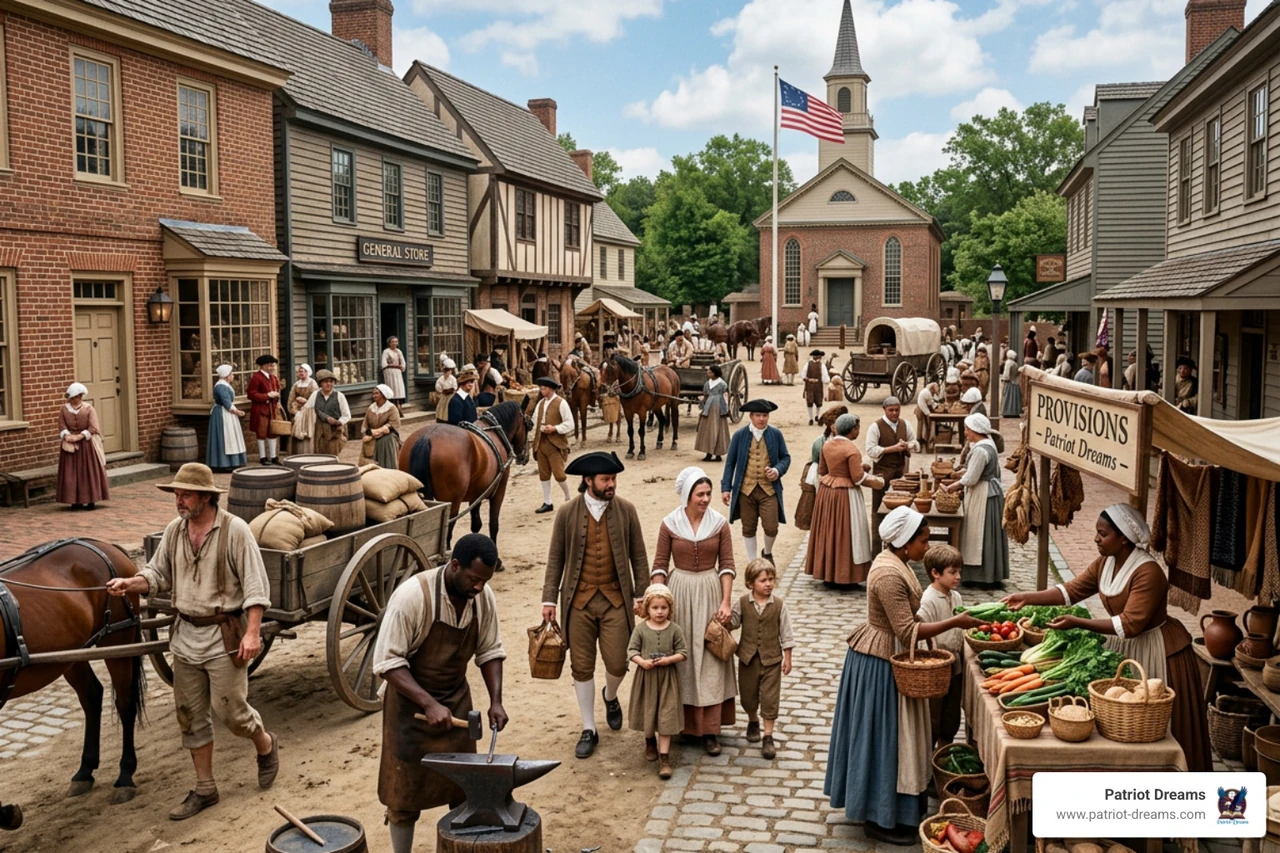
Beyond the political debates of the elite, the Revolutionary War was lived on the ground by ordinary people. Enslaved people, free Black Americans, Native American nations, and women all found themselves navigating a rapidly changing world. For these marginalized groups, the war was not just a struggle over taxes—it was a moment of immense danger and unexpected opportunity to seek freedom, security, and a better future. To explore more of these incredible personal accounts, check out our American Revolution Stories Ultimate Guide.
Diverse Revolutionary War Perspectives of Enslaved and Free Black Americans
For the more than 400,000 people of African descent living in the colonies in 1775, the rhetoric of "liberty" had a profoundly literal meaning. While white colonists compared their political relationship with Britain to "slavery," actual hereditary chattel slavery was a brutal daily reality across all thirteen colonies.
When the war began, Black Americans had to decide which side was more likely to grant them their literal freedom. In late 1775, Lord Dunmore, the royal governor of Virginia, issued a dramatic proclamation offering freedom to any enslaved person owned by a Patriot who escaped and fought for the British Army. This led to the creation of the "Ethiopian Regiment" and prompted between 80,000 and 100,000 enslaved men, women, and children to flee to British lines over the course of the war.
At the same time, approximately 5,000 Black soldiers served honorably in the Patriot forces, particularly from the northern colonies where local governments began promising freedom in exchange for military service. Brave individuals like Peter Salem, who fought heroically at the Battle of Bunker Hill, proved their valor on the battlefield. You can read his inspiring story at At Bunker Hill and Beyond: Peter Salem's Revolutionary War Legacy. We also remember Crispus Attucks, a man of African and Native descent who became the very first martyr of the struggle during the Boston Massacre, whose legacy is detailed in Crispus Attucks Martyr.
For a thoughtful exploration of how Black soldiers navigated these incredibly difficult choices on both sides of the conflict, we highly recommend reading Opinion | Black soldiers on both sides of the Revolutionary War .
Native American Nations and the Hard Choices of War
For the indigenous nations of North America, the Revolutionary War was a profound crisis. Many Native leaders initially viewed the conflict as a private family argument between Europeans and preferred to stay completely neutral. However, as the fighting spilled into their territories, neutrality became impossible.
The war tragically tore apart long-standing alliances, most notably the historic Iroquois Confederacy (the Haudenosaunee). After decades of unity, the confederacy split internally. The Oneida and Tuscarora nations chose to support the Patriots, providing vital food and scouting assistance to Washington's troops. Meanwhile, the Mohawk, Seneca, Onondaga, and Cayuga nations allied with the British, believing that a British victory was the only way to stop colonial settlers from encroaching further onto their ancestral lands.
Seneca leaders like Chief Cornplanter fought bravely to protect their people's sovereignty. Following the war, Cornplanter worked tirelessly to negotiate peace treaties with President Washington, pleading for the new United States to honor its promises and respect Native land rights. The choices made by these nations were born of a deep love for their land, their families, and their sovereign way of life.
Women, Families, and the Quiet Strength of the Home Front
While men marched off to battle, women became the steady anchors of colonial society. Under the 18th-century legal principle of coverture, married women had no legal identity separate from their husbands. This meant that if a husband was declared a Loyalist, his wife could lose her home and land, even if she personally supported the Patriot cause or had tried to remain entirely neutral.
Despite these unfair legal barriers, women stepped into crucial roles. They managed family farms, ran businesses, and kept local economies afloat. Many, like Sarah Riggs of Virginia, had to raise young children and run tobacco farms alone, constantly worrying about inflation, shortages, and approaching armies.
Other women, like Abigail Adams, used their pens to advocate for change. In her famous letters to her husband John, Abigail gently but firmly urged him to "remember the ladies" in the new code of laws, reminding him that true liberty must extend to the home as well as the halls of government.
The Transatlantic View: British and Colonial Perspectives
To truly appreciate the complexity of the era, we also have to look across the wide Atlantic Ocean. The events unfolding in Boston and Philadelphia looked very different when viewed from the busy streets of London.
The British Government's Quest for Order
From the perspective of the British government, the American colonies were a cherished but increasingly unruly part of the family. Great Britain had just spent immense blood and treasure defending the colonies during the global Seven Years' War (known in America as the French and Indian War). The national debt had skyrocketed, and Parliament felt it was only fair that the colonists contribute a small share to the ongoing cost of their own defense.
King George III was not the cruel tyrant often depicted in popular myths; he was a deeply conscientious monarch who believed he was defending the British Constitution and the rule of law. If Parliament allowed one group of subjects to refuse taxes and ignore laws, the entire empire might crumble.
To maintain order during protests, the King sent 3,500 British troops to Boston—a crowded city of only 16,000 inhabitants. This heavy military presence created a pressure cooker environment that eventually exploded in events like the Boston Massacre and the Boston Tea Party, where 342 chests of British tea were dumped into the harbor.
Back home in England, the government also faced its own domestic crises, such as the devastating Gordon Riots of 1780, which resulted in 500 deaths and widespread destruction. For British leaders, the American rebellion was a dangerous threat to global stability that had to be contained.
To read a fascinating, point-by-point defense of the British position written in 1776, you can explore former Massachusetts Governor Thomas Hutchinson's critique, 1776: Hutchinson, Strictures upon the Declaration of Independence | Online Library of Liberty .
Finding Common Ground in Historical Letters
One of the most beautiful ways to connect with these Revolutionary War perspectives is through the personal letters written by everyday people on both sides of the ocean. These letters, often printed in British and colonial newspapers, reveal that behind the grand political speeches lay simple, shared human concerns.
In these letters, we find British soldiers writing home about how much they missed their families, and colonial mothers expressing deep worry over the rising cost of sugar and fabric. We see letters from Philadelphia warning British readers that the colonies were united and prepared to defend their homes, written not out of hatred, but out of a desperate desire to be understood.
Our beloved diplomat, Benjamin Franklin, spent years in London acting as a bridge between these two worlds, trying to help each side see the other's humanity. You can discover more about his diplomatic journeys in All About Benjamin Franklin Inventor Diplomat and Founding Father.
To explore these fascinating historical letters for yourself, visit Revolutionary Perspectives: Discovering the American Revolution ... , which brings these authentic 18th-century voices directly to light.
How Our Understanding of the Revolution Evolves
History is not a static list of dates carved in stone; it is an ongoing conversation. How we remember the Revolution has changed many times over the last two and a half centuries, shaped by the needs and values of each passing generation.
Changing Revolutionary War Perspectives Over 250 Years
As we look toward America’s Semiquincentennial (our 250th anniversary of independence) in 2026, we are reminded of how our national memory has evolved. In the early 19th century, the story was often told as a simple, heroic tale of unified patriots defeating a tyrannical king. During the Civil War, both the Union and the Confederacy used the memory of the Revolution to justify their actions—Lincoln pointed to the founding ideals of equality, while the South claimed they were fighting against a new tyranny.
During the Cold War of the 20th century, the narrative shifted again, emphasizing the legalistic and constitutional stability of the American founding compared to other global revolutions. Today, modern historians are widening the lens to include the stories of Loyalist exiles, Native nations, women, and enslaved people, creating a much richer and more honest tapestry of our past.
To explore this fascinating evolution of historical memory, we recommend reading There’s No One True Story of the American Revolution | Tufts Now , which discusses how our views have shifted over time. For a deeper look at the nuances and debates surrounding these historical narratives, you can also read Echoes of the American Revolution’s War on Nuance . Additionally, for a thoughtful critique of how popular media portrays these complex events, check out A Commentary on “The American Revolution” by Ken Burns et al – Against the Current .
To learn more about the diverse group of leaders who helped shape the early republic, you can read about the Founding Fathers and explore Who Are Founding Fathers of USA.
Preserving Our Shared History for Future Generations
At Patriot Dreams, we believe that every one of these historical voices has something valuable to teach us. When we listen to the letters, the journals, and the quiet stories of our ancestors, we find that we are all part of a continuous, beautiful journey.
Through interactive historical maps and immersive audio storytelling, we can walk the same paths they walked. We can stand at Valley Forge and feel the cold determination of Washington's troops, or walk the streets of Philadelphia where the Constitution was debated. To understand the foundational documents that grew out of these struggles, you can explore The US Constitution & Bill of Rights Explained Simply. You can also learn about the leadership that guided the nation through its darkest hours in our biography of George Washington: The General Who Became America's First President.
Preserving these stories is not just about memorizing the past; it is about keeping our family legacies alive and passing down the values of resilience, kindness, and community to our children and grandchildren.
Frequently Asked Questions about Revolutionary War Perspectives
What were the three main political perspectives during the American Revolution?
The three main political perspectives were the Patriots (who sought complete independence from Great Britain), the Loyalists (who wished to remain part of the British Empire for stability and protection), and the Neutrals (who, due to religious beliefs like Quaker pacifism, geographical isolation, or family concerns, chose not to take a side).
How did the Revolutionary War affect Native American nations?
The war was devastating for many Native nations. It forced difficult choices and ultimately fractured the historic Iroquois Confederacy. Some nations, like the Oneida, supported the Patriots, while others, like the Seneca and Mohawk, allied with the British to protect their lands. Post-war treaties often failed to protect Native sovereignty, leading to significant displacement.
Why did some colonists choose to remain neutral?
Many colonists chose neutrality to protect their families from the violence and destruction of war. Others, such as the Quakers, had deep religious objections to taking up arms. Some lived on the remote frontier and felt the political debates of coastal cities did not affect their daily survival.
Conclusion
When we take a quiet moment to look back at the American Revolution, we see that the birth of our nation was not a simple, easy story. It was a deeply human journey filled with difficult choices, immense sacrifices, and a shared hope for a better tomorrow.
By listening to all of these diverse Revolutionary War perspectives—the dreams of the Patriots, the worries of the Loyalists, the quiet faith of the peacemakers, and the resilient strength of marginalized voices—we do not weaken our history. Instead, we make it whole. We find a deeper, warmer connection to the real people who paved the way for us.
We invite you to join us in preserving these precious memories and exploring the stories of your own ancestors. Let's walk this path of discovery together. To begin sharing your own family stories and exploring our interactive digital heritage tools, visit the Patriot Dreams Creator Hub today.

Join the Patriot Dreams Community
Download the app today and start your journey through American history and personal legacy.

Explore Our Latest Insights
Dive into stories that shape our American legacy.