The Definitive Guide to Betsy Ross Flag


The Flag That Started It All: America's Most Beloved Symbol
Read Time: 10 mins
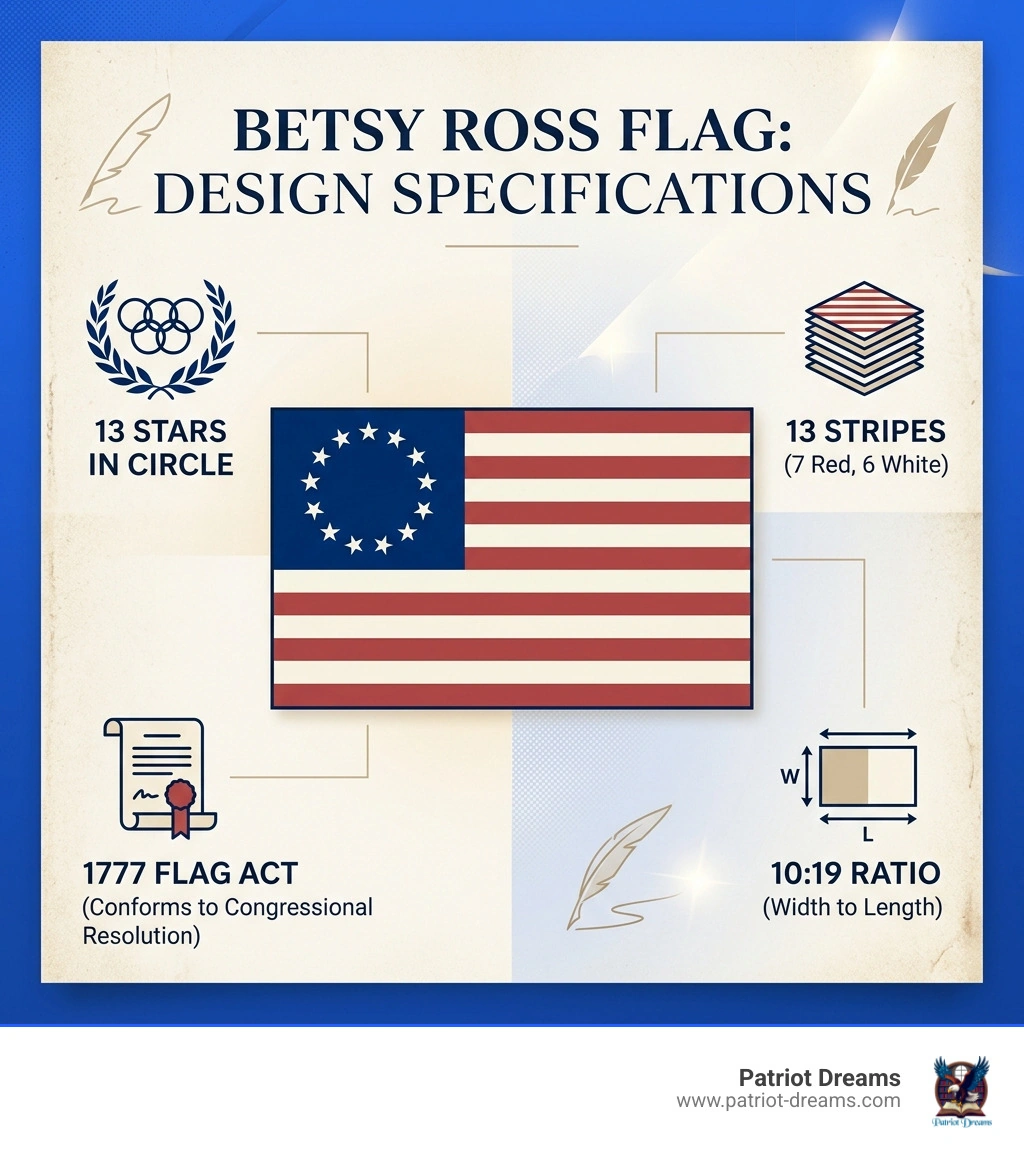
The Betsy Ross flag is the early American flag featuring 13 alternating red and white stripes and 13 five-pointed white stars arranged in a circle on a blue canton — one star for each of the original colonies.
Here's what you need to know at a glance:
- Design: 13 red and white stripes, 13 white stars in a circle on a blue field
- Proportions: 10:19 (width to length)
- Stars: Five-pointed, arranged in a circle to represent unity and equality
- Origin date: Conforms to the Flag Act of 1777, passed by the Second Continental Congress
- The legend: Philadelphia upholsterer Betsy Ross is said to have sewn the first flag at George Washington's request
- The history: The story first surfaced publicly in 1870 — nearly a century after the flag was made
- Where to see it: A replica is on display at the Betsy Ross House, 239 Arch Street, Philadelphia
There is a story most of us learned as children. George Washington walked into a small Philadelphia upholstery shop in 1776. He showed a sketch to the woman working there. She looked it over quietly, then said something that has stayed with Americans ever since:
"I do not know, but I will try."
Whether or not those words were truly spoken, they feel like something worth holding onto. They sound like America at its best — humble, determined, and willing to do the hard work.
That woman was Betsy Ross. And the flag she may — or may not — have sewn became one of the most recognized symbols in the world.
This guide will walk you through everything: the design, the legend, the history, and what the flag means to people today. Whether you are a history lover, a curious family, or someone who simply wants to understand what that circle of stars really stands for, you are in the right place.
Basic Betsy Ross flag glossary:
The Story of the Betsy Ross flag: A Tale of Courage and Craft
In the spring of 1776, Philadelphia was a bustling center of revolution. Imagine the sound of wagon wheels on cobblestones and the smell of salt air from the Delaware River. In a modest upholstery shop on Arch Street, Elizabeth "Betsy" Ross was hard at work. In the 18th century, an upholsterer did much more than fix chairs; they were skilled artisans who sewed tents, blankets, and even ammunition cartridges for the soldiers.
According to the legend passed down through the Ross family, a secret committee of three men visited her shop: George Washington the General Who Became Americas First President, Robert Morris (the financier of the Revolution), and George Ross (her late husband’s uncle). They presented her with a rough sketch of a flag.
The sketch allegedly showed stars with six points. As the story goes, Betsy suggested that five-pointed stars would be more aesthetically pleasing and, more importantly, easier to produce. To prove her point, she took a piece of paper, folded it, and with a single snip of her scissors, revealed a perfect five-pointed star. This moment of quiet ingenuity is a favorite in our American Revolution Stories Ultimate Guide, illustrating how everyday people contributed their unique talents to the birth of a nation.
While Betsy was a young widow struggling to keep her business afloat after her husband John Ross died in a gunpowder explosion, she didn't hesitate to help. Her willingness to "try" is the heartbeat of this story. It reminds us that even when the task seems impossible—like creating a banner for a brand-new country in the middle of a war—courage often starts with a single stitch.
Symbolism and Design: The Heart of the Thirteen Stars
The Betsy Ross flag is a masterpiece of early American symbolism. While the Flag Act of June 14, 1777, provided the basic "recipe" for the flag, it didn't specify exactly how the stars should be arranged. This led to many variations, but the version we associate with Betsy Ross is the most iconic.
The design consists of:
- 13 Stripes: Alternating red and white, representing the original thirteen colonies that dared to stand together.
- 13 Stars: Five-pointed and white, set against a blue field (the canton).
- The Blue Canton: Represents a "new constellation," a phrase used by the Continental Congress to describe the emerging United States.
You can find more about the formal adoption of these symbols in the Betsy Ross Flag | Britannica entry. The colors themselves were chosen for their deep meaning: white for purity and innocence, red for hardiness and valor, and blue for vigilance, perseverance, and justice. These are the same values we explore when discussing The US Constitution Bill of Rights Explained Simply.
The Meaning Behind the Betsy Ross flag Design
The most striking feature of the Betsy Ross flag is the circular arrangement of the stars. In the late 18th century, a circle was a powerful symbol of unity and equality. By placing the stars in a ring, the design suggested that no one state was more important than another. It was a visual representation of the "United" in United States.
Some historians also point out that the circle represents eternity—a hope that the new nation would endure through the ages. Before the stars became the primary focus, the "rebellious stripes" were often considered the most important part of the flag. In fact, early American flags were sometimes referred to simply by their stripes. The addition of the stars in a circle added a layer of grace to the defiance, turning a banner into a national treasure.
History and Heritage: Weaving Fact and Tradition
As much as we love the story of Betsy and the single snip of the scissors, we must also look at the historical records. For nearly a hundred years after the Revolution, the story of Betsy Ross remained a private family memory. It wasn't until 1870 that her grandson, William Canby, presented a paper to the Historical Society of Pennsylvania.
Canby had gathered affidavits from family members who remembered Betsy telling the story on her deathbed. However, historians have noted a lack of contemporary 1776 government records to confirm the meeting. During the war, there were at least 17 other flag makers in Philadelphia, including women like Rebecca Young.
Another figure often credited with the flag's design is Francis Hopkinson, a signatory of the Declaration of Independence. Hopkinson actually sought payment from Congress for designing the "Flag of the United States," though his claim was turned down because he was already a public servant.
To help clarify the differences between what we know from documents and what we know from tradition, we've put together this comparison:
| Feature | The Betsy Ross Legend | Documented Historical Record |
|---|---|---|
| Primary Creator | Betsy Ross (Seamstress) | Francis Hopkinson (Designer) |
| Star Shape | 5-pointed (Betsy's suggestion) | 6-pointed (Common in early drafts) |
| First Public Mention | 1870 (William Canby) | 1777 (Flag Resolution) |
| Documentation | Family oral tradition | Receipts for "Ships Colours" (1777) |
| Star Arrangement | Circular pattern | Rows (4-5-4 or 3-2-3-2-3) |
Despite the academic debate, Betsy Ross remains one of the most important Founding Fathers (and mothers) in our hearts. She represents the thousands of women who kept the country running while the men were at war. We know for a fact that she was paid by the Pennsylvania State Navy Board in 1777 for making "Ships Colours," proving she was indeed a professional flag maker for the patriot cause. You can learn more about these influential figures in our guide on Who are Founding Fathers of USA.
Seeing the Betsy Ross flag Today
If you find yourself in the City of Brotherly Love, a visit to the Betsy Ross House at 239 Arch Street is a must. While historians debate if she lived in that exact house or the one next door (which was later demolished), the site has become a shrine to American craftsmanship. In the 1920s, over 4 million Americans—including many school children—donated pennies and nickels to help restore the home.
The Betsy Ross flag hasn't just stayed in the past; it is a living part of our culture. You might see it as:
- Presidential Inaugurations: Large versions of the flag are traditionally draped as backdrops behind the podium.
- Sports Branding: The Philadelphia 76ers NBA team uses the 13-star circle in their logo as a tribute to the city's Constitutional Convention History.
- National Symbols: It appears on the seal of the U.S. Department of Veterans Affairs and has been featured on numerous commemorative postage stamps.
For a deeper look at the artifacts that remain, The Legend of Betsy Ross | National Postal Museum offers a wonderful digital exhibit on how this story became a national phenomenon.

Frequently Asked Questions about Our First Flag
We know that history can sometimes feel like a puzzle with a few missing pieces. Here are some of the most common questions people ask us about the Betsy Ross flag.
Did Betsy Ross actually design the flag?While there is no written receipt from George Washington for the design, Betsy was a documented flag maker for the Pennsylvania Navy. Most historians believe the design was a collaborative effort that evolved over time, likely involving Francis Hopkinson and various military boards.
Why are the stars in a circle?The circle was not actually a requirement of the Flag Act of 1777. However, it became popular in art and later flag production because it symbolized that all thirteen colonies were equal and united in their cause.
What do the colors mean?The colors were carried over from the Grand Union Flag. Red stands for bravery, white for purity, and blue for justice. To learn more about the documents that established these values, read The Declaration of Independence What It Really Says and Why It Still Matters.
Is the original flag still in existence?Sadly, no. The very first flags were made of wool or silk and were used until they literally fell apart. The "Betsy Ross flags" you see in museums today are high-quality replicas or 19th-century versions created to celebrate the Centennial in 1876.
Why did she want five-pointed stars?The legend says they were easier to cut! A six-pointed star requires more careful measuring, while a five-pointed star can be made with one clever snip if you fold the fabric correctly. It was a practical solution from a professional seamstress.
Conclusion: A Legacy of Unity and Hope
At Patriot Dreams, we believe that history is more than just a list of dates and names. It is a collection of stories that remind us of who we are. The Betsy Ross flag is a perfect example of this. Even if we cannot prove every detail of the meeting in that small upholstery shop, the idea of Betsy Ross remains true.
She represents the quiet perseverance of the American spirit. She represents the entrepreneur who kept her shop open during a revolution, the neighbor who helped when called upon, and the artisan who took pride in her work. When we look at that circle of thirteen stars, we don't just see a piece of fabric; we see a promise that we are stronger when we stand together.
As we look toward the future in May 2026, let's carry that same spirit with us. Let's be willing to say, "I do not know, but I will try," whenever we are faced with a challenge. Because that is how beautiful things—and great nations—are made.
If you enjoyed this journey through American heritage, we invite you to explore more of our historical American figures. There are so many stories waiting to be heard, and we are so glad you’re here to listen with us.
Join the Patriot Dreams Community
Download the app today and start your journey through American history and personal legacy.

Explore Our Latest Insights
Dive into stories that shape our American legacy.