Beyond the Wall of Hate: Exploring Ruby Bridges' Enduring Courage

A Six-Year-Old Who Changed America: Understanding Ruby Bridges Courage
Ruby Bridges courage is one of the most powerful examples of quiet, everyday heroism in American history. In 1960, at just six years old, she walked through a wall of hatred — and never looked back.
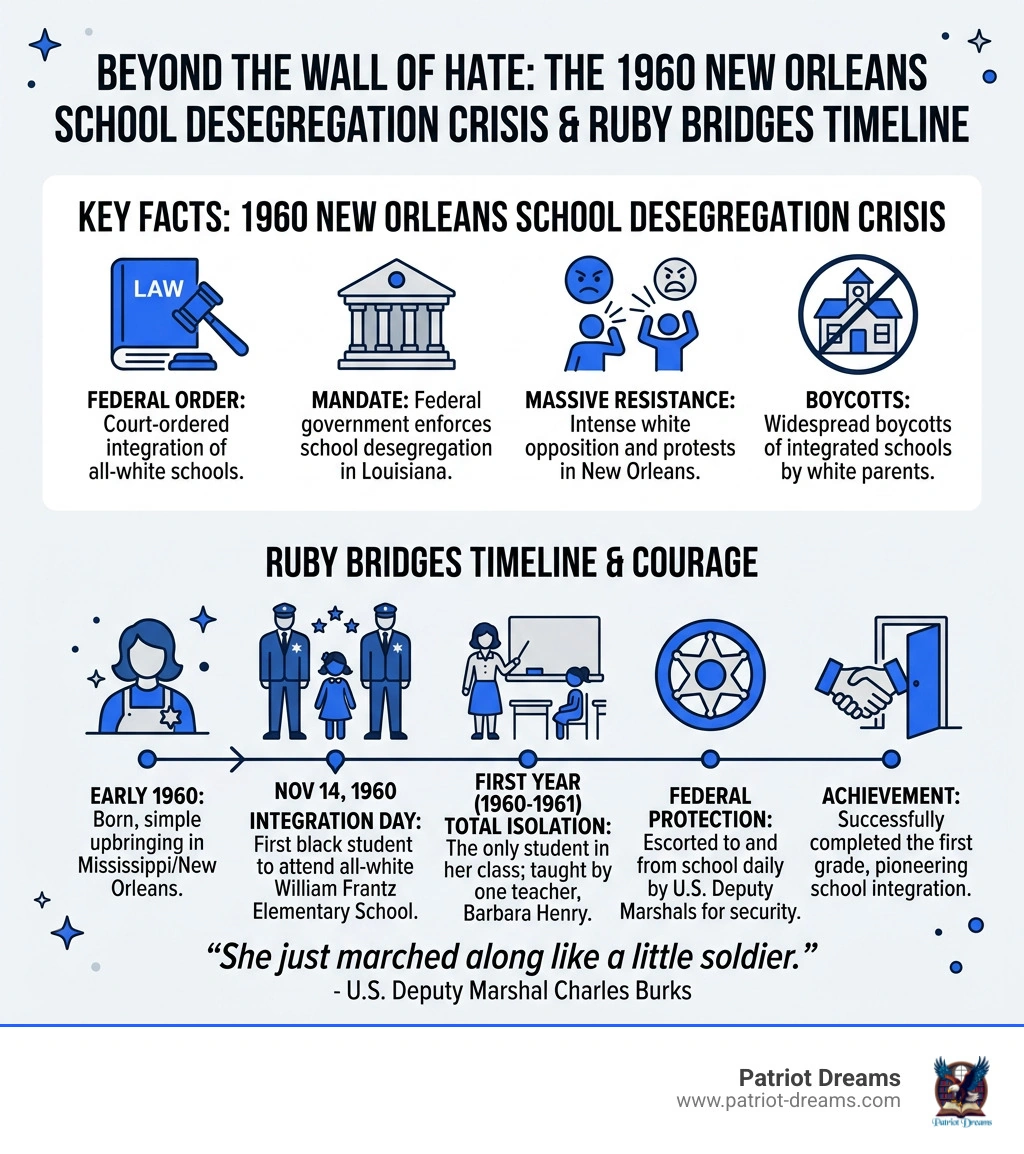
Here is a quick look at what made Ruby Bridges so remarkably courageous:
- Age: Just 6 years old when she integrated an all-white school
- Date: November 14, 1960 — William Frantz Elementary School, New Orleans
- What she faced: Angry mobs, daily threats, total isolation in class, and a year under federal marshal protection
- How she responded: She never missed a single day of school. She prayed for the people who screamed at her.
- Why it matters: Her courage helped crack open a door that changed American education forever
Most of us will never face anything like what Ruby faced. And yet, her story feels personal. It feels human. Because at its heart, it's the story of a little girl who just wanted to go to school — and in doing so, quietly changed the world.
"She showed a lot of courage. She never cried. She just marched along like a little soldier." — U.S. Deputy Marshal Charles Burks
What's remarkable is that Ruby didn't fully understand the history she was making. She was six. She thought the angry crowd outside her school looked like a Mardi Gras parade. And still, she walked forward.
That kind of courage — innocent, steady, and unshakeable — is worth understanding deeply.
Common Ruby Bridges courage vocab:
- Rosa Parks story
- Sojourner Truth speech
- Teddy Roosevelt: The Fearless Leader Every Young American Should Know
The Quiet Strength of a Six-Year-Old: Ruby Bridges Courage in 1960
When we think of the civil-rights-movement, we often picture large crowds, powerful orators, and sweeping legislation. But on the morning of November 14, 1960, the movement rested on the small shoulders of a first-grader in New Orleans.
Ruby Bridges was born in Mississippi in 1954, the very same year the Supreme Court’s Brown v. Board of Education decision declared school segregation unconstitutional. Despite that ruling, many schools in the South remained segregated for years. In 1960, the NAACP asked African American families in New Orleans to volunteer their children to integrate the all-white school system. Ruby was one of only six Black children who passed the rigorous entrance exam designed to test their "readiness."
Her father, Abon, was initially hesitant, fearing for their safety. But her mother, Lucille, felt strongly that this was a step toward a better future not just for Ruby, but for all children. It was Lucille's persistence that ultimately led to Ruby becoming the first Black child to enroll at William Frantz Elementary School.
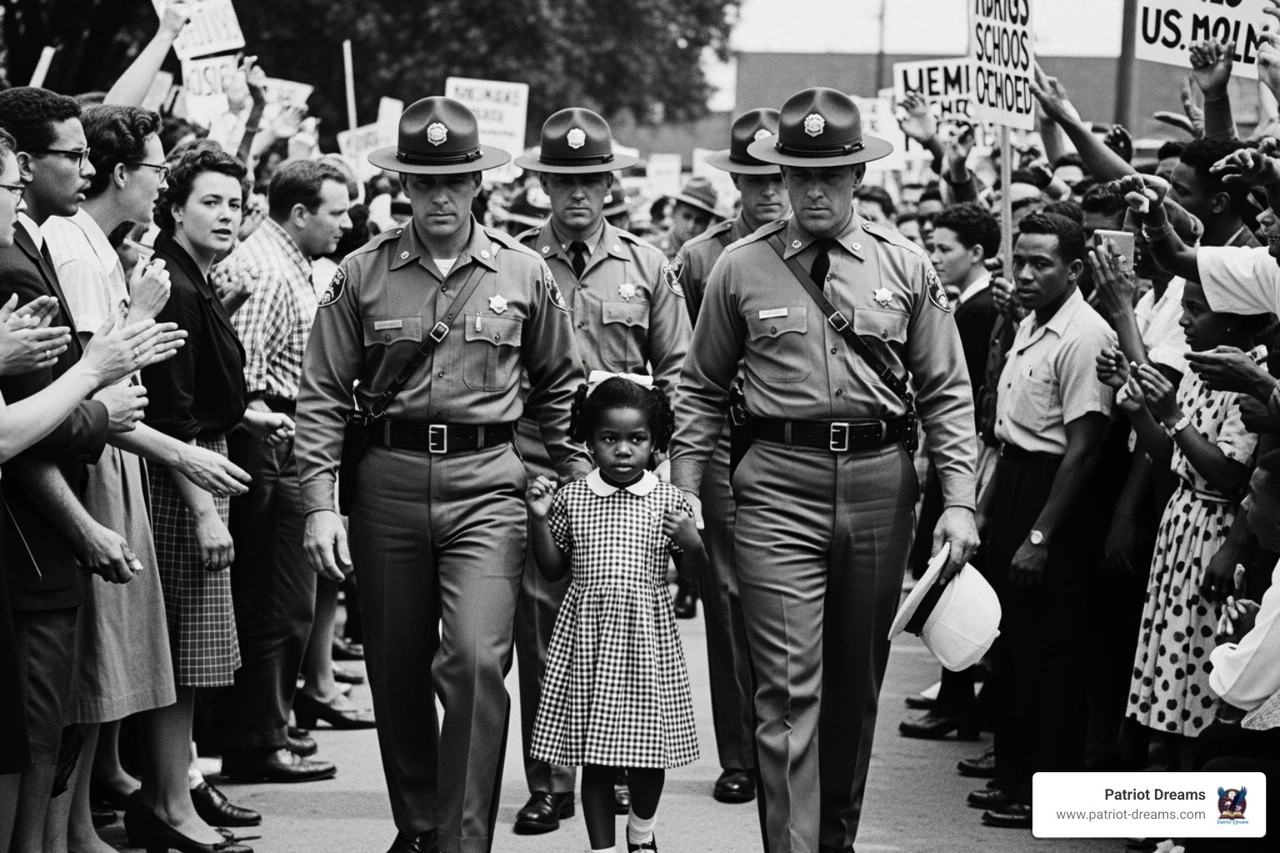
On that first morning, Ruby was met by four U.S. Marshals. They were there because the city was in a state of crisis. As they drove toward the school, Ruby saw crowds of people lining the streets. To her six-year-old eyes, the shouting and the waving of signs looked like the celebrations she had seen during Mardi Gras. She didn't realize the crowd was there to protest her presence.
The scene was harrowing. As she walked up the steps, flanked by federal officers, parents rushed into the building to pull their children out. By the end of that first day, 500 white students had been removed from the school by their parents. Ruby spent her entire first day in the principal's office, watching the chaos through the window.
Facing the Mobs with a Clean Heart
One of the most beautiful aspects of Ruby Bridges courage was her perspective. As adults, we often carry the weight of the world's cynicism, but Ruby approached the situation with what she later called a "clean heart." She didn't see enemies; she saw people who were upset, and she responded with a grace that most adults struggle to find.
Every morning for an entire year, she walked past a woman who held up a black doll in a wooden coffin. She heard people shouting that they would poison her. Because of these threats, the U.S. Marshals instructed her only to eat food brought from home. She wasn't allowed to go to the cafeteria or play on the playground.
Despite this, Ruby showed no fear. She later shared that she would often stop before entering the school to say a prayer. Her teacher once saw her lips moving and thought she was talking to the protesters. When asked, Ruby explained she was praying for them, asking God to forgive them because they didn't know what they were doing.
This innocence didn't mean she wasn't affected. She suffered from nightmares and, for a time, struggled to eat. Her story, documented in The Story of Ruby Bridges, reminds us that while children are resilient, the burden of adult hatred is a heavy one for a child to carry. Yet, she carried it with a steady, quiet strength that eventually began to soften the hearts of those around her.
A Daily Walk into History
Ruby Bridges never missed a single day of school that year. Think about that for a moment. Every single morning, she woke up, put on her best dress and her white socks, and prepared to walk through a gauntlet of protesters.
Her bravery is often compared to other icons of the era, such as the rosa-parks-story, but there is something uniquely poignant about a child being the "frontline soldier." While the marshals provided physical protection, the emotional protection came from her own inner light.

The isolation inside the school was almost as intense as the noise outside. Because so many parents had boycotted the school, Ruby was the only student in her class for the entire first grade year. For months, she didn't see another child. She sat in a room with just her teacher, learning her lessons while the hallways echoed with emptiness. It wasn't until a few white families, like the Foremans, eventually broke the boycott and sent their children back to school that Ruby finally had classmates.
A Circle of Support: The People Who Stood by Ruby
No one walks a path like that alone. Ruby Bridges courage was bolstered by a circle of people who sacrificed their own comfort to stand by her. Her mother, Lucille, was her rock, walking with her to the car every morning and ensuring Ruby felt loved and capable.
However, the family paid a steep price. Because they chose to integrate the school, Ruby's father lost his job at a gas station. Her grandparents, who had been sharecroppers in Mississippi for 25 years, were evicted from their farm. Even the local grocery store where they had shopped for years told them they were no longer welcome.
But where there was hardship, there was also unexpected kindness. The Black community in New Orleans rallied around them. Neighbors volunteered to watch the house and walk behind the marshals' car to provide extra security. A local dry cleaner saw Ruby’s picture in the paper and began tucking dollar bills into the pockets of the clothes they returned to the family, a small but meaningful gesture of support.
This spirit of community is a cornerstone of the American story—the idea that when one person stands up for what is right, others will reach out to hold them up. It echoes the themes we see in the martin-luther-king-jr-the-dream-the-struggle-the-legacy, where the struggle for justice is always a collective effort.
Barbara Henry and the Power of Kindness
Perhaps the most significant person in Ruby’s school life was her teacher, Barbara Henry. Mrs. Henry had recently moved from Boston, and she was the only teacher at William Frantz Elementary who was willing to teach a Black child.
Every day, for over a year, Mrs. Henry taught Ruby as if the room were full of children. They played games together, did calisthenics in the classroom since they couldn't go outside, and formed a bond that would last a lifetime. Mrs. Henry didn't just teach Ruby how to read and write; she taught her that not all white people were like the ones screaming outside.
Mrs. Henry’s kindness was a form of activism in itself. She stood up to the school’s principal, who initially tried to hide the few white students who did attend from Ruby. Mrs. Henry insisted that if the school was integrated, the children should be together. Her commitment to her student is a beautiful reminder of how one person’s choice to be kind can change the trajectory of a life. It’s a story of speaking truth to power, much like the sojourner-truth-speech.
Dr. Robert Coles and the Psychology of Ruby Bridges Courage
During that first year, a child psychiatrist named Dr. Robert Coles began visiting Ruby. He was fascinated by her ability to remain so calm and focused amid such extreme stress. He spent time with her every week, talking to her and watching her draw pictures.
Dr. Coles expected to find a child who was deeply traumatized, but instead, he found a girl with an incredible sense of purpose and a strong spiritual foundation. He later wrote extensively about her, helping the world understand the psychological resilience of children.
Their relationship turned into a lifelong friendship. In 2023, Ruby was even honored with the Robert Coles Call of Service Award at Harvard, a full-circle moment that celebrated the bond between the psychiatrist and the girl who taught him so much about the human spirit.
From a Canvas to a Foundation: A Legacy of Advocacy
In 1964, the artist Norman Rockwell immortalized Ruby’s walk in his famous painting, "The Problem We All Live With." The painting depicts a small, upright girl in a white dress walking between the burly, faceless figures of U.S. Marshals. Behind her, the wall is marked with a racial slur and the juice of a thrown tomato.
This painting became a defining image of the Civil Rights Movement. It captured the contrast between the vulnerability of a child and the harshness of the world she was trying to change. Decades later, Ruby would visit the White House to see this painting on display outside the Oval Office. In a moving video of Obama and Ruby, President Obama told her, "I think it's fair to say that if it hadn't been for you guys, I might not be here."
The Ruby Bridges Foundation and Modern Advocacy
As an adult, Ruby Bridges did not retreat into a quiet life. She spent fifteen years working as a travel agent and raising her four sons, but in the 1990s, she returned to the spotlight. When her youngest brother was killed in 1993, she began volunteering at William Frantz Elementary, the very school she had integrated.
She realized that the school—and the community—still needed the same message of tolerance she had lived as a child. In 1999, she established the Ruby Bridges Foundation to promote the values of tolerance, respect, and appreciation of all differences.
Her advocacy isn't just about history; it's about the future. After Hurricane Katrina devastated New Orleans, Ruby worked tirelessly to save William Frantz Elementary from demolition. She succeeded in getting the school placed on the National Register of Historic Places, ensuring that the site of her historic walk would remain a place of learning for generations to come. Her work in preserving heritage reminds us of other great stories of resilience, like stealing-freedom-how-robert-smalls-commandeered-a-confederate-warship.
Healing the "Grown-Up Disease" through Education
Ruby often says that "racism is a grown-up disease, and we must stop using our children to spread it." She believes that children are born with "clean hearts" and that they only learn to hate from the adults in their lives.
Today, she continues this mission through her writing and public speaking. Her books, including Through My Eyes and her recent work Dear Ruby, are tools to help children and parents navigate conversations about race and kindness. She has received numerous honors, including the Presidential Citizens Medal in 2001 and induction into the National Women's Hall of Fame in 2024.
Her life is a testament to the idea that hope can survive even in the darkest circumstances, a theme that resonates through American history, from the battlefields to the classrooms, much like the stories of rising-from-the-shadows-how-cathay-williams-and-african-american-soldiers-inspired-new-hope-during-the-civil-war.
Finding Your Own Ruby Bridges Courage
You might be wondering, "How can I find that kind of courage in my own life?" The truth is, Ruby Bridges courage wasn't about being a superhero. It was about showing up. It was about taking one step, then another, even when the world felt loud and scary.
We can practice this same courage in small, everyday ways:
- Speak Up: When you see someone being treated unfairly, use your voice. Even if your voice shakes, it matters.
- Be a Friend: Reach out to someone who seems isolated or different from you. Building a bridge of friendship is a powerful act of defiance against division.
- Choose Kindness: In a world that can often feel harsh, choosing to be gentle and thoughtful—like Mr. Rogers or Mrs. Henry—is a brave choice.
Ruby’s story reminds us that we are all standing on the shoulders of those who came before us. When we choose to act with courage and compassion, we are opening the door for the next person. We are building a community where every child can feel safe, loved, and valued.
As we look at the martin-luther-king-jr-memorial or other monuments to our shared history, let's remember that the greatest monuments are the ones we build in our hearts through empathy and understanding.
Frequently Asked Questions about Ruby Bridges
Why did Ruby Bridges have to be escorted by U.S. Marshals?
In 1960, the New Orleans school desegregation crisis was incredibly volatile. Local and state authorities often refused to protect Black students, and the threat of violence from angry mobs was very real. Federal judges ordered the U.S. Marshals to escort Ruby to ensure her physical safety and to guarantee that the federal court order for integration was carried out.
What did Ruby Bridges do after she grew up?
Ruby graduated from a desegregated high school and became a travel agent, a career she held for 15 years. Later in life, she became a parent liaison at William Frantz Elementary and founded the Ruby Bridges Foundation. She is now a world-renowned author, speaker, and civil rights activist who travels the country sharing her message of tolerance.
How did Ruby Bridges' family react to her school integration?
The experience was incredibly difficult for the family. While Ruby's mother was a staunch supporter, the family faced severe economic retaliation, including job losses and eviction. The stress of the situation eventually contributed to her parents' divorce. However, they remained proud of Ruby's role in history and the doors she opened for others.
Conclusion
At Patriot Dreams, we believe that every story from our past is a gift to our future. Ruby Bridges courage is more than just a chapter in a history book; it is a living reminder that even the smallest among us can change the world through simple, steadfast bravery.
By sharing these stories, we hope to bring American heritage to life in a way that feels personal and human. Whether it's through our interactive maps or our audio storytelling, our goal is to help you and your family connect with the heroes who paved the way.
We invite you to explore more historical-american-figures and find the inspiration to start your own trail of courage. After all, as Ruby herself says, "When you start a new trail equipped with courage, strength, and conviction, the only thing that can stop you is you!"
Thank you for being such a kind and thoughtful neighbor in our community of history lovers. We look forward to sharing more stories with you soon.

Join the Patriot Dreams Community
Download the app today and start your journey through American history and personal legacy.

Explore Our Latest Insights
Dive into stories that shape our American legacy.