Never Too Late: A Comprehensive Guide to Learning History as an Adult


Why History for Adults Opens Doors to Connection and Understanding

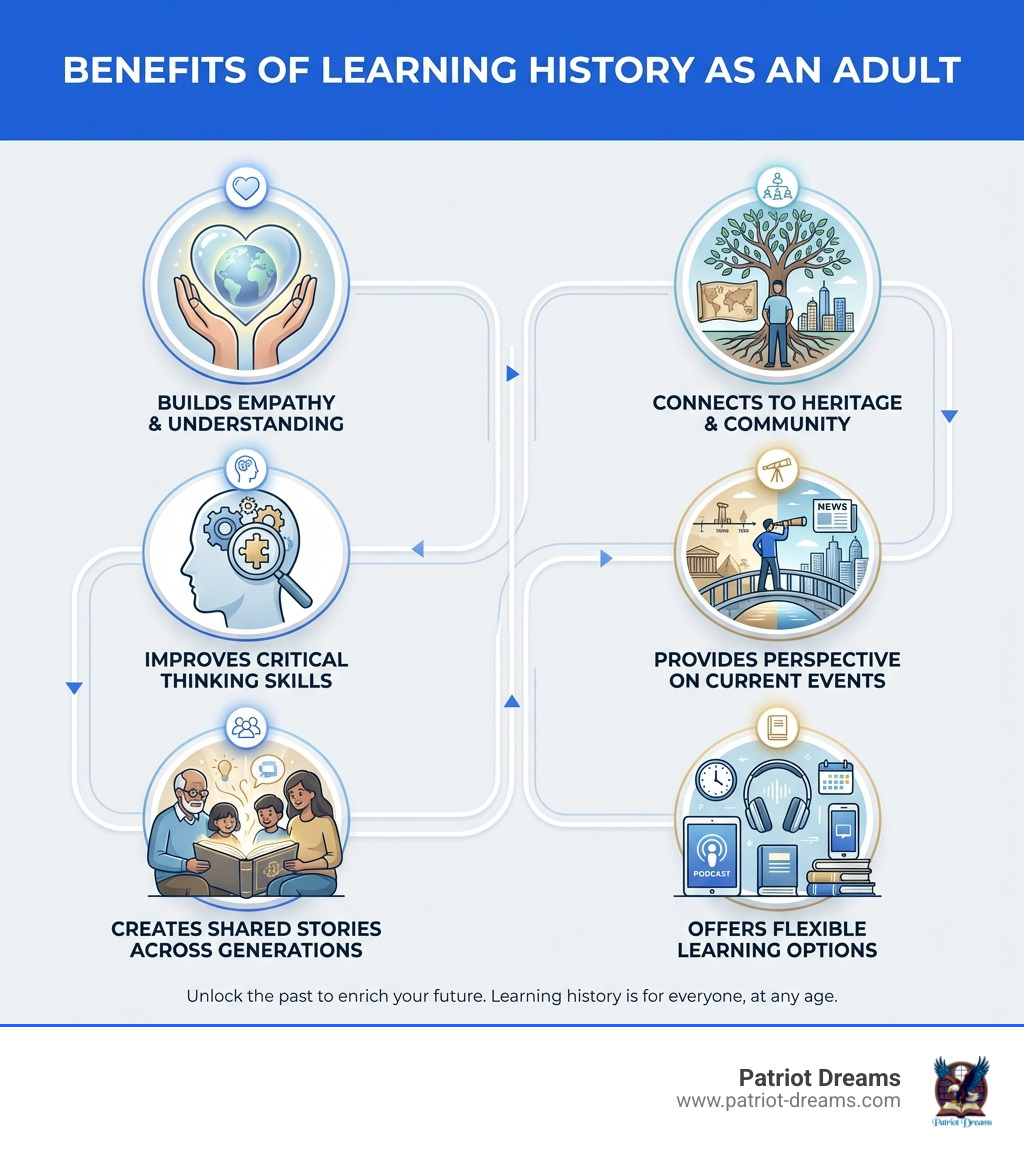
History for adults is more than memorizing dates and battles—it's about discovering the stories of real people who faced challenges, celebrated victories, and built communities just like we do today. Whether you're picking up history for the first time or returning after years away, you'll find that learning as an adult brings fresh perspective and deeper appreciation.
Quick Start Guide for Adult History Learners:
- Begin with what interests you — a family story, a local landmark, or a favorite era
- Choose flexible formats — podcasts during your commute, books before bed, or short videos at lunch
- Start with beginner resources — platforms like Khan Academy and Crash Course offer free, accessible content
- Connect with stories, not just facts — focus on understanding people and their choices
- Build gradually — spend 15-30 minutes a few times per week rather than cramming
Many adults worry they're "too far behind" or that they've forgotten everything from school. The truth? You're starting with something students don't have: life experience that helps you understand why historical events mattered to the people who lived through them.
Research shows that adults learning history often find it more rewarding than they did in school. As one Reddit user who became a history teacher shared, "Pick a period or person you're vaguely interested in and read recent literature on it. Facts and dates are out of style."
You don't need special qualifications or years of study. You just need curiosity about the people who came before us—the everyday heroes who showed kindness during hard times, the neighbors who built communities, and the families who passed down stories of resilience.
Learning history as an adult helps us understand where we came from and connects us to something bigger than ourselves. It reminds us that ordinary people have always faced extraordinary challenges with courage and hope.
Building Your Foundation: Beginner-Friendly History for Adults Resources
Starting your journey into the past doesn't require a dusty classroom or a heavy textbook that feels like a chore to read. In fact, many of the best ways to explore History for adults today are built around storytelling and empathy. When we look at history through the eyes of the people who lived it, we begin to develop "historical thinking"—the ability to see how the choices of the past shaped our world today.
If you are just beginning, we recommend looking for resources that prioritize narrative over dry recitations of facts. For those specifically looking to reconnect with the American story, you can Learn American History Online through curated digital archives and interactive platforms. This approach helps you see history not as a finished book, but as a living conversation that we are all a part of.
One of the most helpful tips for new learners is to find a well-respected historian whose writing style you enjoy. History doesn't have to be "poisonous dough" as some experimental writers suggest; rather, it should feel like a warm invitation to understand your neighbors across time. Whether you are exploring the History for Adults: Welcoming New Learners or diving into a specific biography, the goal is to build a bridge of empathy between the past and the present.

Free Learning Opportunities: Starting Your History for Adults Journey
We are living in a golden age of accessible education. Many world-class institutions now offer their knowledge for free, allowing you to learn at your own pace from the comfort of your favorite armchair. For example, Harvard University offers a fascinating 15-week course titled "China and Communism," which covers the full arc of Maoist China and its reopening to the world.
For those who prefer a more structured but still gentle path, platforms like Khan Academy and US History - Crash Course provide high-quality video lessons that break down complex eras into bite-sized, understandable pieces. These are perfect for building that initial timeline in your mind without feeling overwhelmed.
At Patriot Dreams, we believe that history is a personal journey. That is why we’ve developed Patriot Dreams Learning Pathways, which guide you through the themes of resilience and community that define the American experience. You might also enjoy exploring American Stories for Lifelong Learners, where we highlight the everyday heroes whose names might not be in every textbook but whose kindness changed their communities forever.
The Fun Side of Learning: History for Adults Trivia and Quizzes
Sometimes, the best way to keep our minds sharp and our hearts engaged is through a little bit of friendly competition or self-testing. History trivia isn't just about showing off what you know; it’s a wonderful tool for knowledge retention. When we ask ourselves a question—like "Who was the fourth president of the United States?" (it was James Madison)—we are actually reflecting on the foundations of our society.
Trivia can cover everything from the 282 rules in the Code of Hammurabi to the fact that Queen Elizabeth II was only 25 when she took the throne. These small details make the past feel human and relatable. For instance, knowing that child labor laws in the U.S. didn't start until 1938 helps us appreciate the progress we've made in protecting our families.
To help you see how these different eras connect, we've put together a small comparison of popular trivia topics:
| Era | Key Theme | Fun Fact to Remember |
|---|---|---|
| Colonial America | Founding & Voice | The Declaration of Independence was signed on Aug. 2, 1776. |
| Civil War Era | Resilience & Change | The battles of Lexington and Concord marked the start of the Revolution. |
| 20th Century | Innovation & Growth | The first iPhone was released in 2007, changing how we record history. |
| Modern History | Connection | Same-sex marriage was legalized in the U.S. in 2015. |
If you want to brush up on the basics of our nation's framework, you can find The US Constitution & Bill of Rights Explained Simply to be a helpful and encouraging resource.
Learning on the Go: Podcasts and Audiobooks for the Busy Neighbor
We know that life can be very full. Between work, family, and community commitments, it can be hard to find an hour to sit down with a book. That is the beauty of narrative history in audio format. Whether you are walking through a sunlit park or driving to visit a friend, you can bring the stories of the past with you.
One of the most highly recommended resources is BBC Radio 4 - In Our Time. Hosted by Melvyn Bragg, this program brings together expert panels to discuss everything from the lives of queens like Nefertiti to the scientific genius of the Antikythera Mechanism. It’s a wonderful way to hear different perspectives and see how history, science, and culture all weave together.
For a more personal, story-driven experience, the Patriot Dreams Podcast focuses on the heartbeat of America. We share tales of everyday heroism and the quiet moments of perseverance that have shaped our shared heritage. If you are interested in how our traditions and arts have evolved, our deep dive into American Cultural History is a great place to start.
Exploring the American Spirit: Eras That Bring Us Together
When we study History for adults, we often find ourselves drawn to eras that highlight our shared values of resilience and community. These aren't just stories of "great men," but stories of people working together to build a better future.
Think of the early pioneers who traveled the Oregon Trail Stories or the brave souls who sought freedom, like the incredible Stealing Freedom: How Robert Smalls Commandeered a Confederate Warship. These stories remind us that even in our darkest hours, there is always a glimmer of hope and a chance for courage.
Some of our favorite eras to explore include:
- The Birth of a Nation: Learning about George Washington: The General Who Became America's First President helps us understand the weight of leadership and the importance of character.
- The Age of Exploration: From the True Story of Sacagawea to the Explorers Trailblazers who mapped our wilderness, these tales celebrate the human spirit of discovery.
- The Modern Road: Few things capture the American imagination like the open road. The First Route 66 Road Trip: How America Learned to Wander tells the story of how we became a nation of travelers, seeking connection from coast to coast.
By focusing on these human stories, history becomes a way to feel more connected to our neighbors today. When we see the challenges others have overcome, it gives us the strength to face our own with a little more grace.
Overcoming Challenges and Structuring Your Self-Study
It is perfectly natural to feel a bit stuck when you first start. Many adults feel that history is "dry" because of how it was taught in the past—focusing on rote memorization rather than the "why" behind the events. To overcome this, try structuring your study around themes that matter to you.
Instead of trying to learn everything at once, try building a personal historical timeline. Start with your own family. Where were your grandparents during World War II? What was the first car your parents owned? By connecting global events to your personal Family History Preservation, the dates and names suddenly take on a new, heartfelt meaning.
Another common challenge is time management. We recommend the "15-minute rule." Spend just fifteen minutes a day listening to a podcast or reading an article like Who Are Founding Fathers of USA. You’ll be surprised at how much knowledge accumulates over a month!
Frequently Asked Questions about Learning History
How do I start learning history if I forgot everything from school?
The best way to start is to forget the "rules" of school history! Don't worry about exams or dates. Start with a story. Watch a documentary on a topic that intrigues you—perhaps the Civil Rights Movement or the History of Yellowstone. Use YouTube channels like Oversimplified for a humorous overview, then dive deeper into books or articles as your curiosity grows.
Can I get a formal qualification in history as an adult?
Yes, you certainly can! Many universities offer programs specifically for adult learners. For example, the Undergraduate Certificate in History at Oxford Lifelong Learning is a part-time course designed for those who may not have formal qualifications but have a passion for the past. It’s equivalent to the first year of a full-time degree and can lead to further diplomas or even a full BA. Many of these programs even offer bursaries to help with the costs.
What are the best ways to remember historical dates and events?
The secret to remembering isn't repetition—it's connection. Instead of memorizing "1803," remember that the Louisiana Purchase happened while Thomas Jefferson was president and it doubled the size of the country, opening the way for the American Pioneer Stories we love. When a date is attached to a meaningful story of human struggle or triumph, it sticks in your mind much better.
Conclusion
Learning History for adults is a journey of the heart as much as the mind. It is a way for us to honor the legacy of those who came before us and to find inspiration in their kindness, perseverance, and bravery. Whether you are exploring the US Constitution or listening to the tale of The Pigeon Who Saved 194 Men, you are engaging in a beautiful tradition of storytelling.
We hope this guide has made the past feel a little more welcoming and a little less daunting. History isn't just about what happened "back then"—it’s about the thread of humanity that connects us all today. We invite you to Explore the Patriot Dreams App to continue your journey through our interactive maps and stories. There is always a new story to discover, and it is never too late to start.

Join the Patriot Dreams Community
Download the app today and start your journey through American history and personal legacy.

Explore Our Latest Insights
Dive into stories that shape our American legacy.